Band 5.0 IELTS Writing Task 1 Model Answer
Overall Band Score: 5.0 · IELTS Academic Practice Accelerator · 2026-11-17
IELTS Writing Task 1 question
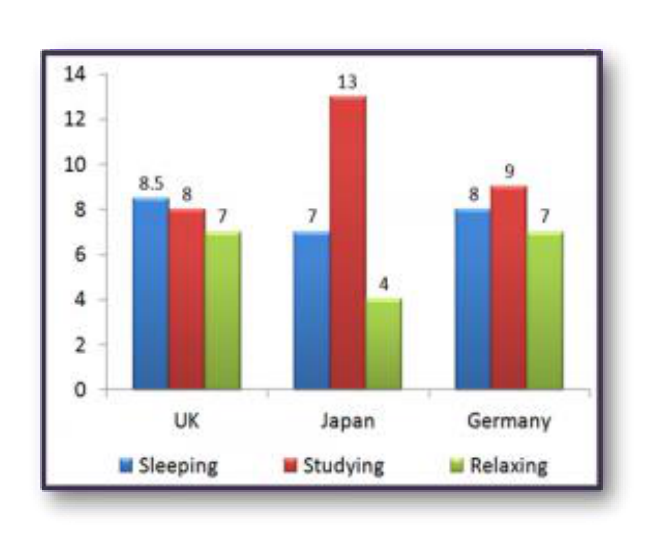
The bar chart shows the typical weekday for students in three different countries.
Summarise the information by selecting and reporting the main features, and make comparisons where relevant.
Student answer (Band 5.0)
The bar chart illustrate the weekdays for students live in three different countries that inculde UK, Japan and Germany along with the percentages that how many students involved in sleeping, studying and relaxing.
Moreover, in weekdays the highest number of students that are studying is japanese and this the the highest among three of them, while the least proportion of relaxing of the graph is also the japanese students, More likely UK and German students are average in the cue nothing spikes on the categories of sleeping, relaxing and studying.
So this bar chart shows that japanese students spent most of there time in studies as compare to other students of respected two countries and also have least relaxing time as compare to other two countries and also he grapsh shows that japanese students spent their time in sleeping is almost less than other students of UK and Germany.
it can be concluded that, the weekdays for students live in three different countries that inculde UK, Japan and Germany along with the percentages that how many students involved in sleeping, studying and relaxing, and the highest number of students that are studying is japanese and this the the highest among three of them, and the least proportion of relaxing of the graph is also the japanese students.
AI examiner evaluation
| Criterion | Band |
|---|---|
| Task Achievement / Task Response | 5.5 |
| Coherence and Cohesion | 4.5 |
| Lexical Resource | 5.0 |
| Grammatical Range and Accuracy | 5.0 |
| Overall | 5.0 |
Task Achievement / Task Response: Band 5.5
You identify the chart’s three countries and activities, and you correctly highlight Japan’s highest study figure (13 hours) and lowest relaxation figure (4 hours). You also note that Japanese students sleep less than those in the UK and Germany. However, the response gives very few precise comparisons and omits several key values, including the UK and Germany’s study figures and the UK’s relaxation figure. The claim that UK and German students are “average” is vague and does not explain the pattern: Germany records 9 hours of study, compared with 8 in the UK, while both spend 7 hours relaxing. A clearer overview and accurate reporting of the main figures would make the summary more complete and developed.
Coherence and Cohesion: Band 4.5
The response has separate paragraphs and a recognisable sequence: it introduces the chart, mentions a main comparison, and ends with a conclusion. However, progression is weak because the final paragraph largely repeats the second paragraph rather than adding a new comparison. Linking expressions such as “Moreover,” “So,” and “it can be concluded” are used mechanically, and the relationship between ideas is sometimes unclear, particularly in “More likely UK and German students are average in the cue.” Organise the body around clear comparisons—for example, study time first, then sleeping and relaxing—and use references and transitions only where they clarify how the figures relate.
Lexical Resource: Band 5.0
You use some relevant chart vocabulary, including “proportion,” “categories,” and “spent most of their time,” so the topic is generally identifiable. However, the range is limited and several choices are inaccurate or unnatural, such as “average in the cue,” “the highest number of students” when the chart reports hours, and “involved in sleeping.” Repetition of “students,” “highest,” and “as compare to” also limits precision. Spelling errors such as “inculde,” “there,” and “grapsh” further reduce control. Use vocabulary that describes time and amounts precisely, and check spelling and collocations; for example, report that students “spend” a number of hours on each activity.
Grammatical Range and Accuracy: Band 5.0
The response attempts longer sentences with comparisons and clauses, but these structures are often faulty, and sentence control is inconsistent. For example, “The bar chart illustrate the weekdays for students live in three different countries” has subject–verb agreement and clause-structure problems. In “this the the highest among three of them,” the verb is missing, while “students spent most of there time in studies as compare to” contains errors in possessive form and comparative construction. The final sentence is also overloaded, making its structure difficult to follow. Practise accurate simple sentences for reporting figures, then combine them with controlled clauses using “while” or “whereas”; check agreement, articles, verb forms, and punctuation.
See this exact question answered at other band scores. The same prompt compared across bands.
Browse more IELTS Writing model answers or get your own writing scored by the same AI examiner.