Band 6.0 IELTS Writing Task 1 Model Answer
Overall Band Score: 6.0 · IELTS Academic Practice Accelerator · 2026-11-18
IELTS Writing Task 1 question
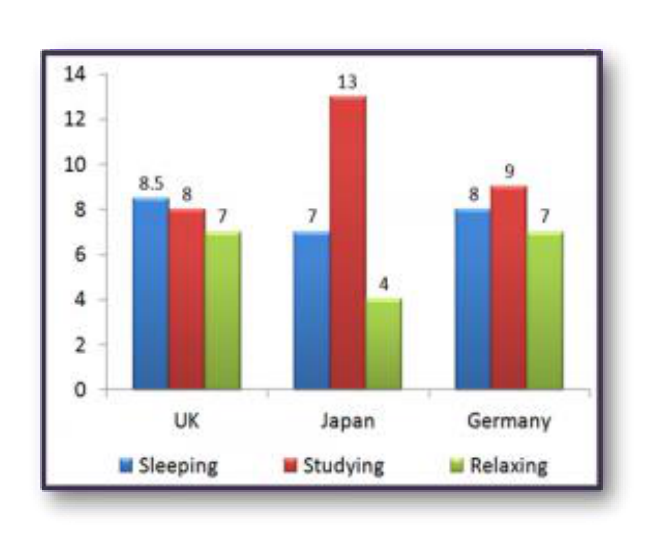
The bar chart shows the typical weekday for students in three different countries.
Summarise the information by selecting and reporting the main features, and make comparisons where relevant.
Student answer (Band 6.0)
The bar chart illustrates the usual weekday for students of UK, Japan, and Germany. It shows what activities they do during their weekdays.
Overall, students of all of these three countries spent almost equal amount of time sleeping, which is 7 to 8.5 hours. The time spent on relaxing and studing are also quite identical for the students of UK and Germany. The biggest difference can be noticed for the students of Japan who spent the highest amount of time on studying and the least amount of time on relaxing, compared to the other two countries.
Among these three country's students, Japan spends the most of their time studying, almost one third more than the other two, followed by Germany. For Sleeping, UK students spend the most time among the three.
The time UK and Japan Students spent on relaxing is same, which is 7 hours and the least is recorded for the students of Japan, which is 4 hours and almost half of the other two.
AI examiner evaluation
| Criterion | Band |
|---|---|
| Task Achievement / Task Response | 6.0 |
| Coherence and Cohesion | 5.5 |
| Lexical Resource | 6.0 |
| Grammatical Range and Accuracy | 5.5 |
| Overall | 6.0 |
Task Achievement / Task Response: Band 6.0
You identify the main pattern: Japan records the most study time and the least relaxation, while sleeping figures are relatively similar across the three countries. You also include several relevant comparisons, such as UK students sleeping the longest and Germany following Japan in study time. However, some details are inaccurate or unclear. You say UK and Japan students spend the same time relaxing, but Japan’s figure is 4 hours, compared with 7 in the UK; the later sentence corrects this, creating a contradiction. The overview also says UK and Germany have similar study and relaxation times, but does not clearly report the key figures. More precise, consistent comparisons would make the main features better developed.
Coherence and Cohesion: Band 5.5
The response has a recognisable structure, moving from an introduction to an overview and then to comparisons, so the reader can follow its general purpose. Linking expressions such as “Overall,” “followed by,” and “For” help connect points. However, progression is weakened by repetition and by the contradiction about relaxation: one sentence says UK and Japan have the same figure, while the final sentence gives Japan’s lower figure. The two detail paragraphs also do not organise the comparisons consistently, and some references, such as “these three countries,” are slightly awkward. Grouping the figures by activity or by country and checking that each comparison agrees would create clearer cohesion.
Lexical Resource: Band 6.0
You use an adequate range of task-related vocabulary, including “illustrates,” “amount of time,” “highest,” “least,” and “followed by.” These choices make the chart’s general comparisons understandable, and you attempt some more formal phrasing. However, several expressions are imprecise or unnatural, such as “usual weekday for students of UK” and “almost one third more,” which does not clearly state the comparison. “Identical” is also too strong for figures that are merely similar. There are spelling errors in “studing” and “country’s,” and repeated use of “time” limits variety. More accurate collocations and terms such as “hours spent” and “approximately” would improve precision.
Grammatical Range and Accuracy: Band 5.5
You use both simple and more complex sentence forms, including a relative clause in “students … who spent the highest amount of time” and a comparison with “followed by Germany.” Most of the intended meaning remains understandable. Some grammatical errors persist, however. The opening phrase needs an article and a more suitable preposition: “students in the UK, Japan and Germany.” In “students of all of these three countries spent almost equal amount,” the noun phrase needs an article, and “students of UK and Germany” has the same article problem. The final sentence also has an unclear construction, “The time UK and Japan Students spent on relaxing is same.” Improve article use, sentence construction and punctuation, while retaining your attempts at complex sentences.
See this exact question answered at other band scores. The same prompt compared across bands.
Browse more IELTS Writing model answers or get your own writing scored by the same AI examiner.