Band 6.5 IELTS Writing Task 1 Model Answer
Overall Band Score: 6.5 · IELTS Academic Practice Accelerator · 2026-11-18
IELTS Writing Task 1 question
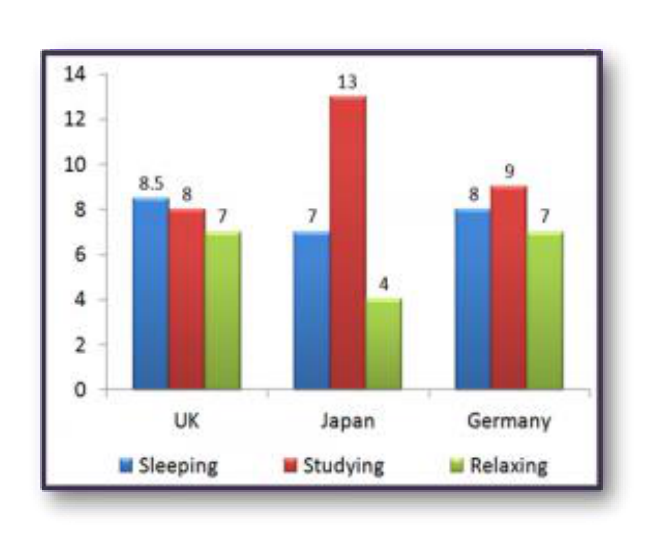
The bar chart shows the typical weekday for students in three different countries.
Summarise the information by selecting and reporting the main features, and make comparisons where relevant.
Student answer (Band 6.5)
The bar chart illustrate how students in three diffrent countries, namely Uk, Japan and Germany, spen their typical weekday on sleeping, studying and relaxing.
Overall, Japanese students spend the most time studying, Whereas students in UK spend slightly more time sleeping. In contrast, japanese students are accounted for the least amount of time in relaxing.
Looking at the figures in detail, students from UK spend approximately 8.5 hours sleeping, which is the highest figure among the three countries. They devote 8 hours to studying and 7 hours for the relaxing.
In japan, Studying takes up the largest proportion of the day, at 13 hours. This is considerably higher than the figures for the UK and Germany.
Japanese students spend 7 hours sleeping, while relaxing accounts for only 4 hours, making it the lowest figure on the graph.
Regarding Germany, students spend 9 hours studying, followed by 8 hours sleeping and 7 hours relaxing. These figures are relatively balanced compared with those of te other two countries
AI examiner evaluation
| Criterion | Band |
|---|---|
| Task Achievement / Task Response | 7.0 |
| Coherence and Cohesion | 6.5 |
| Lexical Resource | 6.0 |
| Grammatical Range and Accuracy | 5.5 |
| Overall | 6.5 |
Task Achievement / Task Response: Band 7.0
The response covers the chart’s main categories and all three countries, and its key comparisons are accurate: Japan has the highest study figure at 13 hours and the lowest relaxation figure at 4, while the UK records the most sleep at 8.5 hours. The overview identifies these dominant features, and the country-by-country details support it with relevant figures. The statement that Germany’s figures are “relatively balanced” is a reasonable summary, though it could be made more precise by noting that studying is still its largest category. To strengthen the response further, compare the countries more directly across each activity, rather than relying mainly on separate country descriptions. Overall, the main features are selected and reported clearly, with only modest scope for fuller comparison.
Coherence and Cohesion: Band 6.5
The response has a clear overall progression: an introduction and overview are followed by details for the UK, Japan and Germany. Paragraphing helps distinguish the main summary from the supporting figures, and phrases such as “In contrast,” “Looking at the figures in detail” and “Regarding Germany” guide the reader. This is a coherent arrangement, but some linking is formulaic and the country-by-country structure makes comparisons across the same activity less immediate. For example, the study figures for all three countries could be brought together in one comparison. There is also a small punctuation issue at the end, where the final sentence lacks a full stop. More varied, precise links between related figures would make the progression smoother.
Lexical Resource: Band 6.0
The vocabulary is adequate for describing the chart, with useful expressions such as “devote,” “takes up the largest proportion” and “considerably higher.” The writer also uses relevant terms for the activities and makes the figures easy to understand. However, spelling errors—including “diffrent,” “spen” and “te”—and inconsistent capitalisation of country names reduce accuracy. Some phrasing is also awkward: “students in UK” and “the relaxing” are less natural than standard chart-description collocations. The range is sufficient, but greater control of spelling, word forms and natural phrasing would make the report more precise and polished. Aim to use a few accurate comparison expressions rather than adding vocabulary that is not fully controlled.
Grammatical Range and Accuracy: Band 5.5
The response includes a mix of simple and more complex structures, including the overview contrast beginning “Whereas” and the clause “making it the lowest figure on the graph.” Most meanings remain clear, but some grammatical errors recur. The opening sentence has subject–verb disagreement (“The bar chart illustrate”), and “students in UK” is missing an article. In “Japanese students are accounted for the least amount,” the passive construction is not formed appropriately; a direct active structure would be clearer. The sentence beginning “Whereas” is also attached to the preceding sentence in a way that creates a fragment. These issues show that complex forms are being attempted, but more reliable agreement, articles and clause construction are needed.
See this exact question answered at other band scores. The same prompt compared across bands.
Browse more IELTS Writing model answers or get your own writing scored by the same AI examiner.