Band 6.5 IELTS Writing Task 1 Model Answer
Overall Band Score: 6.5 · IELTS Academic Practice Accelerator · 2026-11-18
IELTS Writing Task 1 question
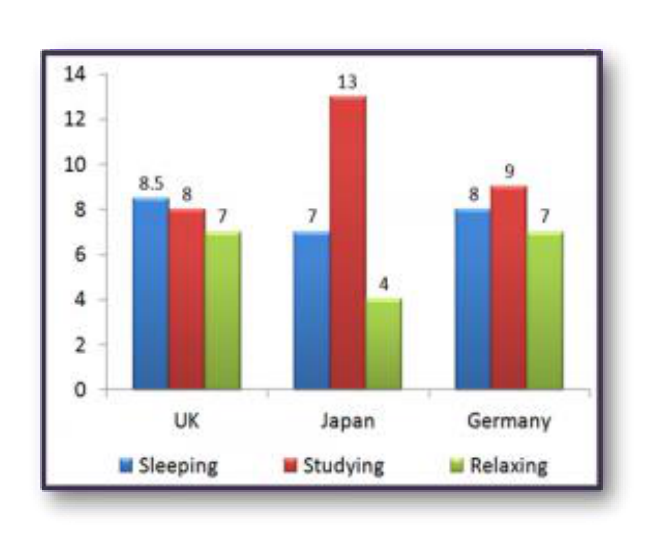
The bar chart shows the typical weekday for students in three different countries.
Summarise the information by selecting and reporting the main features, and make comparisons where relevant.
Student answer (Band 6.5)
The provided bar chart illustrates the time spent by students on a normal day of week in three different states
Overall, it can be seen that the Japanese and German students spent their maximum time while studying whereas students in the United Kingdom gave most of their time to sleeping. Moreover, both the United Kingdom and Germany devoted same time to relaxing while the Japanese spent relatively less time while relaxing.
To commence with, the amount of time consumed by studies were 13 hours in Japan which was the most performed activity. The Japanese students devoted more hours to study as compared to Germany and the United Kingdom which spent only 9 and 8 hours, respectively.
Additionally, the time consumed by sleep was 8.5 hours in the United Kingdom making it the only country with the highest sleeping rate as compared to Japan and Germany. Japanese students spent 7 hours while sleeping while the German students took 8 hours for sleeping. Finally, Japan spent only 4 hours while relaxing; meanwhile, both Germany and UK took same time for relaxing which were 7 hours.
AI examiner evaluation
| Criterion | Band |
|---|---|
| Task Achievement / Task Response | 7.5 |
| Coherence and Cohesion | 7.0 |
| Lexical Resource | 6.0 |
| Grammatical Range and Accuracy | 6.0 |
| Overall | 6.5 |
Task Achievement / Task Response: Band 7.5
The response selects the main comparisons accurately: Japan records the most study time at 13 hours, the UK the most sleep at 8.5 hours, and Japan the least relaxation at 4 hours, while the UK and Germany both relax for 7 hours. The overview also identifies the broad pattern that studying dominates in Japan and Germany, whereas sleeping is highest in the UK. These points address the task clearly and are supported with relevant figures. To make the account more fully developed, report the remaining comparisons more consistently—for example, Germany’s 9 hours of study is higher than the UK’s 8, and the three sleeping figures could be compared together. Avoid describing time as “most performed activity,” which is imprecise for a chart about hours spent.
Coherence and Cohesion: Band 7.0
The response has a clear four-paragraph structure: an introduction, an overview, and two paragraphs presenting details. Information progresses logically from study to sleep and relaxation, and linking expressions such as “Overall,” “Additionally,” and “Finally” help signal the sequence. The comparisons are generally easy to follow. However, some transitions feel formulaic, and the final paragraph combines two categories without a particularly clear organising principle. The repeated use of “time spent/consumed” also makes the progression less smooth. Grouping the details by activity or by country, then using concise comparison phrases such as “by contrast” and “while,” would make the cohesion more flexible and the paragraphing more purposeful.
Lexical Resource: Band 6.0
There is enough vocabulary to describe the chart, including “devoted,” “relatively less,” and “as compared to,” and the meaning remains clear. However, several choices are inaccurate or unnatural for reporting data: “time consumed by studies,” “most performed activity,” and “highest sleeping rate” do not express hours spent naturally. “States” is also unsuitable for the UK, Japan, and Germany, which are countries. Repetition of “spent,” “time,” and “hours” limits the range. Use precise chart language such as “spend,” “record,” “account for,” and “the figure for,” while checking that collocations fit the activity being described. This would improve precision without requiring unnecessarily complex vocabulary.
Grammatical Range and Accuracy: Band 6.0
The response uses a mix of simple and complex forms, including a comparison clause (“as compared to Japan and Germany”) and a participial phrase (“making it the only country…”). Most sentences communicate the intended comparisons, but some grammatical errors remain. For example, “the amount of time consumed by studies were 13 hours” has a subject–verb agreement problem, and “both Germany and UK took same time” needs articles and a more suitable verb pattern. The opening phrase “on a normal day of week” also has an article error. Review agreement with singular subjects, article use before country names where required, and sentence patterns for describing figures. More consistently accurate structures would strengthen the response.
See this exact question answered at other band scores. The same prompt compared across bands.
Browse more IELTS Writing model answers or get your own writing scored by the same AI examiner.