Band 6.0 IELTS Writing Task 1 Model Answer
Overall Band Score: 6.0 · IELTS Academic Practice Accelerator · 2026-11-19
IELTS Writing Task 1 question
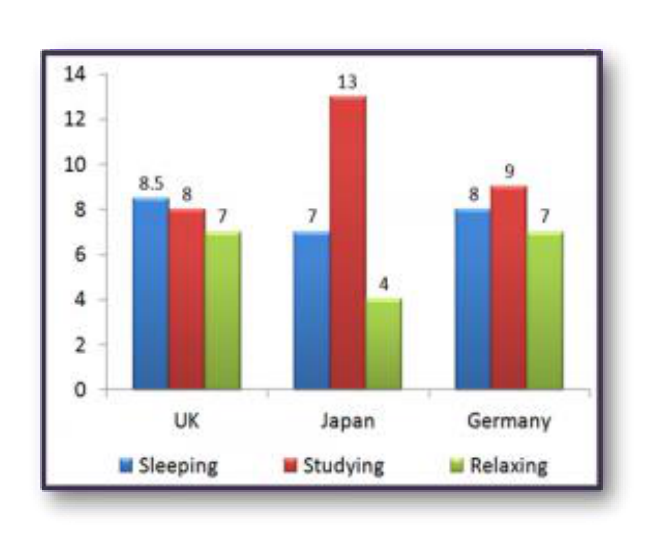
The bar chart shows the typical weekday for students in three different countries.
Summarise the information by selecting and reporting the main features, and make comparisons where relevant.
Student answer (Band 6.0)
The given bar chart shows three different activities for the weekday for students in three different countries.
Overall, in Japan and Germany most of student spend weekday in studying whereas in UK student prefer to sleep in weekday.
Starting with Japan, 13 million student spend their time in studying during weekday which is one fourth higher than student of germany and Uk where as 7 million student prefer sleeping as comparing less than UK and Germany. Least number of student prefer relaxing in japan. In contrast, UK have maximum student spending in sleeping around 8.5 millions higher than other two countires. Studying and relaxing are similar in number 8 and 7 millions respectively comparitavely similar to remaining countires.
In Germany, student participate in all three activities nearly equally. 9 millions student spend instudying which is higher tahn Uk and lower than Japan. Similarly, Germany have second highest activities of sleeping. Germany and UK have similar number of relaxing which is higher than Japan.
AI examiner evaluation
| Criterion | Band |
|---|---|
| Task Achievement / Task Response | 6.5 |
| Coherence and Cohesion | 6.5 |
| Lexical Resource | 5.5 |
| Grammatical Range and Accuracy | 5.0 |
| Overall | 6.0 |
Task Achievement / Task Response: Band 6.5
You identify the main contrast: Japan has the highest study figure, while the UK and Germany record more time for relaxing than Japan. You also include relevant comparisons, such as Germany’s nine hours of study being between the UK and Japan. This covers the task and gives a clear overview. However, the overview claim that UK students “prefer to sleep” is not supported by the chart: studying (8 hours) exceeds sleeping (8.5? actually sleeping is 8.5 hours, so sleeping is slightly higher), but the wording about preference is imprecise, and the chart reports hours, not numbers of students. Some details are also unclear, including “one fourth higher,” and the UK’s sleeping figure is not explicitly compared with Germany’s. More precise reporting of hours and a clearer overview would strengthen the response.
Coherence and Cohesion: Band 6.5
The response has a clear overall structure: an introduction, an overview, and separate discussion of Japan and Germany. This makes the information easy to locate, and comparisons such as Germany’s study figure being higher than the UK’s but lower than Japan’s help connect the data. The progression is generally logical, though the UK is discussed mainly within the Japan paragraph rather than in a consistently organised comparison of all three countries. Some linking phrases are awkward or repetitive, including “In contrast” and “Similarly,” and the final sentence’s reference to “remaining countries” is not fully clear. Grouping the figures by activity or using more precise comparisons would make cohesion more flexible and references easier to follow.
Lexical Resource: Band 5.5
You use relevant task vocabulary, including “bar chart,” “maximum,” “least,” and “higher than,” and the reader can generally understand the comparisons you intend. However, the range is limited and several word choices or collocations are inaccurate, such as “prefer sleeping,” “participate in all three activities,” and “similar in number” when the chart gives hours spent. Repeated use of “student” and “spend” also makes the description less precise. Spelling errors such as “countires,” “comparitavely,” and “tahn” are noticeable and reduce the accuracy of the vocabulary. Aim to use a wider set of natural expressions for describing time and comparisons, while checking spelling and choosing terms that match the chart’s units.
Grammatical Range and Accuracy: Band 5.0
You attempt both simple and more complex sentences, for example, “9 millions student spend instudying which is higher tahn Uk and lower than Japan.” However, errors in agreement, articles, plurals, and sentence construction are frequent enough to make some sentences difficult to read. Examples include “most of student spend,” “UK have maximum student,” and “Germany have second highest activities.” The sentence beginning “Starting with Japan” also combines several comparisons without clear grammatical boundaries. There is some variety in sentence forms, but complex structures are often not controlled accurately. Focus on subject–verb agreement, countable nouns, and building shorter, complete comparison sentences before adding clauses.
See this exact question answered at other band scores. The same prompt compared across bands.
Browse more IELTS Writing model answers or get your own writing scored by the same AI examiner.