Band 7.0 IELTS Writing Task 1 Model Answer
Overall Band Score: 7.0 · IELTS Academic Practice Accelerator · 2026-11-19
IELTS Writing Task 1 question
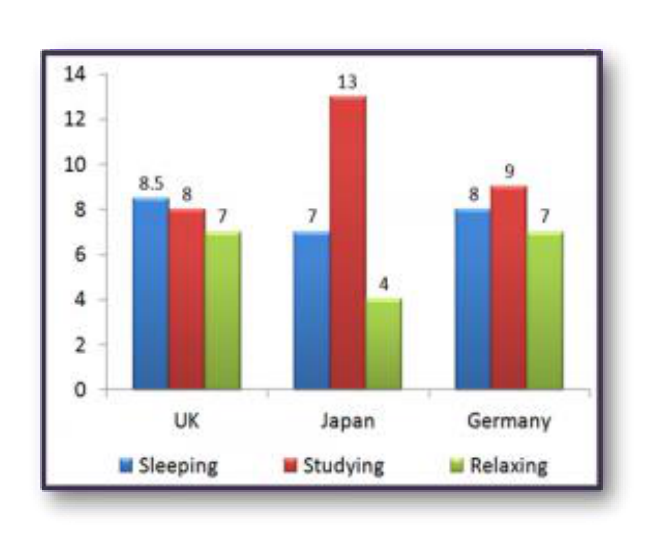
The bar chart shows the typical weekday for students in three different countries.
Summarise the information by selecting and reporting the main features, and make comparisons where relevant.
Student answer (Band 7.0)
The bar chart illustrates how students in the UK, Japan and Germany spend their time on a typical weekday, in terms of sleeping, studying and relaxing.
However, it is clear that Japanese students spend by far the most time studying, while the least time in relaxing. In contrast, the UK and Germany have a more balanced daily routine.
In terms of studying, Japan stands out for 13 hours, which is significantly higher than Geramny at 9 hours and the UK at 8 hours. This suggests that studying takes up largest part of the day for Japanese learners.
when it comes to sleeping, Uk students consume most of their time in it, which is 8.5 hours, slightly lower for Germany that is 8 hours, and takes 7 hours in Japan. Rgarding relaxing, UK and Germany, both spend same time that is 7 hours, which is almost double the figure for Japan, at only 4 hours. This shows that Japanese students have much less leisure time as compared to their counterparts in the other two countris.
AI examiner evaluation
| Criterion | Band |
|---|---|
| Task Achievement / Task Response | 8.0 |
| Coherence and Cohesion | 7.0 |
| Lexical Resource | 6.0 |
| Grammatical Range and Accuracy | 6.0 |
| Overall | 7.0 |
Task Achievement / Task Response: Band 8.0
You cover the chart’s three activities and all three countries, and your overview identifies the main contrasts: Japan has the highest study figure and the lowest relaxation figure, while the UK and Germany are more similar in leisure time. The reported values are accurate, including Japan’s 13 hours of study, the UK’s 8.5 hours of sleep, and the shared 7 hours of relaxation in the UK and Germany. You also make relevant comparisons rather than listing figures in isolation. The description is well developed overall; to make it even more complete, state explicitly that studying is the largest of the three activities in each country, and avoid the broad claim that the UK and Germany have a “more balanced daily routine” without explaining what balance means in the chart.
Coherence and Cohesion: Band 7.0
The response follows a clear progression: an introduction, an overview, then comparisons of studying, sleeping and relaxing. This makes the information easy to follow, and linking phrases such as “In contrast,” “In terms of,” and “when it comes to” help signal shifts between points. The paragraphing is appropriate, although the final paragraph contains both the sleeping and relaxing comparisons and is somewhat crowded. A few transitions feel formulaic, and the opening “However” does not express a clear contrast with the introductory sentence. Use a more purposeful overview transition and consider separating the final activity comparison into its own paragraph to make the organisation more controlled.
Lexical Resource: Band 6.0
You use an adequate range of vocabulary for describing the chart, including “stands out,” “significantly higher,” “slightly lower,” and “counterparts.” These choices help communicate comparisons, and the meaning remains clear. However, some word choices and collocations are inaccurate or awkward: students do not “consume” time sleeping, and “the least time in relaxing” is not a natural construction. There are also spelling errors in “Geramny,” “Rgarding,” and “countris,” as well as inconsistent capitalisation of “UK.” Aim for precise chart language and check spelling carefully; this would make the vocabulary more accurate and natural without requiring more elaborate wording.
Grammatical Range and Accuracy: Band 6.0
You use a mix of simple and complex forms, including a subordinate clause in “while the least time in relaxing” and comparative structures such as “slightly lower for Germany.” Most relationships between the figures are understandable, but some grammatical errors remain. For example, “takes up largest part of the day” needs an article (“the largest part”), and “UK and Germany, both spend same time” needs clearer sentence structure and articles (“the UK and Germany both spend the same amount of time”). The sentence beginning “when it comes to sleeping” also starts with a lowercase letter, and the comma after “Germany” in “Germany, that is 8 hours” is not appropriate for this construction. Review articles, sentence boundaries and punctuation while retaining your varied sentence forms.
See this exact question answered at other band scores. The same prompt compared across bands.
Browse more IELTS Writing model answers or get your own writing scored by the same AI examiner.