Band 6.0 IELTS Writing Task 1 Model Answer
Overall Band Score: 6.0 · IELTS Academic Practice Accelerator · 2026-11-19
IELTS Writing Task 1 question
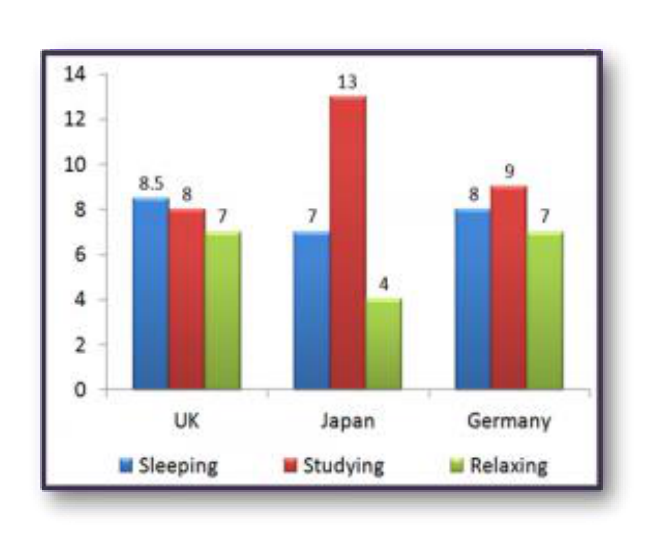
The bar chart shows the typical weekday for students in three different countries.
Summarise the information by selecting and reporting the main features, and make comparisons where relevant.
Student answer (Band 6.0)
The image illustrates that most students spends the majority of their weekday on studying. In general, studying and sleeping are the most important activity according to the amount of time spent on them every day. For instance, the UK and germany students' are following the same routine, but the UK students' tends to sleep a bit longer. Whereas Japan studens' are following a strict lifestyle, their records reflect a very short time of relaxation with only 4 hours.
By looking at the graph, it is obvious that the UK and germany students' have a lot of things in common, the are both saving about 7 hours of their day for leisure time. Additionally, both of them sleep and study almost the same number of hours. However, the UK students' are resting more by half hour.
Next, Japan students' are focusing too much than the last two type of studens on study, which lead to lesser hours for recovery. They study for about 13 hours and resting for about 11 hours .
AI examiner evaluation
| Criterion | Band |
|---|---|
| Task Achievement / Task Response | 6.5 |
| Coherence and Cohesion | 6.5 |
| Lexical Resource | 5.5 |
| Grammatical Range and Accuracy | 5.5 |
| Overall | 6.0 |
Task Achievement / Task Response: Band 6.5
You identify the main contrast: studying takes the most time in Japan, while UK and German students have similar routines, and Japanese students have the least leisure time. The comparison that UK and German students each spend about seven hours relaxing is accurate. However, several figures are misreported or unclear: UK students sleep 8.5 hours, not simply “a bit” longer, and Japan’s 11 hours of “resting” is not shown—the chart gives 7 hours sleeping and 4 relaxing. The overview also says studying and sleeping are the most important activities, but does not clearly summarise the full pattern across all three countries. More precise reporting of the categories and key figures would make the response more complete and support the comparisons more effectively.
Coherence and Cohesion: Band 6.5
The response has a recognisable structure, moving from an opening overview to comparisons between the UK and Germany and then Japan. Linking phrases such as “In general,” “Additionally,” and “Next” help signal this progression, and the main comparisons are generally easy to follow. However, the organisation is somewhat repetitive: the similarity between UK and German students is stated in both the first and second paragraphs, while the final paragraph introduces a confusing claim about Japanese students “resting” for 11 hours. Some connections are also awkward, particularly the sentence beginning “Whereas Japan students’,” which is not smoothly attached to the preceding idea. Grouping the overview separately and then comparing all three activities more systematically would create clearer progression.
Lexical Resource: Band 5.5
You use a relevant range of vocabulary, including “majority,” “routine,” “strict lifestyle,” “leisure time,” and “recovery,” and the reader can generally understand the intended comparisons. However, several choices are imprecise or unnatural for describing chart data. “Most important activity” does not clearly mean the activity taking the most time, and “saving about 7 hours” is not an appropriate collocation for leisure time. “Resting” is also used ambiguously for both sleep and relaxation, which contributes to the inaccurate 11-hour claim. There are noticeable spelling and word-form errors, including “germany,” “studens’,” and “studens.” Use precise chart vocabulary such as “spend,” “sleep,” and “relax,” and check spelling and possessive forms.
Grammatical Range and Accuracy: Band 5.5
You attempt a mix of simple and complex sentences, including clauses with “Whereas” and “which,” and the overall meaning is usually recoverable. However, some errors in agreement, sentence construction, and verb forms remain. For example, “most students spends” should be “most students spend,” while “the are both saving” appears to be a faulty construction. In “Japan students’ are focusing,” the possessive form is not appropriate, and “which lead to lesser hours” has agreement and comparative-form problems. The sentence beginning “Whereas Japan students’” is also incomplete or awkwardly joined. These errors do not usually prevent understanding, but more consistent control of subject–verb agreement and complete clause structure would improve accuracy.
See this exact question answered at other band scores. The same prompt compared across bands.
Browse more IELTS Writing model answers or get your own writing scored by the same AI examiner.