Band 5.5 IELTS Writing Task 1 Model Answer
Overall Band Score: 5.5 · IELTS Academic Practice Accelerator · 2026-11-19
IELTS Writing Task 1 question
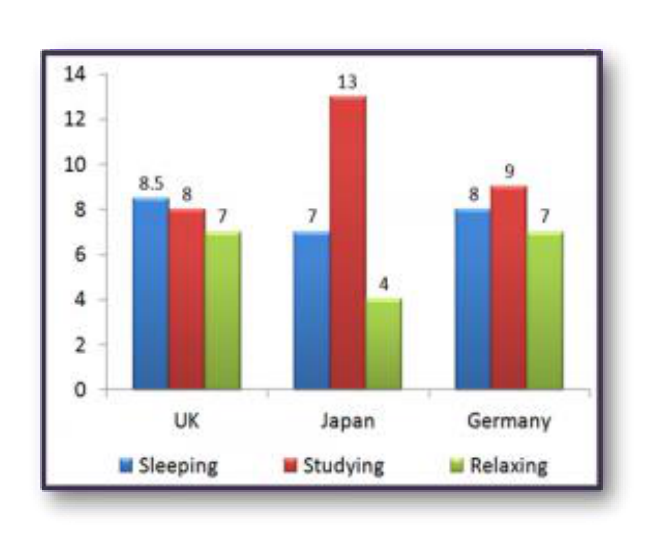
The bar chart shows the typical weekday for students in three different countries.
Summarise the information by selecting and reporting the main features, and make comparisons where relevant.
Student answer (Band 5.5)
This chart is illustrating the weekday for students in three multiple countries of UK, Japan and Germany.
It's also indicating the three comparisons of student's life which are sleeping, studying and relaxing time.
Overall Japan has the highest leading bar which is going up to 13 hours of studying.
Meanwhile the Uk has almost the same time of these comparisons.
In the UK sleeping hours are around 8.5, the studying hours are 8 and the relaxing hours are 7.
In Japan sleeping time is for 7 hours and relaxing time is for only 4 hours which is the lowest level of all the bars.
However in Germany the bar is balancing and the time for study is 9 hours, and the sleeping time is for 8 hours and relaxing time is also for 7 hours.
AI examiner evaluation
| Criterion | Band |
|---|---|
| Task Achievement / Task Response | 5.5 |
| Coherence and Cohesion | 5.5 |
| Lexical Resource | 5.5 |
| Grammatical Range and Accuracy | 5.5 |
| Overall | 5.5 |
Task Achievement / Task Response: Band 5.5
You identify the three countries and activities, and report several figures accurately, including Japan’s 13 hours of study and the UK’s 8.5 hours of sleep, 8 of study and 7 of relaxation. You also note that Japan’s relaxation figure is the lowest. However, the overview is limited: “the UK has almost the same time” is unclear and does not explain that Germany and the UK have similar relaxation figures, while Japan spends much more time studying. The description of Germany as “balancing” is also vague. The response is 135 words, below the required 150, and this limits the detail available. Add a clearer overview and compare the main contrasts across all three countries.
Coherence and Cohesion: Band 5.5
The response has a basic sequence: an introduction, an overall statement, and then details about the countries. This gives the reader some organisation, and transitions such as “Meanwhile” and “However” show an attempt to connect ideas. However, progression is not always clear because the comparisons are mostly presented country by country rather than grouped around the main patterns. “The UK has almost the same time of these comparisons” is difficult to interpret, and “However” does not establish a clear contrast with the preceding point. Use separate overview and detail paragraphs, and organise the figures by activity or by the most important similarities and differences. More precise referencing would also make the relationships between figures easier to follow.
Lexical Resource: Band 5.5
You use relevant vocabulary for the chart, including “sleeping,” “studying,” “relaxing,” “hours,” and “highest,” so the topic remains understandable. There are also attempts to vary expression, such as “lowest level” and “indicating.” However, several choices are unnatural or imprecise: “three multiple countries,” “highest leading bar,” and “the bar is balancing” do not communicate the comparisons clearly. Repetition of “time” and “hours” also makes the description less flexible. Choose standard chart language such as “three countries,” “the highest figure,” and “the figures are relatively similar.” More accurate collocations and a wider range of comparison terms would make the report clearer and more natural.
Grammatical Range and Accuracy: Band 5.5
You produce several complete sentences and attempt some variation, including the contrastive opening “Meanwhile” and the clause beginning “which is the lowest level.” Most of the intended meaning can be understood. However, sentence structures are limited and some patterns are awkward or inaccurate. For example, “This chart is illustrating the weekday” uses an unnecessarily progressive form, while “the three comparisons of student's life” has problems with the possessive and sentence construction. “In Japan sleeping time is for 7 hours” also shows an inaccurate grammatical pattern. Use direct present-simple reporting, such as “The chart shows…” and “Students in Japan sleep for seven hours.” Check articles, possessives and punctuation, and practise combining accurate simple sentences with controlled complex ones.
See this exact question answered at other band scores. The same prompt compared across bands.
Browse more IELTS Writing model answers or get your own writing scored by the same AI examiner.