Band 5.0 IELTS Writing Task 1 Model Answer
Overall Band Score: 5.0 · IELTS Academic Practice Accelerator · 2026-11-20
IELTS Writing Task 1 question
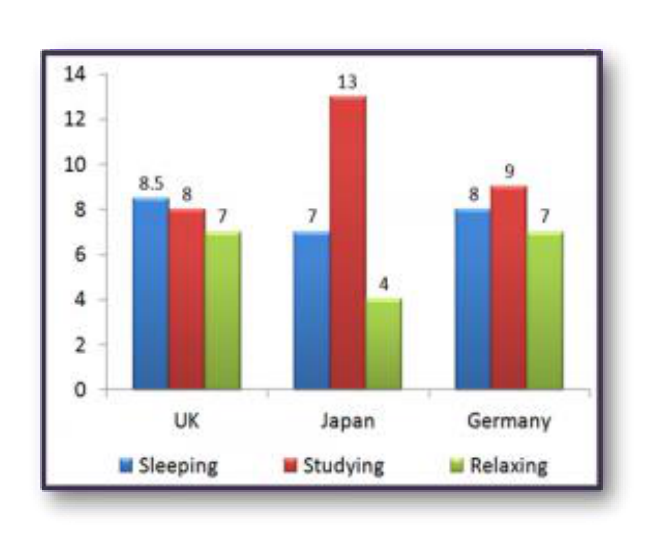
The bar chart shows the typical weekday for students in three different countries.
Summarise the information by selecting and reporting the main features, and make comparisons where relevant.
Student answer (Band 5.0)
The bar chart illustrates the typical weekday for the learner in three different countries.
Overall, it is clear that they were significant differences in the main features shown in the given information with some aspects and being more prominent than the others.
First, in this bar i will describe three countries ratio such as Uk, Japan, Germany. In Uk sleeping ratio is higher as compared to other, sleeping ratio contain 8.5% and second ratio contain studying that was 8%. Third include relaxing that was 7%.
Second, chart was Japan city in this chart i would like to define three modes. First of all sleeping that was 7% and furthermore studying contain 13%. Last contain relaxing mode it was 4%. Third step contain Germany city, first contain sleeping that was 8% and second contain studying it was 9% and last have relaxing contain 7%.
AI examiner evaluation
| Criterion | Band |
|---|---|
| Task Achievement / Task Response | 4.5 |
| Coherence and Cohesion | 5.0 |
| Lexical Resource | 5.0 |
| Grammatical Range and Accuracy | 5.0 |
| Overall | 5.0 |
Task Achievement / Task Response: Band 4.5
You report the figures for all three countries accurately: for example, Japan has 13 hours of studying and 4 of relaxing, while Germany has 8 hours of sleeping and 9 of studying. However, the response mainly lists each country’s values rather than selecting and comparing the chart’s main features. The overview is unclear and does not identify the key contrast: Japan spends much more time studying, while its relaxing figure is lower than those of the UK and Germany. Also, the chart gives hours, not percentages, so describing the figures as “8.5%” and “8%” misrepresents the units. The response is 143 words, below the required 150. Develop a clear overview and make direct comparisons to address the task more fully.
Coherence and Cohesion: Band 5.0
The response has a basic structure, with an opening, an overview attempt, and separate sections for the countries. This helps the reader locate the figures, and sequencing words such as “First” and “Second” signal movement through the information. However, there is little overall progression from the most important features to supporting details: the body largely repeats the same list pattern for each country. Some linking phrases are awkward or unclear, including “First, in this bar” and “Third step contain Germany city,” while “First of all” and “furthermore” do not show meaningful comparisons. Organise the body around key contrasts, such as study time and relaxation, and use clear references and transitions to connect the figures.
Lexical Resource: Band 5.0
You use a small set of relevant terms, including “sleeping,” “studying,” “relaxing,” and “significant differences,” so the topic is generally understandable. However, vocabulary is repetitive and several choices are unnatural or imprecise for describing a chart. “Ratio” is repeated for values that represent hours, “modes” does not fit these activities, and “Japan city” incorrectly treats a country as a city. Phrases such as “contain studying” and “last contain relaxing mode” also make the description less clear. Aim for accurate chart language and vary the verbs used to report data, while keeping the wording simple and precise. This would make the comparisons easier to follow.
Grammatical Range and Accuracy: Band 5.0
You attempt both simple statements and longer sentences, and most of the figures can still be understood. However, the range of sentence structures is limited, and errors occur frequently enough to make some sentences awkward or unclear. For example, “it is clear that they were significant differences” has an incorrect verb construction; “sleeping ratio contain 8.5%” has subject–verb agreement and article problems; and “Third include relaxing that was 7%” is not a complete, well-formed sentence. Capitalisation and punctuation are also inconsistent, as in “Uk” and “i.” Practise forming complete sentences with accurate subjects and verbs, and use straightforward comparative structures to report the data.
See this exact question answered at other band scores. The same prompt compared across bands.
Browse more IELTS Writing model answers or get your own writing scored by the same AI examiner.