Band 5.5 IELTS Writing Task 1 Model Answer
Overall Band Score: 5.5 · IELTS Academic Practice Accelerator · 2026-11-20
IELTS Writing Task 1 question
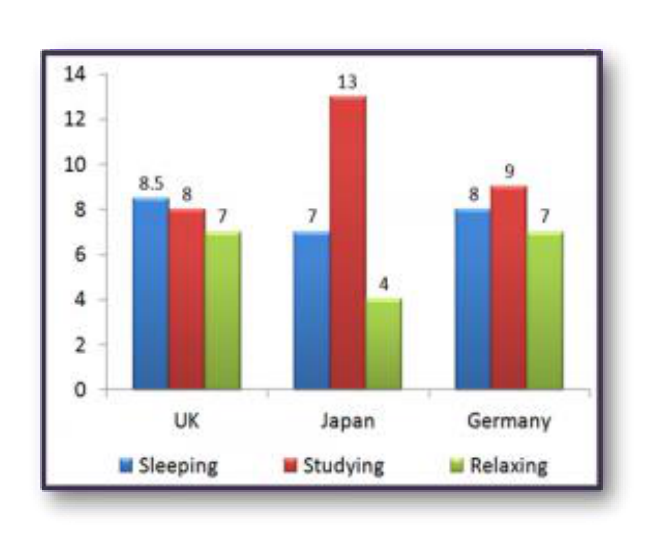
The bar chart shows the typical weekday for students in three different countries.
Summarise the information by selecting and reporting the main features, and make comparisons where relevant.
Student answer (Band 5.5)
The bar chart illustrates weekday activities of the students in three distinct countries.
Overall, 3 key activities are focused, where japanese students lead in studying with a whooping time of 13 hours, while the students in UK study the least.
In the United Kingdom, students study for 8 hours, sleep for 8.5 hours, and the remaining time they reserve for relaxing that is similar to german students.
In contrast, Japanese students sleep for only 7 hours, making their country where students sleep the least, relaxation is for only 4 hours while all the time remaining goes for studying which makes them the students, who spend their significant proportion of the time in studying.
While german students study for 9 hours and sleep one hour less as compare to studying.
AI examiner evaluation
| Criterion | Band |
|---|---|
| Task Achievement / Task Response | 5.5 |
| Coherence and Cohesion | 5.5 |
| Lexical Resource | 5.5 |
| Grammatical Range and Accuracy | 5.5 |
| Overall | 5.5 |
Task Achievement / Task Response: Band 5.5
You identify the chart’s three activities and report several accurate figures, including Japanese students’ 13 hours of study and the UK figures. You also make relevant comparisons, such as Japan having the lowest relaxation time. However, the overview is incomplete: it does not clearly summarise the main contrasts across all three countries, and the German figures are only partly reported. The claim that UK students “study the least” is inaccurate, since Japan studies the most and the UK’s eight hours is below Germany’s nine but not the lowest overall if comparing the stated figures? Japan is highest, while UK is lowest among the three. More importantly, the response is below the required 150 words, limiting the detail and development of the summary. Add a fuller overview and report the key comparisons consistently.
Coherence and Cohesion: Band 5.5
The response has a basic overall structure: an introduction, an overview, and country-by-country details. Linking expressions such as “Overall,” “In contrast,” and “While” help signal relationships between points. However, progression is not always clear. The final sentence beginning “While german students…” is incomplete as a dependent clause, and the long sentence about Japanese students combines several facts without clear separation. Some references, such as “all the time remaining,” are also imprecise because the chart presents separate activity totals rather than a complete 24-hour breakdown. Use distinct, balanced paragraphs and connect each comparison clearly to the relevant country and activity.
Lexical Resource: Band 5.5
You use a reasonable range of task-related vocabulary, including “illustrates,” “activities,” “relaxing,” and “in contrast,” so the main information is generally understandable. However, several choices are inaccurate or too informal for an academic report. “Whooping time” is an unsuitable collocation, while “3 key activities are focused” does not express the chart’s categories naturally. “Reserve for relaxing” is also awkward, and “significant proportion” is not precise when the chart gives hours. Capitalisation is inconsistent in “japanese” and “german.” Aim for neutral, precise reporting language and use the same activity terms consistently, such as “spend,” “study,” “sleep,” and “relax.”
Grammatical Range and Accuracy: Band 5.5
You attempt a mixture of simple and more complex sentences, including clauses introduced by “while” and “making,” and the reader can usually understand your comparisons. However, complex structures are not consistently controlled. The final sentence, “While german students study for 9 hours and sleep one hour less as compare to studying,” is grammatically incomplete and contains an incorrect comparison pattern. In “the remaining time they reserve,” the clause structure is awkward, and the Japanese sentence runs several clauses together, making it difficult to follow. There are also article and punctuation issues, such as “in UK” and the comma before “who.” Practise complete sentence structures and check that each subordinate clause is attached to a main clause.
See this exact question answered at other band scores. The same prompt compared across bands.
Browse more IELTS Writing model answers or get your own writing scored by the same AI examiner.