Band 5.5 IELTS Writing Task 1 Model Answer
Overall Band Score: 5.5 · IELTS Academic Practice Accelerator · 2026-11-21
IELTS Writing Task 1 question
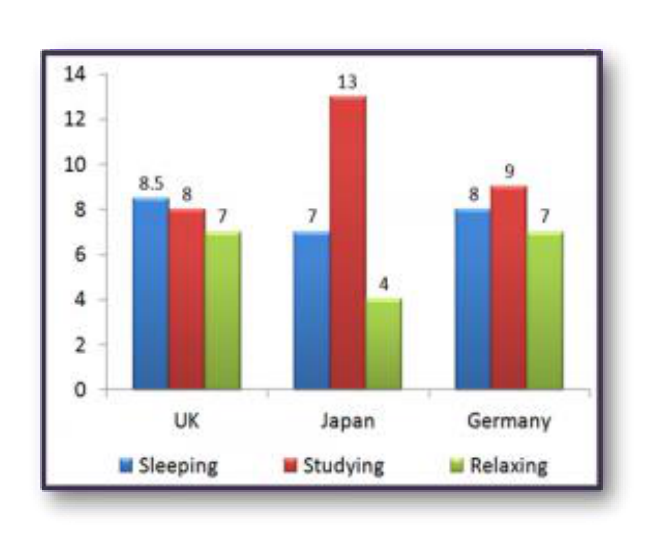
The bar chart shows the typical weekday for students in three different countries.
Summarise the information by selecting and reporting the main features, and make comparisons where relevant.
Student answer (Band 5.5)
The bar chart given below demonstrates the weekdays for students in three different countries.
Overall, the chart illustrates studying, sleeping and realxing time of students in Japan, UK and Germany. In Japan students study for 13 hours. In Germany students study for 9 hours and in UK students study for 8 hours. In UK students take 8.5 hours of sleep as in other two countries students give more time to study.
In Japan, the students take a sleep of 7 hours and also it is scientifically proven that 7 to 8 hours of sleep is enough for our body.The students spent 13 hours studying which takes most of the time of their day .The remaining 4 hours are used by students as their relaxing time.
In Germany, the students study for 9 hours, take sleep of 8 hours and remaining 7 hours relaxation.
In UK, students study for 8 hours, sleep for 8.5 hours and relax for 7 hours.
In conclusion, japnese students spent most of the time of their day studying. In UK and Germany students give studies a little more time than sleeping and relaxing. These students spent most of the time of their day sleeping and relaxing.
AI examiner evaluation
| Criterion | Band |
|---|---|
| Task Achievement / Task Response | 5.5 |
| Coherence and Cohesion | 6.0 |
| Lexical Resource | 5.0 |
| Grammatical Range and Accuracy | 5.5 |
| Overall | 5.5 |
Task Achievement / Task Response: Band 5.5
You report the main figures for studying, sleeping and relaxing in all three countries, and correctly identify Japan as having the longest study time. However, the overview is not fully clear: the claim that UK and German students give studies “a little more time than sleeping and relaxing” does not fit the UK figures, where sleep is slightly longer than study, and the final sentence about students spending most of the day sleeping and relaxing is too broad. The chart also shows that Japan has the shortest relaxation time, a useful comparison you could highlight. Keep the response focused on what the chart shows; the comment that seven to eight hours of sleep is scientifically sufficient is unsupported and not relevant to summarising the data.
Coherence and Cohesion: Band 6.0
The response has a recognisable structure, moving from an opening and overview to country-by-country details, so the reader can follow the basic organisation. The separate paragraphs for Japan, Germany and the UK also help group information. However, the overview mixes key comparisons with details, and the conclusion repeats or contradicts earlier points rather than drawing the main patterns together. For example, the statement that UK and German students spend most of their day sleeping and relaxing is unclear after the country figures. Some links, such as “as in other two countries,” are awkward and make relationships between ideas less clear. A concise overview followed by logically grouped comparisons would create smoother progression.
Lexical Resource: Band 5.0
You use relevant task vocabulary, including “studying,” “sleep,” “relaxing time” and “hours,” and the reader can generally understand the comparisons. However, the range is limited and several expressions are unnatural or imprecise, such as “take a sleep,” “give more time to study,” and “remaining 7 hours relaxation.” There are also spelling errors in “realxing” and “japnese,” and “weekdays” does not accurately describe the chart’s subject as clearly as “a typical weekday.” Aim for precise chart language and natural collocations, such as “spend eight hours studying” or “allocate seven hours to relaxation.” Avoid adding general claims that do not help describe the data.
Grammatical Range and Accuracy: Band 5.5
You communicate the figures mainly through simple sentences, and several are grammatically clear, such as “In Germany, the students study for 9 hours.” There are also attempts to combine ideas, but control is uneven: “In UK students take 8.5 hours of sleep as in other two countries students give more time to study” has unclear clause structure and missing articles. In “The students spent 13 hours studying,” the past tense is inconsistent with the present-tense descriptions elsewhere. Punctuation and spacing are also inconsistent, particularly around sentence boundaries. Practise accurate comparisons using structures such as “whereas” and “while,” and check articles, tense consistency and sentence boundaries before finishing.
See this exact question answered at other band scores. The same prompt compared across bands.
Browse more IELTS Writing model answers or get your own writing scored by the same AI examiner.