Band 5.0 IELTS Writing Task 1 Model Answer
Overall Band Score: 5.0 · IELTS Academic Practice Accelerator · 2026-11-22
IELTS Writing Task 1 question
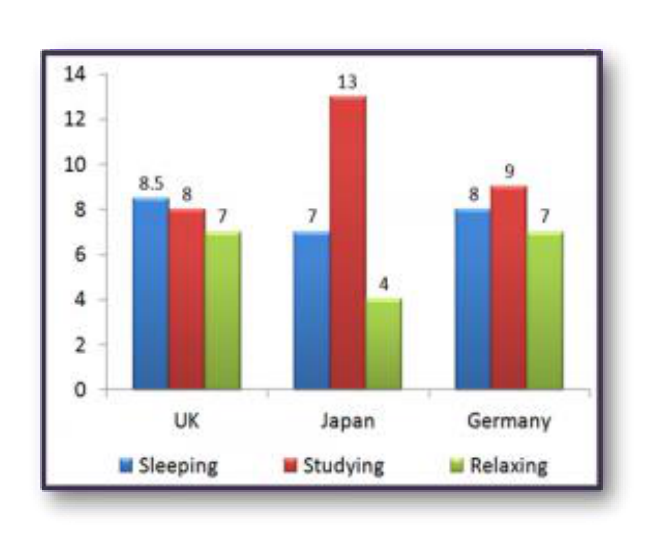
The bar chart shows the typical weekday for students in three different countries.
Summarise the information by selecting and reporting the main features, and make comparisons where relevant.
Student answer (Band 5.0)
The bar chart compares the weekly activities of students in three countries.
Overall, it has categorized in three activities such as Sleeping,Relaxing and Studying.However Studying accounted for the highest in two countries,in contrast sleeping remain stable and Relaxing were the lowest in all countries.
Studying in japan recorded for 13% and marginaly decline in germany at 9% and in uk stood at 8%.While sleeping was on 8.5 in UK and dropped 1 % and reached at 7% and then it went up 8%
AI examiner evaluation
| Criterion | Band |
|---|---|
| Task Achievement / Task Response | 4.0 |
| Coherence and Cohesion | 5.0 |
| Lexical Resource | 5.0 |
| Grammatical Range and Accuracy | 5.0 |
| Overall | 5.0 |
Task Achievement / Task Response: Band 4.0
You identify the chart’s three activities and make a relevant comparison by noting that studying is highest in Japan, Germany and the UK. However, the response reports only part of the information: it gives no figures for relaxing and stops before describing that activity, while the overview incorrectly says relaxing was lowest in all countries. In fact, sleeping is lower than relaxing in Japan. The sleeping figures are broadly represented, but the description of the changes is unclear and the chart shows hours, not percentages. The response is also substantially below the required 150 words, leaving the main features underdeveloped. To improve, provide a complete overview and compare all three activities using accurate units and selected figures.
Coherence and Cohesion: Band 5.0
There is a basic attempt to organise the response: an opening sentence is followed by an overview and then some details about studying and sleeping. This gives the reader a general sense of the intended structure. However, the response ends abruptly, and the information does not progress through all three activities. Linking is limited and sometimes awkward: “However” does not clearly introduce a contrast, while “While” begins a comparison that is left incomplete. Several ideas are crowded into the overview rather than separated into clear points. Use distinct paragraphs for the overview and supporting comparisons, and connect each comparison explicitly so the reader can follow the chart’s main patterns.
Lexical Resource: Band 5.0
The response uses some relevant chart vocabulary, including “compares,” “accounted for,” “recorded” and “decline,” showing an attempt to describe data rather than simply list labels. However, the range is limited, and several choices or forms are inaccurate or unnatural, such as “recorded for 13%” and “sleeping remain stable.” “Stable” is also not an accurate description of the sleeping figures, which vary across the countries. Spelling errors such as “marginaly” and inconsistent capitalisation of “japan” reduce control. Aim for precise, natural reporting language and use the chart’s units: for example, “students spent 13 hours studying” rather than giving a percentage.
Grammatical Range and Accuracy: Band 5.0
You attempt both simple statements and longer comparisons, for example, “Studying in japan recorded for 13% and marginaly decline in germany at 9% and in uk stood at 8%.” This shows an effort to combine information, but the sentence is difficult to follow because its clauses are not formed consistently. There are frequent problems with verb forms and agreement, as in “sleeping remain stable,” and the final sentence lacks clear punctuation and a complete comparison. Spacing after commas and full stops is also inconsistent. Build accuracy first with clear subject–verb patterns, such as “The figure for studying was 13 hours in Japan and 9 in Germany,” then add comparisons using correctly structured clauses.
See this exact question answered at other band scores. The same prompt compared across bands.
Browse more IELTS Writing model answers or get your own writing scored by the same AI examiner.