Band 6.0 IELTS Writing Task 1 Model Answer
Overall Band Score: 6.0 · IELTS Academic Practice Accelerator · 2026-11-22
IELTS Writing Task 1 question
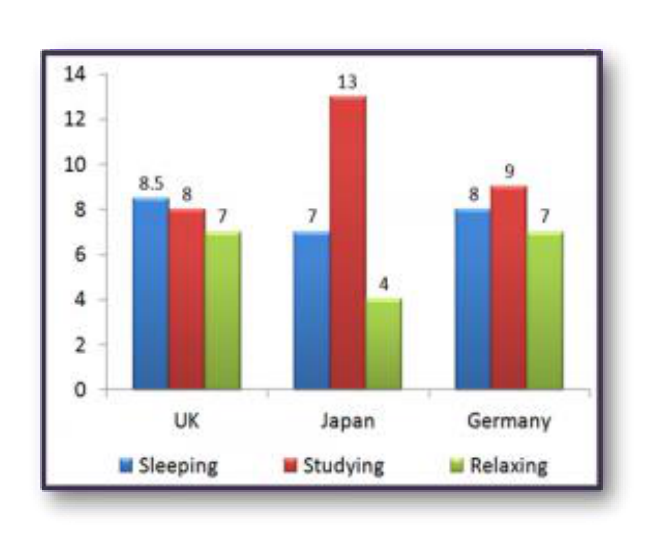
The bar chart shows the typical weekday for students in three different countries.
Summarise the information by selecting and reporting the main features, and make comparisons where relevant.
Student answer (Band 6.0)
The bar chart compares weekdays routine of ( Sleeping, studying and relaxing) for students in three countries, namely UK, Japan and Germany,
Overall, students spend more time on studying in Japan, followed by Germany and UK. In contrast, students give less time for relaxing acitivities across the given countries, while sleeping remain the second.
Students give adequate time to studying across the given countries. In Japan, students spend average of 13 hours on studying, followed by Germany nine hours, whereas in the UK students spend least amount of time on sleep, which making a total of 8 hours. In contrast, students have probably less time for relaxing. In the UK and Germany, pupils spend equal amount of time to relax thierselves, an average of 7 hours, while in Japan, students have hectic routine, which spending the lowest time on relaxing ( four hours).
Regarding sleep, it remains relatively in the middile among mentioned categories. In the UK, average amount of sleep recored is 8.5 hours, followed by Germany and Japan, 8 and 7 hours, respectively.
AI examiner evaluation
| Criterion | Band |
|---|---|
| Task Achievement / Task Response | 6.0 |
| Coherence and Cohesion | 6.0 |
| Lexical Resource | 6.0 |
| Grammatical Range and Accuracy | 5.5 |
| Overall | 6.0 |
Task Achievement / Task Response: Band 6.0
You identify the main pattern accurately: Japan has the highest study figure, while its relaxation figure is the lowest, and you report the sleep values correctly. The overview also attempts to compare all three activities. However, some details are unclear or misreported: the UK’s eight hours refers to studying, not sleeping, and the statement that students “give less time for relaxing” is too broad because relaxation is seven hours in both the UK and Germany. The claim that studying receives “adequate time” does not add a clear comparison. To strengthen the response, select the most notable contrasts and state each country’s figures and activity accurately, especially when comparing the three categories.
Coherence and Cohesion: Band 6.0
The response has a clear overall structure: an introduction, an overview, and separate discussion of studying/relaxing and sleeping. This makes the information reasonably easy to follow, and transitions such as “In contrast” and “Regarding sleep” help signal shifts. However, some links are mechanical or do not express the relationship precisely. For example, “In contrast” introduces relaxation, but the comparison is not consistently clear, and the overview’s “while sleeping remain the second” is difficult to interpret. The studying paragraph also moves between activities and countries in a way that contributes to the UK figure being assigned to sleep. Grouping the figures more consistently by activity, and using clearer references, would improve progression.
Lexical Resource: Band 6.0
You use an adequate range of task-related vocabulary, including “compares,” “followed by,” “relatively,” and “respectively,” and the meaning is generally understandable. There are also attempts at more descriptive language, such as “hectic routine,” although this is not a precise or objective way to describe the chart. Some word choices and collocations are awkward: “give adequate time to studying,” “time to relax thierselves,” and “the middile among mentioned categories” do not sound natural in this context. Spelling errors such as “acitivities,” “thierselves,” and “recored” also reduce accuracy. Prefer neutral reporting language and standard collocations, for example, “spend time studying” and “the lowest figure for relaxation.”
Grammatical Range and Accuracy: Band 5.5
You attempt both simple and more complex sentence forms, including comparisons with “whereas” and clauses introduced by “while.” Most of the intended meaning can be understood, but some grammatical errors remain. The opening sentence is incomplete as punctuated, and “students spend average of 13 hours” needs an article. In “which making a total of 8 hours,” the verb form is incorrect; similarly, “which spending the lowest time” needs a finite verb or a different clause structure. There are also agreement and sentence-construction problems in “sleeping remain the second.” Review articles, subject–verb agreement, and the structure of relative clauses, then proofread punctuation and sentence boundaries.
See this exact question answered at other band scores. The same prompt compared across bands.
Browse more IELTS Writing model answers or get your own writing scored by the same AI examiner.