Band 5.0 IELTS Writing Task 1 Model Answer
Overall Band Score: 5.0 · IELTS Academic Practice Accelerator · 2026-11-22
IELTS Writing Task 1 question
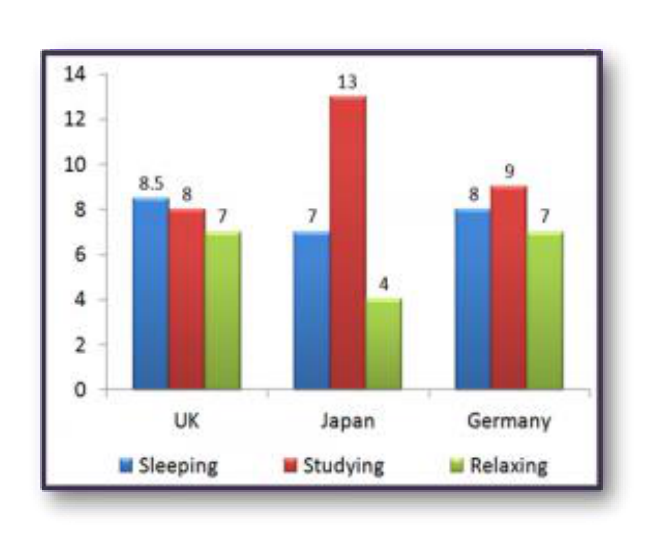
The bar chart shows the typical weekday for students in three different countries.
Summarise the information by selecting and reporting the main features, and make comparisons where relevant.
Student answer (Band 5.0)
the bar chart despite the students routine in three different regions during weak days
overall, the highest study time is in japan and the lowest in uk and students in in uk or germeny use similer time for sleeping or relaxing in the japan student use less hours for freshment.
the study hours in uk is 8 or in germeny 9 but in japan is much higher about 13 hour per day and the relaxing hours in japan is lower than germeny is about 7 same in uk . the students of japan use 7 hour for sleep but less than others in uk students take higer bed rest round about 8.5 hours and in the germeny the students only use a half hour less than uk is 8 so the routine of japan is harder than others because student serve 13 hours for thier studies
AI examiner evaluation
| Criterion | Band |
|---|---|
| Task Achievement / Task Response | 5.5 |
| Coherence and Cohesion | 5.0 |
| Lexical Resource | 5.0 |
| Grammatical Range and Accuracy | 5.0 |
| Overall | 5.0 |
Task Achievement / Task Response: Band 5.5
You identify the main contrast accurately: Japan has the most study time (13 hours), while the UK has the least (8), and you note that Japanese students spend less time relaxing. Most reported figures also match the chart. However, the overview is unclear and includes an unsupported conclusion that Japan’s routine is “harder”; the chart shows time allocations, not how demanding students find their day. The comparison that UK and German students spend similar time relaxing is relevant, but the response does not clearly summarise the overall pattern across all three activities. The response is also four words below the 150-word minimum. Add a concise, accurate overview and develop the comparisons without interpreting the data beyond what it shows.
Coherence and Cohesion: Band 5.0
There is an attempt to organise the response with an opening, an overview beginning “overall,” and further comparisons. The reader can follow the main points about study, sleep and relaxation, but progression is limited because the ideas are packed into a few long, loosely connected sentences. Linking words such as “but,” “and” and “because” do not always show the relationship between comparisons clearly, and the final explanation about Japan being harder shifts from reporting data to interpretation. Use distinct paragraphs for the overview and details, then group comparisons by activity or by country. Shorter sentences and clearer transitions would make the information easier to follow.
Lexical Resource: Band 5.0
You use some task-relevant vocabulary, including “study time,” “relaxing hours” and “sleep,” and attempt comparisons such as “much higher” and “lower than.” However, the range is limited and several word choices or spellings make the meaning less clear, including “weak days,” “freshment,” “bed rest” and “serve 13 hours.” “Routine” is also repeated without adding precision. Choose standard chart language such as “weekdays,” “leisure time,” “spend” and “hours of sleep,” and check spelling carefully, particularly “Germany,” “similar” and “their.” More precise vocabulary would help you describe the figures without awkward or ambiguous phrasing.
Grammatical Range and Accuracy: Band 5.0
The response attempts to combine ideas using clauses, for example, “the study hours in uk is 8 or in germeny 9,” but sentence structures are often faulty and punctuation is inconsistent. Errors in subject–verb agreement appear in “study hours … is” and “students … use,” while articles and plural forms are frequently missing or inconsistent. Several sentences run together, making relationships between clauses difficult to identify; the opening is also not a complete, clear sentence. Use simple, accurate sentence patterns first, such as “Students in the UK study for eight hours,” then add controlled comparisons with “whereas” or “while.” Check agreement, articles, and sentence boundaries before submitting.
See this exact question answered at other band scores. The same prompt compared across bands.
Browse more IELTS Writing model answers or get your own writing scored by the same AI examiner.