Band 6.0 IELTS Writing Task 1 Model Answer
Overall Band Score: 6.0 · IELTS Academic Practice Accelerator · 2026-11-10
IELTS Writing Task 1 question
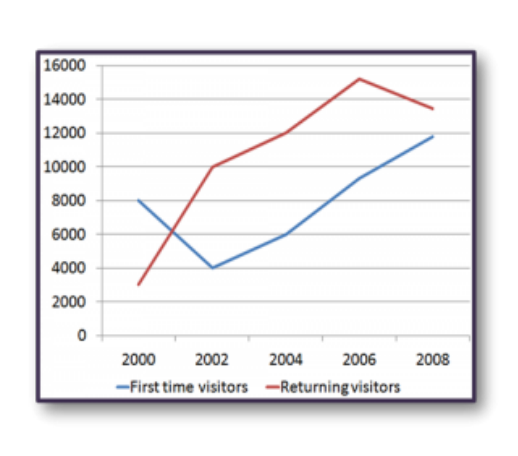
The line graph shows the number of first time visitors and returning visitors who visited Caryl Island from 2000 to 2008.
Summarise the information by selecting and reporting the main features, and make comparisons where relevant.
The line graph shows the number of first time visitors and returning visitors who visited Caryl Island from 2000 to 2008.
Student answer (Band 6.0)
The line graph demonstrate the number of people who visit for the first time and returning visitors to Caryl Island over the period 2000 to 2008.
Overall, The number of repeator visitors grew rapidly over the period, while number people who were visiting for the first time were declining at start then gradualy increased.
On the one hand, First time visitors to caryl isand were recorded 8000 in the year 2000,which dropped to almost 4000 in the next 2 years, which then grew rapidly to 10000 in 2008.
On the other hand, number of returning visitors to the Island started from 2500 in the year 2000 rising to 4 times in just 2 years reaching to 10000, and then reaching to 14500 in 2006, while slightly dropping to 13500 in 2008.
By looking at the graph it is clear that people who visit one time caryl island were travelling again as compare to first time visitors.
AI examiner evaluation
| Criterion | Band |
|---|---|
| Task Achievement / Task Response | 6.5 |
| Coherence and Cohesion | 6.5 |
| Lexical Resource | 5.5 |
| Grammatical Range and Accuracy | 5.5 |
| Overall | 6.0 |
Task Achievement / Task Response: Band 6.5
You identify the two visitor groups and give a relevant overview: returning visitors rose overall, while first-time visitors fell initially and then increased. The account also includes several key figures, such as 8,000 first-time visitors in 2000 and 10,000 returning visitors in 2002. However, some details are inaccurate or unclear: first-time visitors reached about 11,800 in 2008, not 10,000, and returning visitors peaked at about 15,200 in 2006, rather than 14,500. The final claim that visitors were “travelling again” is an unsupported interpretation; the graph shows visitor numbers, not whether individuals returned. The main trends are covered, but more precise reporting and a clearer distinction between the series would strengthen the response.
Coherence and Cohesion: Band 6.5
The response has a recognisable structure, moving from an introduction to an overview and then separate descriptions of the two visitor groups. “Overall” and “On the one hand / On the other hand” help signal these stages, and the main trends are generally easy to follow. However, the contrastive phrases are somewhat mechanical, and the final sentence introduces an inference that does not follow clearly from the data. Some sentences also carry several stages of change at once, making the comparisons less precise. For example, the first-time visitor sentence combines the initial fall and later rise but gives an incorrect endpoint. Grouping the figures by year or describing each series’ turning points more directly would create smoother progression and clearer links between details.
Lexical Resource: Band 5.5
You use relevant task vocabulary, including “number,” “visitors,” “dropped,” “rising,” and “slightly dropping,” so the general meaning is usually understandable. However, the range and control are limited, with noticeable spelling and word-choice problems: “repeator,” “gradualy,” and “caryl isand” are inaccurate, while “rising to 4 times” and “people who visit one time” are unnatural expressions. Repetition of “visitors” and “number” also limits flexibility. Aim for accurate, conventional trend language such as “increased fourfold,” “first-time visitors,” and “rose steadily.” More precise vocabulary would help distinguish a rise, a peak, and a subsequent decline without relying on awkward phrasing.
Grammatical Range and Accuracy: Band 5.5
There is an attempt to use both simple statements and longer clauses, as in “which dropped …, which then grew,” and the overall meaning can generally be understood. However, grammatical control is uneven. The opening has subject–verb disagreement (“graph demonstrate”), and the overview omits articles in “while number people.” Several sentence patterns are incomplete or awkwardly joined, particularly “started from 2500 … rising to 4 times … reaching to 10000.” Capitalisation and punctuation are also inconsistent, including “Overall, The” and missing spaces after commas. These errors sometimes make relationships between events harder to follow. Practise accurate subject–verb agreement, articles, and complete comparative clauses, while checking sentence boundaries and punctuation.
See this exact question answered at other band scores. The same prompt compared across bands.
Browse more IELTS Writing model answers or get your own writing scored by the same AI examiner.