Band 6.0 IELTS Writing Task 1 Model Answer
Overall Band Score: 6.0 · IELTS Academic Practice Accelerator · 2026-11-10
IELTS Writing Task 1 question
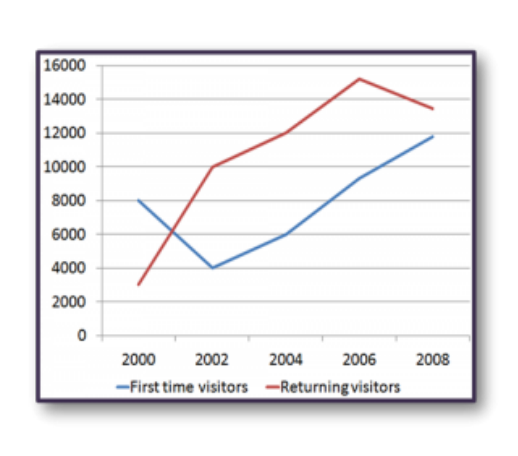
The line graph shows the number of first time visitors and returning visitors who visited Caryl Island from 2000 to 2008.
Summarise the information by selecting and reporting the main features, and make comparisons where relevant.
The line graph shows the number of first time visitors and returning visitors who visited Caryl Island from 2000 to 2008.
Student answer (Band 6.0)
The line graph shows the amount of visitors who are visiting for the first time Caryl island and then the amount of visitors who return to island from the eight years.
Overall, the amount of returning visitors experienced a substantial increase, reaching a peak in 2006 before declining slightly. In contrast, first time visitors initially decrease then recovered and followed the upward trend.
Regarding returning visitors, the figure started at approximately 3000 in 2000.It then increased dramatically to around 10,500 in 2002, followed by a further rise to 13,000 in 2004. The number reached its peaked 16,000 in 2006 before declining slightly to 15,000 in 2008.
In comparision the first time visitors starts from 8000 in 2000. Then it fell down to 4000 in 2002. After then it follows the upward trend reaching to 6000 in 2004 to 9000 in 2006.Reaching the highest number in 2008 which is 11,000 visitors.
AI examiner evaluation
| Criterion | Band |
|---|---|
| Task Achievement / Task Response | 6.5 |
| Coherence and Cohesion | 6.5 |
| Lexical Resource | 5.5 |
| Grammatical Range and Accuracy | 5.5 |
| Overall | 6.0 |
Task Achievement / Task Response: Band 6.5
You identify the main contrast accurately: returning visitors rose to a high point in 2006 and then fell, while first-time visitors dropped early before recovering. The overview is relevant, and the response reports the key stages for both groups. Most figures are close to the graph, although the returning-visitor values are generally overstated—for example, the graph shows about 12,000 in 2004 and 15,200 in 2006, rather than 13,000 and 16,000; the 2008 figure is about 13,400, not 15,000. The first-time figures are also approximate but broadly reflect the pattern. This covers the task, though more precise reporting and a clearer comparison of the groups at the end would strengthen it further.
Coherence and Cohesion: Band 6.5
The response has a clear overall structure: an introduction, an overview, and separate paragraphs describing each visitor group. This makes the main trends easy to follow, and sequencing expressions such as “In 2000,” “Then,” and “before” help show changes over time. However, some linking is mechanical or awkward, particularly “In comparision” and the repeated “Then” and “After then.” The final first-time visitor detail is also attached as a fragment (“Reaching the highest number…”), which interrupts the progression. Use a wider range of natural transitions and connect each data point in complete sentences. A brief direct comparison between the two groups would also make the organisation more integrated.
Lexical Resource: Band 5.5
You use relevant vocabulary for describing trends, including “substantial increase,” “peak,” “declining,” and “upward trend,” so the reader can understand the main movements. However, the range and control are uneven. Some phrases are unnatural or imprecise, such as “the amount of visitors,” “return to island,” and “fell down”; “amount” is also less suitable for countable people than “number.” There are noticeable spelling and word-form errors, including “comparision” and “peaked” in “reached its peaked.” These do not prevent understanding, but they limit precision and naturalness. Aim for accurate collocations and consistent terms such as “first-time visitors” and “returning visitors.”
Grammatical Range and Accuracy: Band 5.5
You attempt both simple and more developed sentence forms, and the overview uses a useful contrast structure: “In contrast, first time visitors initially decrease then recovered.” However, tense control is inconsistent when describing past data: “starts,” “decrease,” and “follows” should be in the past tense. There are also errors in sentence construction and punctuation, such as “The number reached its peaked” and the fragment “Reaching the highest number in 2008.” Missing spaces after full stops and inconsistent sentence boundaries further reduce accuracy. These errors sometimes make the writing less smooth, although the intended meaning is generally clear. Check past-tense consistency and ensure each sentence has a complete main clause.
See this exact question answered at other band scores. The same prompt compared across bands.
Browse more IELTS Writing model answers or get your own writing scored by the same AI examiner.