Band 5.0 IELTS Writing Task 1 Model Answer
Overall Band Score: 5.0 · IELTS Academic Practice Accelerator · 2026-11-17
IELTS Writing Task 1 question
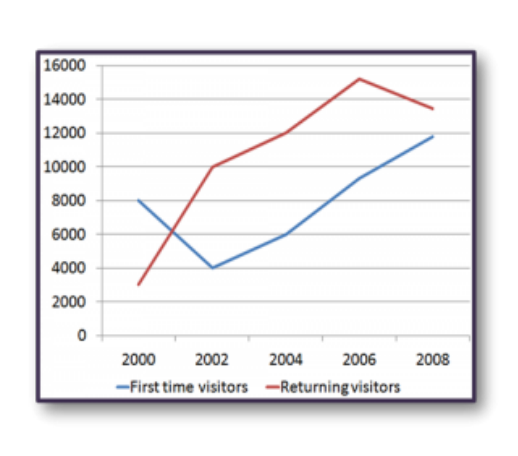
The line graph shows the number of first time visitors and returning visitors who visited Caryl Island from 2000 to 2008.
Summarise the information by selecting and reporting the main features, and make comparisons where relevant.
The line graph shows the number of first time visitors and returning visitors who visited Caryl Island from 2000 to 2008.
Student answer (Band 5.0)
The line graph illustrates the number of first time of visitors and returing visitors who visited Caryl island from 2000 to 2008.
Overall, it is clear that in graph returning visitors higher then pepple who visit first time caryl island
from 2000 to 2008.
In the era 2000 the visitor who visit first time Caryl island is 8000 people while other side return visitor is above 2000 but in 2002 the first time visitor decrease and total people is 4000 on the othside people who was return visitor in increase and the total people is 10,000. but in 2006 the return visitors increase repdily and total people who re visit the Caryl island is above 14,000 on the otherside the first time visitor who visit first time is 10,000 but in 2008 the returing visitor total population is below the 14,000 and the otherside the peple who visit first time is total population is above the 11,000.
conclusion is people who visit first time is less then who re visit caryl island in 20
AI examiner evaluation
| Criterion | Band |
|---|---|
| Task Achievement / Task Response | 5.5 |
| Coherence and Cohesion | 5.0 |
| Lexical Resource | 5.0 |
| Grammatical Range and Accuracy | 5.0 |
| Overall | 5.0 |
Task Achievement / Task Response: Band 5.5
You identify both visitor groups and report several key figures, including first-time visitors at 8,000 in 2000 and 4,000 in 2002, and returning visitors at 10,000 in 2002. You also capture the broad rise in returning visitors to a peak around 2006, followed by a decline. However, the overview that returning visitors were higher throughout is inaccurate: first-time visitors outnumbered returnees in 2000. Some figures are vague or misreported; for example, first-time visitors were about 9,300 in 2006, not 10,000, and returning visitors were about 13,400 in 2008. The final conclusion is incomplete, and the account omits the 2004 figures. A more accurate overview and clearer coverage of the main changes would strengthen the response.
Coherence and Cohesion: Band 5.0
The response has a basic structure, with an introduction, an overview, a body paragraph and a concluding sentence. The reader can follow the general comparison between the two visitor groups, and time references such as “in 2002” and “in 2006” provide some sequence. However, most of the data is crowded into one long body paragraph, and the repeated pattern “on the other side” does not clearly signal comparisons. The sentence beginning “In the era 2000” runs through several years and ideas with limited punctuation, making the progression difficult to follow. The conclusion, “in 20,” is unfinished. Grouping the early figures separately from later trends and using clear linking phrases would improve organisation and cohesion.
Lexical Resource: Band 5.0
You use some relevant task vocabulary, including “first time visitors,” “returning visitors,” “decrease,” and “increase,” so the topic remains recognisable. However, the range is limited and several expressions are repeated or imprecise, such as “people who visit first time” and “total people.” Some word choices and collocations make the description awkward, including “in the era 2000,” “increase rapidly,” and “total population” for visitor numbers. Spelling errors such as “returing,” “pepple,” and “repdily” are noticeable and can slow the reader. Aim for concise, accurate trend language and vary the terms for the two groups; for example, use “first-time visitors,” “rose,” “fell,” and “visitor numbers.”
Grammatical Range and Accuracy: Band 5.0
The response attempts longer sentences and uses time clauses, but complex structures are often difficult to control. Errors in sentence formation and agreement appear in phrases such as “returning visitors higher then” and “the first time visitor decrease,” while “people who was return visitor” has an incorrect verb form. Articles and plural forms are also inconsistent, as in “the visitor who visit first time” and “the returing visitor total population.” The long sentence beginning “In the era 2000” joins several clauses with limited punctuation, and the final sentence is incomplete. These frequent errors sometimes make relationships between ideas unclear. Practise writing shorter, complete sentences with consistent past-tense verbs, then combine related information using accurate conjunctions.
See this exact question answered at other band scores. The same prompt compared across bands.
Browse more IELTS Writing model answers or get your own writing scored by the same AI examiner.