Band 6.0 IELTS Writing Task 1 Model Answer
Overall Band Score: 6.0 · IELTS Academic Practice Accelerator · 2026-11-18
IELTS Writing Task 1 question
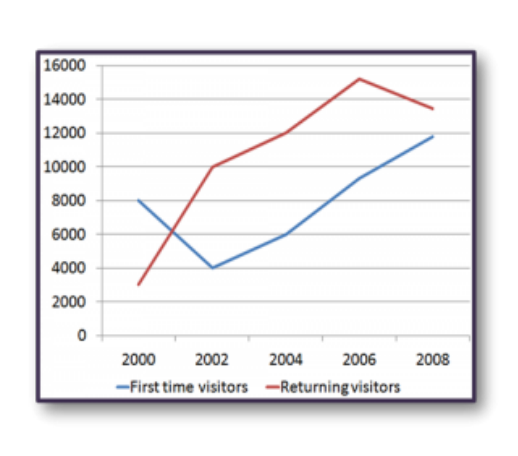
The line graph shows the number of first time visitors and returning visitors who visited Caryl Island from 2000 to 2008.
Summarise the information by selecting and reporting the main features, and make comparisons where relevant.
The line graph shows the number of first time visitors and returning visitors who visited Caryl Island from 2000 to 2008.
Student answer (Band 6.0)
The line graph shows the data about the number of visitors visiting Caryl Island for the first time and numbers of repeated visitors from 2000 to 2008.
Overall, Visitors were consistently repeated, making 2006 as the most visited year whereas 2002 saw the lowest number of first time visitors.
Regarding the data about first time visitors, in 2000 there were 8000 new visitors which later on fell to 4000 which was the lowest number of visitors. Then the trend increases and the graph consistently rises .In 2004 there were 8000 new visitor which further increased to approximately 10500. The number of visitors peaked at around 12,000 in 2008.
Analysing the number of repeated visitors in 2006, around 15000 visitors repeatedly visited Island making it the highest figure meanwhile only around 3000 visitors repeated in 2000. In 2002 and 2004 there were 10000 and 12000 repeated visitors. In 2008, around 13000 old visitors repeatedly visited Island.
AI examiner evaluation
| Criterion | Band |
|---|---|
| Task Achievement / Task Response | 6.0 |
| Coherence and Cohesion | 6.5 |
| Lexical Resource | 6.0 |
| Grammatical Range and Accuracy | 5.5 |
| Overall | 6.0 |
Task Achievement / Task Response: Band 6.0
You cover both visitor groups and identify several important movements, including the low for first-time visitors in 2002 and the peak for returning visitors in 2006. However, the overview is unclear: “Visitors were consistently repeated” does not accurately summarise the overall pattern, and saying 2006 was “the most visited year” overlooks that returning visitors peaked then while first-time visitors continued rising to 2008. There are also notable data inaccuracies: first-time visitors were about 6,000 in 2004, not 8,000, and about 9,300 in 2006, not 10,500; their peak was around 11,800 in 2008. The returning-visitor figures are broadly accurate. A clearer overview and more precise reporting of the first-time series would make the account more complete.
Coherence and Cohesion: Band 6.5
The response has a coherent overall arrangement: an introduction and overview are followed by separate paragraphs for first-time and returning visitors. This makes the two series easy to locate, and sequencing words such as “Then,” “In 2004,” and “In 2008” help show chronology. The organisation is not fully smooth, however. The overview’s “making 2006 as the most visited year” is difficult to interpret, and the first-time paragraph shifts between a general trend and individual figures without consistently clear links. “Meanwhile” also joins the 2006 and 2000 comparison awkwardly. To strengthen progression, state the main contrast in the overview, then describe each series in chronological order using clear comparisons and references.
Lexical Resource: Band 6.0
You use an adequate range of task-related vocabulary, including “first time visitors,” “repeated visitors,” “fell,” “increased,” and “peaked.” These choices generally communicate the trends, and terms such as “approximately” help signal estimates. Some wording is repetitive or imprecise: “visitors visiting,” “new visitors,” and “old visitors” refer to the same categories in different ways, while “Visitors were consistently repeated” is not a natural description of the data. “Repeatedly visited Island” is also an awkward collocation. Use consistent labels such as “first-time visitors” and “returning visitors,” and choose precise trend language such as “rose steadily” or “reached a high.” This would improve clarity and control without requiring unnecessarily complex vocabulary.
Grammatical Range and Accuracy: Band 5.5
You attempt a mix of simple and more complex forms, including the relative clause in “which was the lowest number of visitors” and the comparison introduced by “whereas.” Most sentences remain understandable, but some grammatical errors and punctuation problems are noticeable. For example, “making 2006 as the most visited year” has an incorrect construction; write “making 2006 the year with the highest number of visitors.” In “In 2004 there were 8000 new visitor,” the singular noun does not agree with the quantity, and “visited Island” needs an article. There is also an unnecessary space before the full stop in “rises .” Review articles, plural forms, and sentence boundaries, while continuing to use varied sentence structures.
See this exact question answered at other band scores. The same prompt compared across bands.
Browse more IELTS Writing model answers or get your own writing scored by the same AI examiner.