Band 6.0 IELTS Writing Task 1 Model Answer
Overall Band Score: 6.0 · IELTS Academic Practice Accelerator · 2026-11-24
IELTS Writing Task 1 question
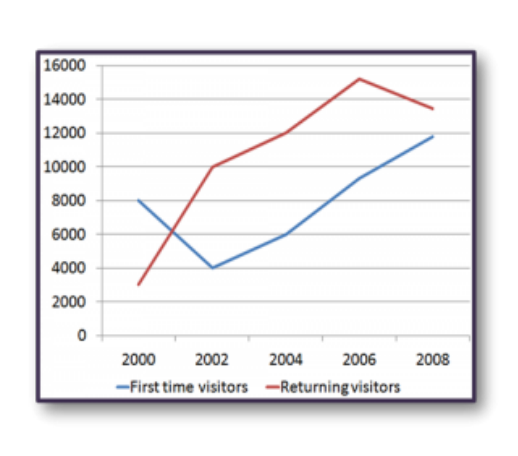
The line graph shows the number of first time visitors and returning visitors who visited Caryl Island from 2000 to 2008.
Summarise the information by selecting and reporting the main features, and make comparisons where relevant.
The line graph shows the number of first time visitors and returning visitors who visited Caryl Island from 2000 to 2008.
Student answer (Band 6.0)
The line graph illustrates the ratio of visitors who visted Caryl Island first time and those who returned to visit Caryl Island between 2000 to 2008.
Overall, the ratio of visitors who visited Caryl Island for the first time in 2000 was higher than than returning visitors. But in 2002, the ratio of first time visitors took dip and the amount of reurning visitors increaded substantially. And over the period of years the amount of both visitors kept increasing: returning visitors took lead.
First of all, in 2000 approximately 3000 returning visitors and 8000 first time visitors visited Caryl Island and then an inverse trend has been observed in 2002 when returning visitors with the ratio of 10,000 visited Carlyn Islanad and the the ratio of first time visitors dropped to 4000 only. But with each passing year the ratio of both types of visitors kept increasing gradually. And in 2008, a dip from 14000 returning visitors in 2006 to 13000 returning visitors was observed. And returning visitors ratio was higher in comparison to first time visitors after 2000.
AI examiner evaluation
| Criterion | Band |
|---|---|
| Task Achievement / Task Response | 6.0 |
| Coherence and Cohesion | 6.0 |
| Lexical Resource | 5.5 |
| Grammatical Range and Accuracy | 5.5 |
| Overall | 6.0 |
Task Achievement / Task Response: Band 6.0
The response identifies the main contrast and several key movements: first-time visitors fell from about 8,000 to 4,000 by 2002, while returning visitors rose from 3,000 to 10,000, and returning visitors were generally higher thereafter. These are relevant features, and the overview gives the reader a broad picture. However, some details are incomplete or imprecise. The claim that both groups “kept increasing gradually” overlooks the first-time visitors’ initial fall and the returning visitors’ decline after their 2006 peak. The 2006 and 2008 figures are also understated or rounded, and the account does not clearly report the first-time visitors’ rise to about 11,800 by 2008. A more precise overview and fuller coverage of the later trends would strengthen the report.
Coherence and Cohesion: Band 6.0
The response has a clear overall arrangement, with an introduction, an overview and a detail paragraph. It also follows the timeline and uses linking expressions such as “Overall,” “First of all” and “in 2008,” so the reader can follow the main comparisons. However, cohesion is sometimes mechanical, particularly through repeated use of “And,” and some references are unclear: “the ratio” is used repeatedly where the figures represent numbers of visitors. The overview also combines several trends in a long sequence, making the distinction between the initial changes and the later pattern less clear. Organising the details into clearer comparisons—for example, the early crossover followed by the later movements—would improve progression and make the links between ideas more precise.
Lexical Resource: Band 5.5
The response uses a reasonable range of task-related vocabulary, including “inverse trend,” “dropped,” “increaded substantially” and “took lead,” and the intended meaning is generally understandable. However, several choices are inaccurate or unnatural for describing visitor numbers. “Ratio” is repeatedly used instead of “number” or “figure,” while “kept increasing gradually” does not accurately describe all the movements. There are also noticeable spelling errors, including “visted,” “reurning,” “increaded” and “Islanad,” which reduce the overall control of vocabulary. Aim for precise, natural collocations and check spelling carefully; this would make the description clearer and more appropriate to an academic report.
Grammatical Range and Accuracy: Band 5.5
The response attempts both simple and more complex sentence forms, including a contrast introduced by “when” and a time clause beginning “after 2000.” Most of the intended meaning remains clear, but some grammatical errors recur. For example, “between 2000 to 2008” uses an incorrect preposition pattern; write “between 2000 and 2008.” In “the ratio of visitors who visited … first time,” the article and sentence structure need attention, and “the the ratio” contains an unnecessary repeated article. The overview also has a long sequence of clauses joined by “But” and “And,” which makes punctuation and sentence boundaries less controlled. Practise accurate comparisons and use a mix of shorter sentences and well-punctuated complex sentences.
See this exact question answered at other band scores. The same prompt compared across bands.
Browse more IELTS Writing model answers or get your own writing scored by the same AI examiner.