Band 5.5 IELTS Writing Task 1 Model Answer
Overall Band Score: 5.5 · IELTS Academic Practice Accelerator · 2026-11-24
IELTS Writing Task 1 question
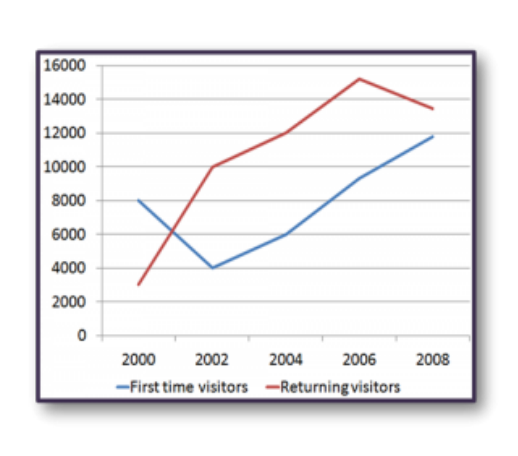
The line graph shows the number of first time visitors and returning visitors who visited Caryl Island from 2000 to 2008.
Summarise the information by selecting and reporting the main features, and make comparisons where relevant.
The line graph shows the number of first time visitors and returning visitors who visited Caryl Island from 2000 to 2008.
Student answer (Band 5.5)
The line graph illustrates the number of CaryI Island first time visitors and returning visitors from 2000 to 2008.
Overall,it is clear that the number of the two types of visitors flactuated between 2000 to 2008.In addition,the number of new visitors was initially higher than the returning visitors with 8000 visitors and around 3000 visitors , respectively.
Let's begin with the new visitors,their number declined until it reached the bottom in 2002 with only 4000 visitors.Nevertheless,the Island attracted more visitors after 2002.In fact the number rose from 4000 tourists to 12000 visitors ,we can assume that is a significant increase as the number of visitors tripled during just 6 years.
Moving on Returning visitors ,the number rose significantly until it became 10000 visitors ,then this huge number continiued at increasing but gradually until it reached it highest level in 2006 with approximately 15000 visitors .However, the number experienced a considerable fall as it became roughly 13500 visitors
To sum up, the nember of new tourists increased generally for both types.Moreover, 2001 is the only year that the two numbers of visitors are the same.
AI examiner evaluation
| Criterion | Band |
|---|---|
| Task Achievement / Task Response | 5.5 |
| Coherence and Cohesion | 6.0 |
| Lexical Resource | 5.5 |
| Grammatical Range and Accuracy | 5.5 |
| Overall | 5.5 |
Task Achievement / Task Response: Band 5.5
You identify both visitor groups and report several important movements, including the first-time visitors’ fall to 4,000 in 2002 and the returning visitors’ peak of about 15,000 in 2006. However, the overview is not fully accurate: it says both series fluctuated, although returning visitors rose steadily until 2006, and it does not clearly summarise their contrasting overall patterns. The claim that first-time visitors rose to 12,000 is also inaccurate; the graph shows about 11,800 in 2008. The final claim that the figures were equal in 2001 is unsupported: the graph gives data only for 2000, 2002, 2004, 2006 and 2008. These inaccuracies and the limited coverage of the first-time series keep the report from addressing the key features consistently.
Coherence and Cohesion: Band 6.0
The response has a recognisable structure: an introduction, an overview, separate paragraphs for the two series, and a concluding sentence. Sequencing is generally easy to follow, and phrases such as “Nevertheless” and “Moving on” signal transitions. However, some linking is mechanical or unclear, particularly “To sum up,” which introduces a conclusion that repeats and confuses earlier information rather than synthesising it. The overview and final paragraph also conflict: the overview says the series fluctuated, while the conclusion says both increased generally. Some sentences contain several ideas joined without clear punctuation, making the progression less smooth. Grouping the main trends more directly and using references such as “this figure” precisely would improve cohesion.
Lexical Resource: Band 5.5
You use a reasonable range of trend vocabulary, including “declined,” “rose significantly,” “highest level,” and “considerable fall,” which helps describe changes. There are also attempts at more descriptive phrasing, such as “the number of visitors tripled.” However, several spelling errors—“flactuated,” “continiued,” and “nember”—are noticeable, and some choices are inaccurate or awkward, including “the bottom” for a low point and “huge number” for a figure. Repetition of “number,” “visitors,” and “increased” also limits flexibility. Choose precise terms for peaks and lows, check spelling carefully, and vary expressions for visitor totals and changes to make the account more natural and exact.
Grammatical Range and Accuracy: Band 5.5
You attempt both simple and more complex sentences, for example, “In fact the number rose from 4000 tourists to 12000 visitors,” and the sentence beginning “as the number of visitors tripled.” The main meaning is usually understandable, but some grammatical and punctuation errors remain. Examples include “between 2000 to 2008” rather than “between 2000 and 2008,” “until it reached it highest level,” and the incomplete construction “Moving on Returning visitors.” Commas are often missing after introductory phrases, while spaces before commas and full stops are inconsistent. There is also a tense and structure problem in “this huge number continued at increasing.” Review articles, pronouns, prepositions, and sentence boundaries, while retaining attempts at complex structures.
See this exact question answered at other band scores. The same prompt compared across bands.
Browse more IELTS Writing model answers or get your own writing scored by the same AI examiner.