Band 5.5 IELTS Writing Task 1 Model Answer
Overall Band Score: 5.5 · IELTS Summit Mastery · 2026-11-07
IELTS Writing Task 1 question
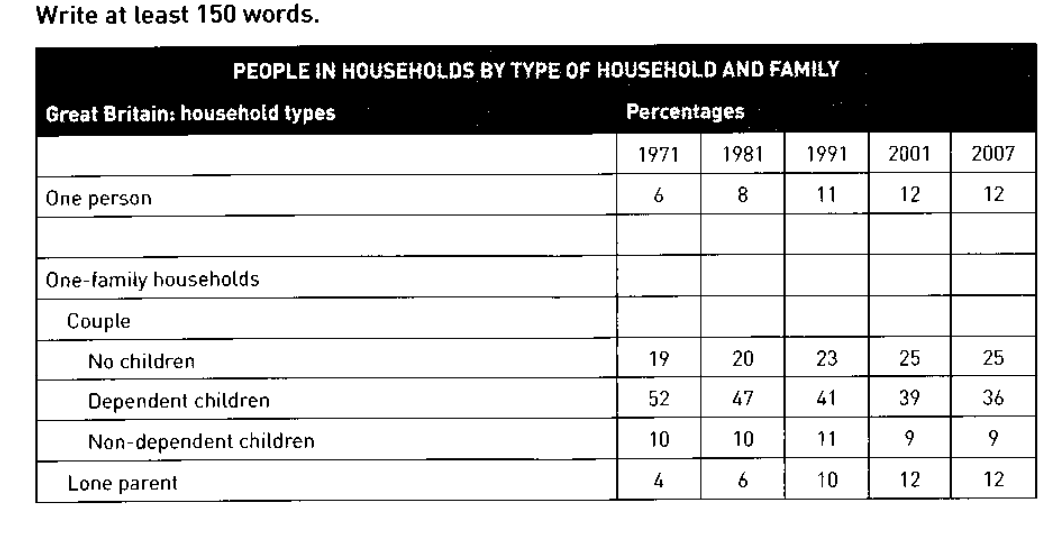
The table below shows the change in some household types in Great Britain from 1971 to 2007.
Summarise the information by selecting and reporting the main features, and make comparisons where relevant.
PEOPLE IN HOUSEHOLDS BY TYPE OF HOUSEHOLD AND FAMILY
Student answer (Band 5.5)
Table demonestrates percentages of different household types in Great Britain through time period of 1971 to 2007.
Overall, percentage of dependant children in Great Britain households is the highest in all years with a slight decrease as time passes .In contrast, lone parents are the least frequent from 1971 to 1991;whereas, in 2001 and 2007 its the non-dependant children.
Firlsty, percentage of Dependent children are the highest througout the whole period, but with minimal decrease each year so it goes from 52% in 1971 reaching to 36% in 2007.Furthermore, non-dependent children witnessed slight fluctuation around 10%. On the other hand, lone parent had a significant rise going from 4% up to 12%, along with the one person type also going from 6% to 12%.Lastly, the no children type got gradually increasing from 19% reaching to 25%.there is no much change found from 2001 up to 2007 witnessed.
AI examiner evaluation
| Criterion | Band |
|---|---|
| Task Achievement / Task Response | 5.5 |
| Coherence and Cohesion | 6.0 |
| Lexical Resource | 5.5 |
| Grammatical Range and Accuracy | 5.0 |
| Overall | 5.5 |
Task Achievement / Task Response: Band 5.5
You identify the main pattern: dependent-child households are the largest category and decline, while one-person and lone-parent households rise. Several figures are reported accurately, including the fall from 52% to 36% and the increase in lone-parent households from 4% to 12%. However, the overview misidentifies the least common category in 2001 and 2007: non-dependent children are at 9%, while one-person and lone-parent households are both at 12%. The final claim that there is “no much change” from 2001 to 2007 is also too broad, since dependent-child households fall by three percentage points. The response is three words below the required minimum. Include a more precise overview and develop comparisons across the years.
Coherence and Cohesion: Band 6.0
The response has a recognisable structure, with an introduction, an overview and a paragraph reporting details. Sequencing expressions such as “Overall,” “Furthermore” and “On the other hand” help signal relationships between points. However, progression is weakened by some mechanical or unclear linking: “Lastly” introduces the no-children category without a clear reason for its position, and “there is no much change found from 2001 up to 2007 witnessed” does not connect smoothly to the preceding comparison. The overview and detail paragraph also repeat that dependent children are the largest category. Use paragraphing to separate the main trends more clearly, and make each comparison lead logically to the next rather than listing categories.
Lexical Resource: Band 5.5
You use relevant vocabulary for describing data, including “percentages,” “slight fluctuation,” “significant rise” and “gradually increasing.” These choices show an attempt to vary your language beyond basic repetition. However, several noticeable spelling and word-choice errors reduce precision, such as “demonestrates,” “Firlsty,” “dependant” and “througout.” Some phrases are also unnatural or imprecise: “through time period” and “the no children type got gradually increasing.” Use standard chart language and check spelling carefully. For example, “over the period” is more natural than “through time period,” and “the proportion of couples with no children rose” is clearer than “the no children type got gradually increasing.”
Grammatical Range and Accuracy: Band 5.0
You attempt both simple and more complex sentence forms, including a contrast with “whereas” and a clause beginning “but with minimal decrease.” However, errors in sentence construction and punctuation are frequent enough to make some statements difficult to follow. For example, “percentage of Dependent children are the highest” has an article and agreement problem, while “going from 52% in 1971 reaching to 36% in 2007” lacks a well-formed verb pattern. The final sentence, “there is no much change found … witnessed,” is grammatically incomplete. Full stops and spaces are also missing in places. Practise accurate comparative structures, such as “the figure fell from … to …,” and proofread sentence boundaries.
See this exact question answered at other band scores. The same prompt compared across bands.
Browse more IELTS Writing model answers or get your own writing scored by the same AI examiner.