Band 5.0 IELTS Writing Task 1 Model Answer
Overall Band Score: 5.0 · IELTS Summit Mastery · 2026-11-08
IELTS Writing Task 1 question
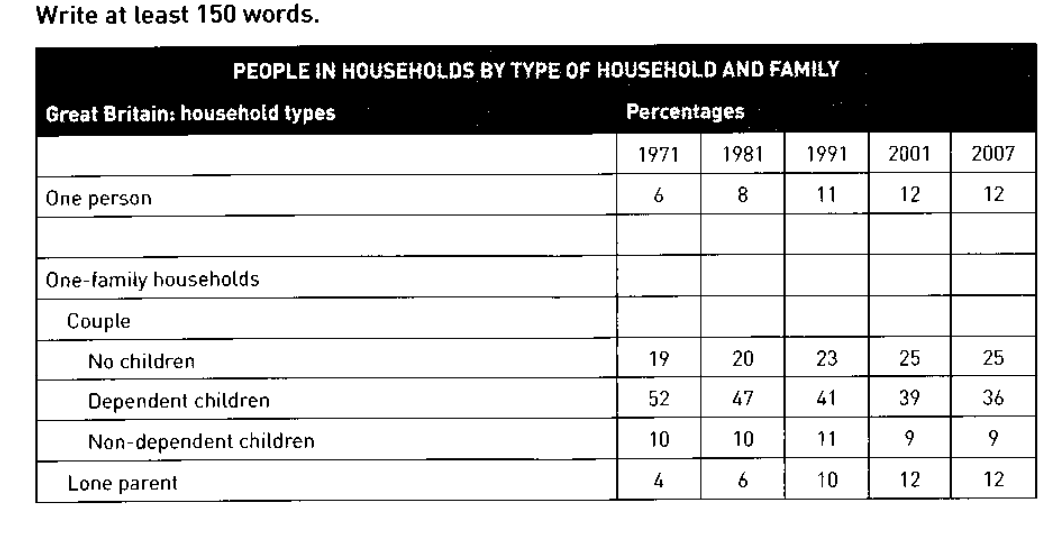
The table below shows the change in some household types in Great Britain from 1971 to 2007.
Summarise the information by selecting and reporting the main features, and make comparisons where relevant.
PEOPLE IN HOUSEHOLDS BY TYPE OF HOUSEHOLD AND FAMILY
Student answer (Band 5.0)
The table illustrates the household changes and types of households and family in Great Britain over the years 1971 to 2007. The data is measured in percantage.
Overall, There are three types of households in which the proportion of the dependent childerns are the highest and parents living alone is the lowest.
By looking at table we can say that individuals living alone was 6% in 1971, but in 2001 and 2007 it has been doubled. In 1981, parents who were living alone was about 6% whereas in the years 2001 and 2007 it was twice.
In family households, in 2971 the couples residencing without childerns was least with 19%.Moreover, living with the dependent childerns was quit high in the year 1972 witg the proportion of 52, which is the highets. However, in 2007 it has dropped significantly with 36%.While the couples living with non-dependent childerns are highest in the year 1991 with 11% and with the drop of 1% in the year 200
AI examiner evaluation
| Criterion | Band |
|---|---|
| Task Achievement / Task Response | 4.5 |
| Coherence and Cohesion | 5.0 |
| Lexical Resource | 5.5 |
| Grammatical Range and Accuracy | 5.0 |
| Overall | 5.0 |
Task Achievement / Task Response: Band 4.5
You identify several relevant patterns, including the rise in one-person households and the decline in households with dependent children. However, the overview is unclear and partly inaccurate: dependent children are the largest category, but lone-parent households—not “parents living alone”—are the smallest in 1971, while one-person households are also low. Several figures or dates are misreported: the table begins in 1971, not “2971” or “1972,” and the 2007 figure for non-dependent children is 9%, not a completed comparison in your final sentence. The response also leaves the last point unfinished and gives limited coverage of the full period. To improve, present a clear overview and select accurate start- and end-point comparisons for the main categories.
Coherence and Cohesion: Band 5.0
The response has a basic paragraph structure, moving from an introduction and overview to details about household categories. Linking expressions such as “Overall,” “Moreover,” and “However” show an attempt to guide the reader. Nevertheless, progression is difficult to follow because some comparisons are repeated or unclear, as in the two statements about people living alone and parents living alone. The final sentence stops at “in the year 200,” leaving the comparison incomplete, and the sequence of categories does not consistently help the reader understand the table. Group the figures into clear trends, use one paragraph for increases and another for decreases or family types, and ensure each sentence completes its point.
Lexical Resource: Band 5.5
You use some task-relevant vocabulary, including “proportion,” “dropped significantly,” “dependent children,” and “non-dependent children.” These terms show an attempt to describe data rather than simply list figures. However, inaccurate or repetitive wording sometimes obscures meaning: “parents who were living alone” does not clearly identify the lone-parent category, and “couples residencing without children” is an unnatural way to describe couples without children. There are also noticeable spelling errors, including “percantage,” “childerns,” “highets,” and “witg.” Aim for precise table terminology and check spelling carefully; a small set of accurate expressions such as “accounted for,” “rose to,” and “fell to” would make comparisons clearer.
Grammatical Range and Accuracy: Band 5.0
You attempt both simple statements and more complex comparisons, for example, “individuals living alone was 6% in 1971, but in 2001 and 2007 it has been doubled.” However, errors in agreement, tense, and sentence construction are frequent enough to make some relationships unclear. In that example, “individuals” requires “were,” and the past-time data calls for a consistent past-tense form such as “had doubled.” The overview’s “There are three types … in which” is also an awkwardly constructed sentence, while “in the year 2007 it has dropped” shifts tense unnecessarily. Punctuation is inconsistent, with missing spaces after full stops and commas. Practise accurate past-tense comparisons and check each sentence for a clear subject and verb.
See this exact question answered at other band scores. The same prompt compared across bands.
Browse more IELTS Writing model answers or get your own writing scored by the same AI examiner.