Band 5.5 IELTS Writing Task 1 Model Answer
Overall Band Score: 5.5 · IELTS Summit Mastery · 2026-11-08
IELTS Writing Task 1 question
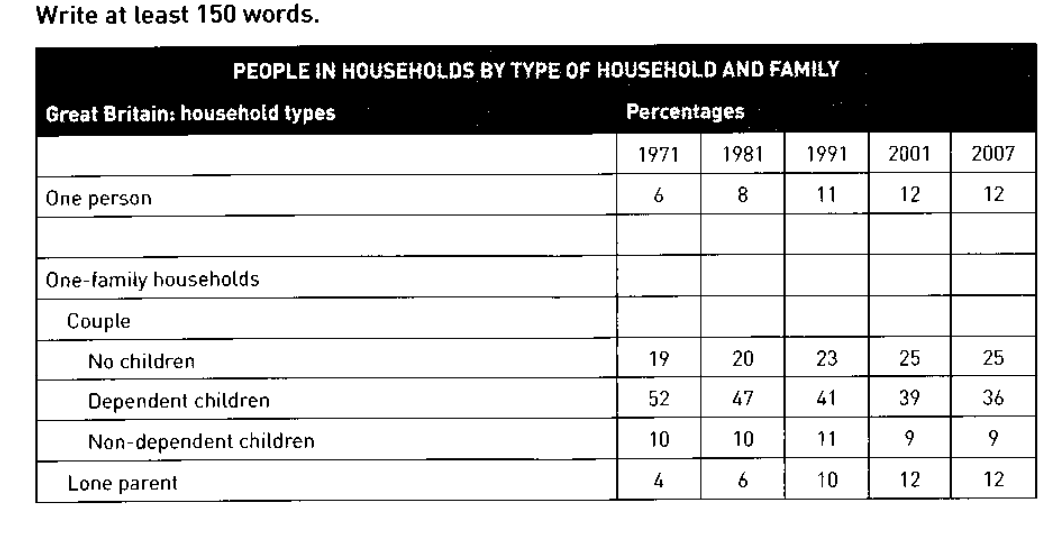
The table below shows the change in some household types in Great Britain from 1971 to 2007.
Summarise the information by selecting and reporting the main features, and make comparisons where relevant.
PEOPLE IN HOUSEHOLDS BY TYPE OF HOUSEHOLD AND FAMILY
Student answer (Band 5.5)
In this table, we see that in 1971 in Great Britain 6% of households were occupied by one person, while the majority of the households were dependent children, and only 4% are lone parent.
In 1981 and 1991, both the percentage of one persons households and lone parent raised up to 11% and 10% in order, while the dependent children went a bit down to 41% and couples with no children went up to 23%.
In 2001 and 2007 shows a bit of stability with a simple rise by 1% of one person households and 2% of lone couples, there was a significant decrease of couples with one child to 36% which was 41% in 1991, and a simple decrease too in the couples with non dependent children to a percentage of 9%
From this table we see that lone couples are in the way to be the majority of householders.
AI examiner evaluation
| Criterion | Band |
|---|---|
| Task Achievement / Task Response | 5.0 |
| Coherence and Cohesion | 6.0 |
| Lexical Resource | 5.5 |
| Grammatical Range and Accuracy | 5.5 |
| Overall | 5.5 |
Task Achievement / Task Response: Band 5.0
You identify several relevant trends, including the rise in one-person households and the fall in households with dependent children. However, the account only partially covers the table and its overview is inaccurate: “lone couples” are not a category, and lone-parent households did not become the majority; they reached 12%, equal to one-person households in 2007. Some figures are also misreported or unclear. For example, one-person households were 8% in 1981 and 11% in 1991, rather than rising to 11% across those years, while the 2001–2007 changes were not a rise of 1% for one-person households. A clearer overview should highlight the largest category’s decline and the growth in several smaller categories, supported by accurate comparisons.
Coherence and Cohesion: Band 6.0
The response has a generally understandable chronological order, moving from 1971 to the later years, and phrases such as “In 1981 and 1991” help signal the time sequence. The final sentence also attempts to provide an overall conclusion. However, the organisation is limited to a sequence of long sentences rather than clearly separated overview and detail. Some links between ideas are difficult to follow, particularly the sentence beginning “In 2001 and 2007 shows,” which combines several trends without clear boundaries. The reference to “lone couples” also makes the conclusion unclear. Grouping the main trends into a concise overview and two comparison paragraphs, and using clearer sentence divisions, would make progression more effective.
Lexical Resource: Band 5.5
You use some relevant vocabulary for describing data, including “percentage,” “significant decrease,” and “stability,” so the reader can recognise the general subject and trends. However, several word choices and collocations are inaccurate or imprecise, sometimes obscuring the meaning. “Lone couples” appears repeatedly, although the table refers to “lone parent” households, and “couples with one child” does not match the category “dependent children.” Phrases such as “in the way to be the majority of householders” are also unnatural and do not express the data accurately. Aim to use the table’s category labels consistently and choose standard trend language, such as “accounted for,” “increased,” and “declined.”
Grammatical Range and Accuracy: Band 5.5
The response attempts a mixture of simple and more complex sentences, including clauses linked with “while” and “which.” The main trends are usually understandable, but some grammatical errors affect clarity. For example, “In 2001 and 2007 shows” lacks a clear grammatical subject, and “both the percentage … raised up” has an incorrect structure and verb form. There are also problems with agreement and sentence construction in “there was a significant decrease … which was 41% in 1991,” where the comparison is awkwardly attached. Work on forming complete subjects and verbs, maintaining consistent past-tense reporting, and separating multiple comparisons into shorter sentences. More accurate control of these structures would make the data easier to interpret.
See this exact question answered at other band scores. The same prompt compared across bands.
Browse more IELTS Writing model answers or get your own writing scored by the same AI examiner.