Band 5.5 IELTS Writing Task 1 Model Answer
Overall Band Score: 5.5 · IELTS Summit Mastery · 2026-11-09
IELTS Writing Task 1 question
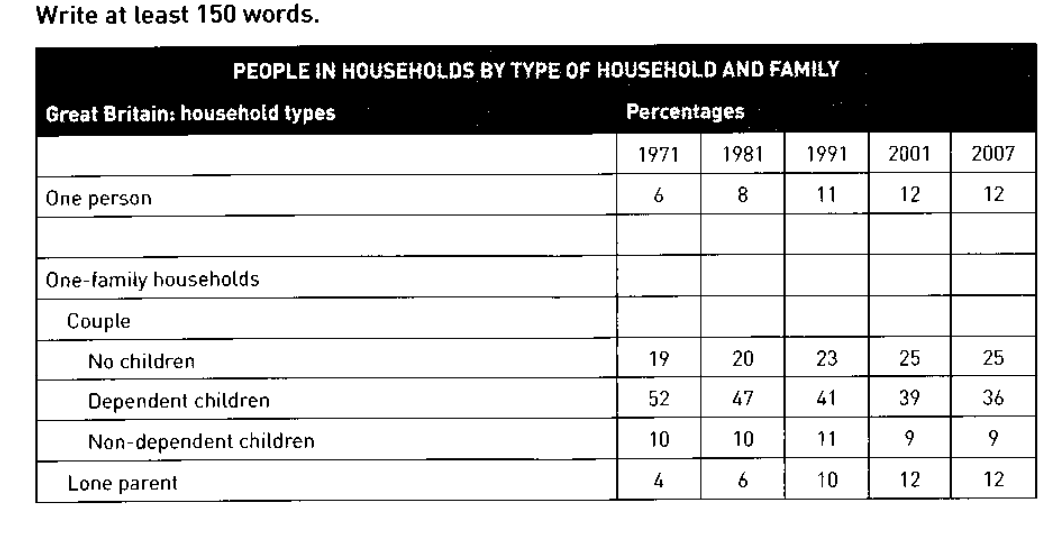
The table below shows the change in some household types in Great Britain from 1971 to 2007.
Summarise the information by selecting and reporting the main features, and make comparisons where relevant.
PEOPLE IN HOUSEHOLDS BY TYPE OF HOUSEHOLD AND FAMILY
Student answer (Band 5.5)
The table briefs changes in household in great britian between the year of 1971 to 2007.
Overall, the number of dependent children were highest in terms of household types holding the highest percentage in comparision with all, however the lone parent wre the lowest in comparision with one person having equal amount of percentage as lone parent.
The one person household having increased from 6 to 8% in both 1971 and 1981. However , one person and lone parent were running equal amount of percentage in the year 2001 and 2007. Dependent children having 52% percentage in 1971 but significantly decreased in year from 1981 to 2007.
Non-dependent children holding same 10 % in both 1971 and 1981. But, growned by 11% in 1991 however,It significantly increase by 12 % in both 2001 and 2007. The household with no children having 19% in 1971 . it significantly growned in 1981 and 1991 , Whereas , they were having equal percentage of 25% in both 2001 and 2007.
AI examiner evaluation
| Criterion | Band |
|---|---|
| Task Achievement / Task Response | 5.5 |
| Coherence and Cohesion | 5.5 |
| Lexical Resource | 5.0 |
| Grammatical Range and Accuracy | 5.0 |
| Overall | 5.5 |
Task Achievement / Task Response: Band 5.5
You identify several relevant trends, including the fall in households with dependent children and the rise in one-person and no-child households. The overview also recognises that dependent-child households were the largest category. However, some key details are inaccurate or unclear: lone-parent households were not the lowest in 1971–2007, and they did not have the same percentage as one-person households in 2001 and 2007 (both were 12% then, but lone parents began at 4%, compared with 6% for one-person households). You also report that non-dependent children reached 12% in 2001 and 2007, whereas the table shows 9%. Select the main trends accurately and compare categories across the period more clearly.
Coherence and Cohesion: Band 5.5
The response has an introduction, an overview and two detail paragraphs, so there is a recognisable overall structure. You also use time references to organise some comparisons. However, progression is uneven: the overview’s comparison of the lowest categories is confusing, and the first detail paragraph moves between one-person, lone-parent and dependent-child figures without a clear sequence. Linking words such as “However”, “But” and “Whereas” are repeated and sometimes do not express the relationship accurately. Group the categories by their main trends—for example, rising categories together and declining categories together—and use clear references to the years and figures so readers can follow each comparison.
Lexical Resource: Band 5.0
You use some task-relevant terms, including “percentage”, “dependent children” and “household”, and attempt to describe change with words such as “decreased” and “increase”. However, the range is limited and several word choices or collocations are inaccurate, making parts of the report difficult to interpret. Phrases such as “the table briefs changes”, “running equal amount of percentage” and “significantly growned” are not natural ways to describe statistical data. There are also spelling errors, including “britian”, “comparision” and “wre”. Use precise reporting language consistently, such as “the proportion rose”, “remained stable” and “fell to”, and check spelling and word forms before finishing.
Grammatical Range and Accuracy: Band 5.0
You attempt both simple and more complex sentences, including clauses introduced by “however” and “whereas”, but control is inconsistent. Errors in agreement and verb forms occur in examples such as “the number … were highest”, “one person household having increased” and “it significantly growned”. Articles and sentence boundaries are also problematic: “The household with no children having 19%” is not a complete sentence, while “it significantly growned in 1981 and 1991” begins with an unclear pronoun and lacks a correctly formed verb. These errors sometimes make the intended comparison hard to follow. Practise complete subject–verb sentences and accurate past-tense forms, then check punctuation and capitalisation.
See this exact question answered at other band scores. The same prompt compared across bands.
Browse more IELTS Writing model answers or get your own writing scored by the same AI examiner.