Band 6.0 IELTS Writing Task 1 Model Answer
Overall Band Score: 6.0 · IELTS Summit Mastery · 2026-11-09
IELTS Writing Task 1 question
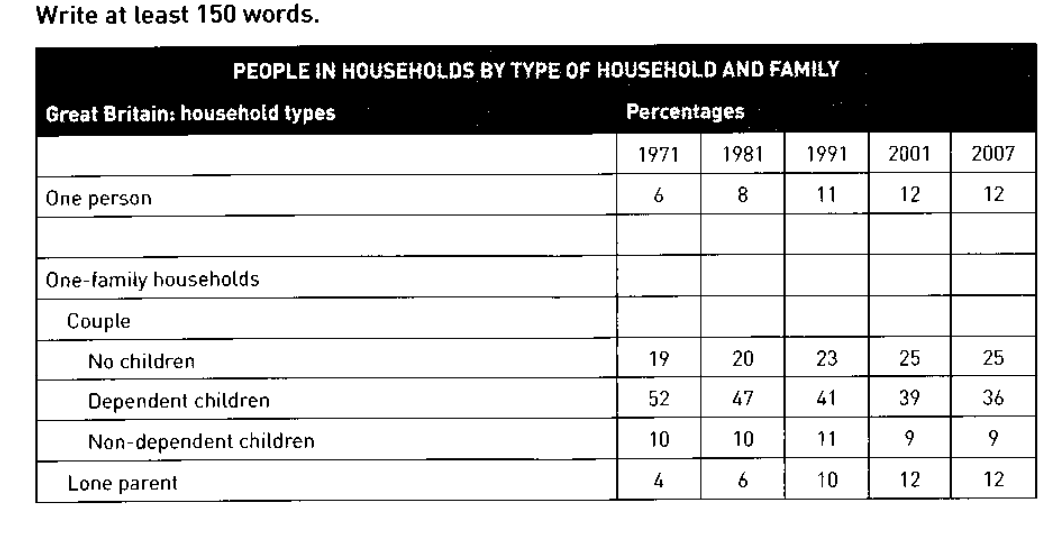
The table below shows the change in some household types in Great Britain from 1971 to 2007.
Summarise the information by selecting and reporting the main features, and make comparisons where relevant.
PEOPLE IN HOUSEHOLDS BY TYPE OF HOUSEHOLD AND FAMILY
Student answer (Band 6.0)
The table compares different categories of households of families in Great Britain over the five decades of period by percentages.
Overall, household for one person and lone parent shows increased significitally around similar percentages whereas one-family households with dependent children drops slightly over the years. A slight fluctuation can be seen in no children and non-dependent children category households.
One person household doubled over these five decades from 6% 1971 to 12% in 2007. Similarly lone parent household started with 4% and ended up at 12% in 2007. Furthermore dependent children household seems to have changes by approx 5% in each decade, starting from 52% in 1971 decreased to 47% in 1981 then 41%, 39% and 36% in the last three decades.
On the other hand, only few percentage of different can be seen in no children and non-dependent children household categories as they just flactuated by 1 or 2 percentage in each decade and but as seen no children catergory household remainded under 25% and non-dependent children household under 11% throughout the five decades.
AI examiner evaluation
| Criterion | Band |
|---|---|
| Task Achievement / Task Response | 7.0 |
| Coherence and Cohesion | 6.5 |
| Lexical Resource | 5.5 |
| Grammatical Range and Accuracy | 5.5 |
| Overall | 6.0 |
Task Achievement / Task Response: Band 7.0
You identify the main patterns and support them with accurate figures: the one-person share rises from 6% to 12%, lone-parent households from 4% to 12%, and households with dependent children fall from 52% to 36%. The overview also correctly notes that the other categories change less. This gives the response a clear, relevant account of the table. To make the key features more fully developed, compare the categories more explicitly—for example, dependent-children households remain the largest category despite their decline, while one-person and lone-parent households reach 12% by the end. The claim that dependent-child figures changed by “approx 5% in each decade” is a little broad, since the decreases vary, and the small fluctuations in the other categories could be described more precisely.
Coherence and Cohesion: Band 6.5
The response has a clear overall progression: an introduction, an overview, and then paragraphs covering the main trends and the smaller changes. Linking phrases such as “Overall,” “Similarly,” and “On the other hand” help signal how the information is organised. This is coherent, and the reader can follow the comparisons. However, some connections are mechanical or awkward, particularly “On the other hand” for categories that are not really in opposition, and “and but” in the final sentence. The final paragraph also combines several points in a long sentence, making the comparison less easy to follow. Use more precise links and separate the two minor-trend observations into clearer sentences.
Lexical Resource: Band 5.5
You use relevant vocabulary for describing data, including “doubled,” “fluctuation,” “categories,” and “decreased,” so the main trends are understandable. However, the range and control are limited by repeated use of “household” and several inaccurate or unnatural expressions. For example, “household for one person,” “changes by approx 5%,” and “only few percentage of different” do not express the intended comparisons naturally. There are also noticeable spelling errors, including “significitally,” “flactuated,” “catergory,” and “remainded.” Aim for accurate collocations such as “the proportion of one-person households” and “varied by a few percentage points,” and proofread spelling carefully.
Grammatical Range and Accuracy: Band 5.5
You attempt a mix of simple and more complex sentences, including a comparison with “whereas” and a time sequence introduced by “starting from.” The meaning is generally recoverable, but errors in sentence structure and grammatical forms occur often enough to reduce accuracy. Examples include “household … shows increased” and “dependent children household seems to have changes,” where the verb forms and agreement are faulty. In “from 6% 1971,” the year needs a preposition, and “as they just fluctuated … and but as seen” creates an incomplete, tangled construction. Practise forming clear subject–verb patterns and checking tense, articles, and prepositions; shorter sentences would help you control the grammar while retaining some complex structures.
See this exact question answered at other band scores. The same prompt compared across bands.
Browse more IELTS Writing model answers or get your own writing scored by the same AI examiner.