Band 6.0 IELTS Writing Task 1 Model Answer
Overall Band Score: 6.0 · IELTS Summit Mastery · 2026-11-09
IELTS Writing Task 1 question
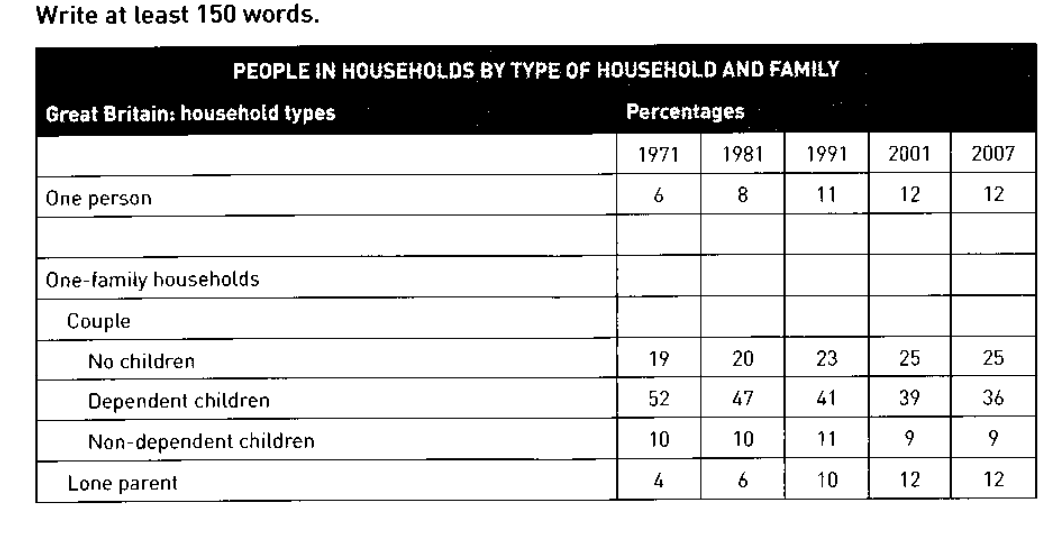
The table below shows the change in some household types in Great Britain from 1971 to 2007.
Summarise the information by selecting and reporting the main features, and make comparisons where relevant.
PEOPLE IN HOUSEHOLDS BY TYPE OF HOUSEHOLD AND FAMILY
Student answer (Band 6.0)
The table chart illustrates the change in some family types in one particular country namely- Great Britain between 1971 and 2007.
Overall, the percentage of lonely parents household shows significant increase whilst the percentage of dependent children experienced sharp decline over the 36 years of period.
The household of one person was only 6% in 1971 ,it shows slow increase during the years and became double in 2007. The percentage of no children accounted for 19% in 1971 and there was a steady increased and it represented 25 % in 2007. In 1971 , the percentage of lonely parents were only 4% whereas after 36 years, the number rose tree times and shows 12%.
Although, the percentage of dependent children household was 52% in 1971 . By the time the number was felling considerably and in 2007 , dependent household constitute 36% of percentage. The percentage of non independent children decreased slightly from 10% to 9% between 1971 during the period from 1971 to 2007.
AI examiner evaluation
| Criterion | Band |
|---|---|
| Task Achievement / Task Response | 6.5 |
| Coherence and Cohesion | 6.0 |
| Lexical Resource | 5.5 |
| Grammatical Range and Accuracy | 5.5 |
| Overall | 6.0 |
Task Achievement / Task Response: Band 6.5
You identify the main contrast accurately: the share of households with dependent children fell from 52% to 36%, while lone-parent households rose from 4% to 12%. You also report the one-person and childless-couple figures correctly, and the opening overview gives the reader a useful summary of the broad trends. This covers the task well, with some features more fully reported than others. However, the overview could capture the full pattern more clearly: one-person households and lone-parent households both reached 12% by 2001 and remained there in 2007, while childless couples rose to 25%. The final sentence about non-dependent children is difficult to interpret and does not clearly state that the figure peaked at 11% in 1991 before falling to 9%. More precise comparisons would strengthen the summary.
Coherence and Cohesion: Band 6.0
The response has a recognisable structure: an introduction, an overview, and paragraphs describing increases and decreases. This gives the information an overall progression, and contrast markers such as “Overall” and “Although” help signal relationships. However, the grouping is not always clear: the paragraph beginning “The household of one person” moves between one-person, childless-couple and lone-parent figures without a consistent organising principle. The final sentence is also repetitive and confusing, particularly “between 1971 during the period from 1971 to 2007.” Use clearer topic groupings—for example, rising household types together and declining types together—and make each sentence’s comparison explicit. This would make the cohesion less mechanical and the progression easier to follow.
Lexical Resource: Band 5.5
You use a reasonable range of vocabulary for describing trends, including “significant increase,” “sharp decline,” “steady increased,” and “decreased slightly.” These choices show an attempt to vary the language rather than repeat “rose” and “fell.” However, several word choices or forms are inaccurate and sometimes make the meaning less clear. “Lonely parents” is not the appropriate term for the household category, and “non independent children” changes the meaning of “non-dependent children.” “The number rose tree times” also uses an incorrect word and an imprecise expression. Aim for accurate category labels and natural collocations such as “the proportion of lone-parent households increased threefold.” Check spelling and word forms, and prefer precise terms over unusual or approximate phrasing.
Grammatical Range and Accuracy: Band 5.5
You attempt both simple and more complex sentence forms, including a contrast clause beginning “Although” and a time clause with “whilst.” The main trends are generally understandable, but some grammatical errors remain across the response. For example, “the percentage … shows significant increase” needs an article and consistent tense, while “there was a steady increased” uses the wrong form after “a.” The sentence beginning “Although” is not completed as a subordinate clause, and several sentences have awkward punctuation or spacing around commas. There are also inconsistencies in singular and plural forms, as in “the percentage … were only 4%.” Review articles, verb forms, agreement, and sentence boundaries. More consistently accurate complex sentences would make your comparisons clearer.
See this exact question answered at other band scores. The same prompt compared across bands.
Browse more IELTS Writing model answers or get your own writing scored by the same AI examiner.