Band 5.0 IELTS Writing Task 1 Model Answer
Overall Band Score: 5.0 · IELTS Summit Mastery · 2026-11-10
IELTS Writing Task 1 question
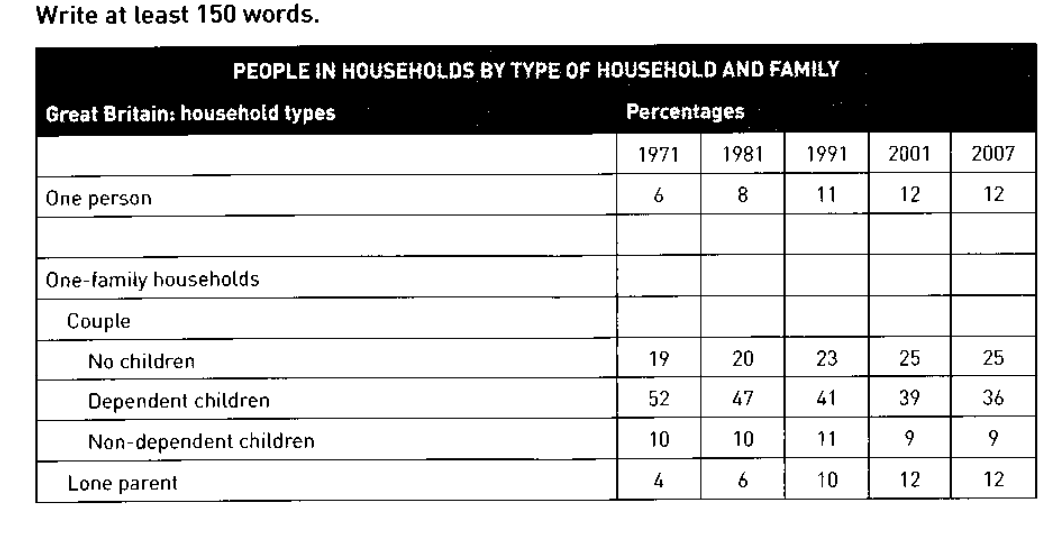
The table below shows the change in some household types in Great Britain from 1971 to 2007.
Summarise the information by selecting and reporting the main features, and make comparisons where relevant.
PEOPLE IN HOUSEHOLDS BY TYPE OF HOUSEHOLD AND FAMILY
Student answer (Band 5.0)
The given table provides information about the change in some household types in Great Britain from 1971 to 2007, measured in percentages.
Overall, a clear disparity is evident across the people in households by type of household and family. Dependent children accounted for the largest share throughout the period, whereas lone parent accounted for the lowest share.
Looking first at great Britain household types, dependent children occupied the top position all of the years, at around 52, 47, 41, 39, 36 percentages in since 1971 to untill 2007. followed by no children, and non-dependent children, whose figure stood at approximately 19, 20, 23, 25, 25 pescentages and 10, 10, 11, 9, 9 percentages.
turning to the same catagory, lone partent is the lowest at around 4,6,610.
AI examiner evaluation
| Criterion | Band |
|---|---|
| Task Achievement / Task Response | 4.5 |
| Coherence and Cohesion | 5.5 |
| Lexical Resource | 5.5 |
| Grammatical Range and Accuracy | 5.0 |
| Overall | 5.0 |
Task Achievement / Task Response: Band 4.5
You identify the table’s subject and include a relevant overview: dependent-children households are the largest category, while lone-parent households are the smallest in 1971. However, the overview is incomplete, and the response reports only a small selection of the data. The figures for dependent children and the two couple categories are mostly accurate, but the final sentence is unfinished and gives only “4,6,610,” which does not accurately report the lone-parent trend through 2007. You also omit the one-person category. The response contains 104 words, below the required 150, so the task is addressed only minimally. Add a complete overview and compare the main rises and falls, including the endpoint figures.
Coherence and Cohesion: Band 5.5
There is some basic organisation: an introduction is followed by an overview and then an attempt to describe the figures. The paragraphing helps distinguish these functions, and phrases such as “Overall” and “Looking first” signal movement between sections. However, progression is limited because the final paragraph breaks off after an incomplete figure, and the response does not develop a clear comparison across the whole period. The long sequence of numbers is difficult to follow, while “turning to the same catagory” does not clearly identify what is being discussed. Use complete, focused paragraphs and group related trends—for example, the declining dependent-children share separately from categories that increased.
Lexical Resource: Band 5.5
You use some task-relevant vocabulary, including “household types,” “dependent children,” “accounted for,” and “share,” so the topic is generally understandable. There is also an attempt to describe ranking with “largest” and “lowest.” However, the range is limited and some expressions are inaccurate or awkward, such as “occupied the top position,” “in since 1971 to untill 2007,” and “lone partent.” Spelling and word-form errors, including “pescentages” and “catagory,” are noticeable and reduce precision. Choose standard chart language such as “accounted for the highest proportion” and “rose/fell from … to …”. Check spelling carefully and avoid repeating “percentages” after every number when a clearer sentence can convey the comparison.
Grammatical Range and Accuracy: Band 5.0
You produce some understandable simple sentences, including “The given table provides information about the change…” and “Dependent children accounted for the largest share throughout the period.” However, grammatical control is uneven, and the range of sentence structures is limited. The sentence beginning “Looking first…” becomes a fragment when it ends with a list of figures, and “turning to the same catagory, lone partent is the lowest at around 4,6,610” is incomplete and difficult to interpret. Punctuation and capitalisation are also inconsistent: “followed” begins a sentence with a lowercase letter, and the final line lacks clear sentence boundaries. Practise writing complete comparisons with a subject and verb, and use accurate punctuation to separate figures and clauses.
See this exact question answered at other band scores. The same prompt compared across bands.
Browse more IELTS Writing model answers or get your own writing scored by the same AI examiner.