Band 5.0 IELTS Writing Task 1 Model Answer
Overall Band Score: 5.0 · IELTS Summit Mastery · 2026-11-10
IELTS Writing Task 1 question
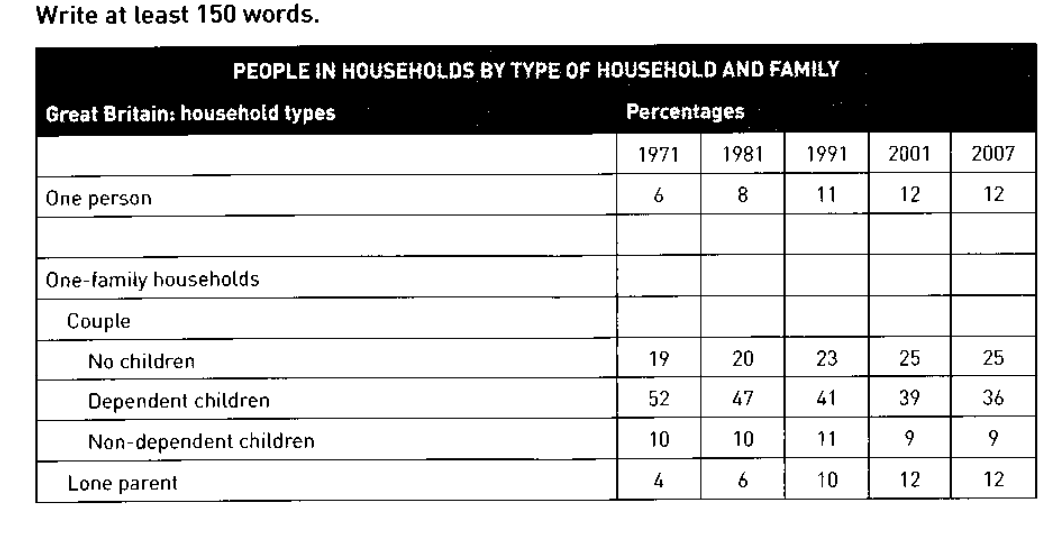
The table below shows the change in some household types in Great Britain from 1971 to 2007.
Summarise the information by selecting and reporting the main features, and make comparisons where relevant.
PEOPLE IN HOUSEHOLDS BY TYPE OF HOUSEHOLD AND FAMILY
Student answer (Band 5.0)
The table illustrates diffrent types of households alter in the uk between 1971 and 2007.
Overall, it is clear that lone family household was the lowest percentages instated of the highest proportion was the dependent children households. On the other catagories last recent year has been changed, the biggest amount of percentages was in dependent children household, while the smallest number of proportions had in non-dependent children household.
In 1971 one person households was at 6 percentage , which gradually increased from 6 percentages to 12 percentages in 2007. In terms of non- dependent childrean types households was dramatically declined at 2 percentage from 1971 to 2007. Another catagories is no childrean househods rapidly increased aroun
AI examiner evaluation
| Criterion | Band |
|---|---|
| Task Achievement / Task Response | 4.0 |
| Coherence and Cohesion | 5.0 |
| Lexical Resource | 5.0 |
| Grammatical Range and Accuracy | 5.0 |
| Overall | 5.0 |
Task Achievement / Task Response: Band 4.0
The response identifies the period and refers to several household categories, but it only addresses the task minimally. The overview is unclear and partly inaccurate: dependent-child households were the largest category throughout, but non-dependent-child households were not the smallest in the final year, as one-person and lone-parent households both stood at 12%, compared with 9% for non-dependent children. The claim that non-dependent households fell by two percentage points is accurate, but the final sentence is cut off and gives no usable comparison for childless couples. The response also contains only 116 words, below the required 150, leaving key trends and comparisons undeveloped. To improve, provide a clear overview and report the main changes across the full period, including the fall from 52% to 36% for dependent-child households and the rise in lone-parent households.
Coherence and Cohesion: Band 5.0
There is a basic attempt to organise the response into an introduction, an overview and a detail paragraph, and time markers such as “In 1971” and “in 2007” help orient the reader. However, progression is weak: the overview repeats the idea that dependent-child households had the largest share without clearly contrasting it with the other trends, and the final paragraph stops mid-sentence at “rapidly increased aroun”. Linking phrases such as “On the other categories” and “Another categories” do not establish clear relationships between points. Group the main trends logically, use a complete paragraph for comparisons, and ensure each sentence connects clearly to the one before it.
Lexical Resource: Band 5.0
The response uses some relevant task vocabulary, including “households”, “percentage” and “declined”, so the topic is generally recognisable. However, the range is limited and several word choices or collocations make the meaning difficult to follow, such as “lone family household was the lowest percentages” and “the smallest number of proportions”. There are also repeated spelling errors, including “diffrent”, “catagories” and “childrean”, which reduce clarity. Use precise terms such as “share”, “proportion” and “category” consistently, and describe changes with natural combinations such as “rose from” or “fell to”. Proofreading spelling and avoiding repeated, awkward phrases would make the data description clearer.
Grammatical Range and Accuracy: Band 5.0
The response attempts a few different sentence forms, including an overview beginning “Overall” and a sentence with “which”, but control is inconsistent. Errors in agreement and sentence construction appear in phrases such as “one person households was” and “the smallest number of proportions had in non-dependent children household”. The sentence “In terms of non-dependent childrean types households was dramatically declined” also has an unclear subject and an incorrect verb pattern. Punctuation and spacing are uneven, and the final sentence is incomplete. Practise forming complete subject–verb sentences, for example, “The proportion of one-person households rose from 6% to 12%,” and check agreement, articles and plural forms before submitting.
See this exact question answered at other band scores. The same prompt compared across bands.
Browse more IELTS Writing model answers or get your own writing scored by the same AI examiner.