Band 4.5 IELTS Writing Task 1 Model Answer
Overall Band Score: 4.5 · IELTS Summit Mastery · 2026-11-10
IELTS Writing Task 1 question
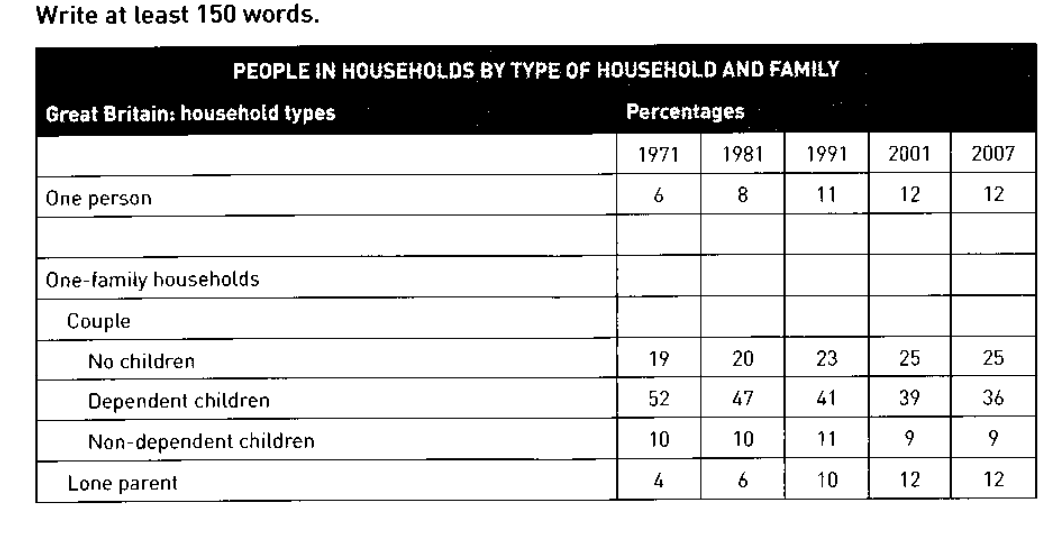
The table below shows the change in some household types in Great Britain from 1971 to 2007.
Summarise the information by selecting and reporting the main features, and make comparisons where relevant.
PEOPLE IN HOUSEHOLDS BY TYPE OF HOUSEHOLD AND FAMILY
Student answer (Band 4.5)
The given table illustrates the percentage of house hold types in the great britian between the two years from 1971 to2007. The dependent childern had the high percentage than that all the years.
Firstly, The one person household from 1971 to 1991 was take just two perecent difference in this years. the percentage was 6,8, and 11 percent. On the other hand the household types that was from 2001 to 2007 was same on both years that was 12 percent. Secondly, the one famliy household and the couple household was not disscus in the table. On the other hand the no childern house accomodation that was start from 1971 to 1991 and the percentage wastake ashort differences the percentage was 19 ,20 and 23 percent.
Thirdly, I disscus the house accommodation of dependent and non dependent childern was start from 1971 to 1991 the percentage of dependent was fifty two, forty seven and forty one percent. onthe other hside the house hold percentage was 39 to 36 percent. In the last the hoiusehold of non dependent choildern was two year was same that was 10 percentand in next year that was 11 percent. while in the hose hold accommodation from 2001 to 2007 was same that was nine percent
in overall the house accommodation of dependent childern was very high than the others. The other,s famliy accommodation that was non- dependent , nochildern , one famliy, one persn and couple
AI examiner evaluation
| Criterion | Band |
|---|---|
| Task Achievement / Task Response | 4.5 |
| Coherence and Cohesion | 4.5 |
| Lexical Resource | 4.5 |
| Grammatical Range and Accuracy | 4.5 |
| Overall | 4.5 |
Task Achievement / Task Response: Band 4.5
You identify a genuine main feature: households with dependent children had the largest share throughout, and you report several figures for one-person households and other categories. However, the response only partially summarises the table. The overview is vague and incomplete, and some comparisons are inaccurate or unclear: for example, the no-children couple category rises from 19% to 25%, but you describe only its early years. You also say the one-family and couple households are not discussed, although the table includes one-family household subcategories, including couples. The dependent-children share falls from 52% to 36%, a major trend that should be clearly stated. Select the key rises and falls, compare the start and end years, and avoid unsupported or confusing statements.
Coherence and Cohesion: Band 4.5
The response has an attempt at an introduction, several body sections and an overall statement, and sequencing words such as “Firstly,” “Secondly” and “Thirdly” show an effort to organise the information. However, the progression is difficult to follow because the categories are discussed in a fragmented order and some sentences repeat or contradict earlier information. For instance, the claim that one-family and couple households are not discussed is followed by figures for the no-children category, which belongs to that group. References such as “the household types” and “the other” are often unclear, while “on the other hand” is used where no contrast is established. Group related trends into clear paragraphs and use linking phrases only when their relationship is accurate.
Lexical Resource: Band 4.5
You use some relevant task vocabulary, including “percentage,” “dependent children,” “non-dependent children” and “household,” so the reader can recognise the subject. However, the range is basic and repetitive, and frequent spelling and word-choice problems strain understanding. Examples include “house accomodation,” “house hold,” “disscus” and “hoiusehold.” The phrase “take just two percent difference” is not a natural way to describe a change, and “very high than” does not express the comparison accurately. Use precise terms such as “share,” “proportion,” “rose,” “fell” and “remained stable,” and check spelling carefully. Avoid repeatedly calling the categories “accommodation,” since the table reports household types, not accommodation.
Grammatical Range and Accuracy: Band 4.5
There are attempts to form longer sentences and use time references, but sentence structures are very limited and errors are frequent enough to make some relationships hard to understand. For example, “The one person household … was take just two perecent difference” has an incorrect verb form and an unclear construction; “the percentage wastake” also combines forms incorrectly. Agreement and articles are often missing or inaccurate, as in “the one family household and the couple household was.” Capitalisation and punctuation are inconsistent, with sentence starts such as “the percentage” and “onthe other hside.” Build accurate simple sentences first—for example, “The proportion of one-person households rose from 6% to 11%”—then add controlled comparisons using “while” or “whereas.”
See this exact question answered at other band scores. The same prompt compared across bands.
Browse more IELTS Writing model answers or get your own writing scored by the same AI examiner.