Band 6.5 IELTS Writing Task 1 Model Answer
Overall Band Score: 6.5 · IELTS Summit Mastery · 2026-11-11
IELTS Writing Task 1 question
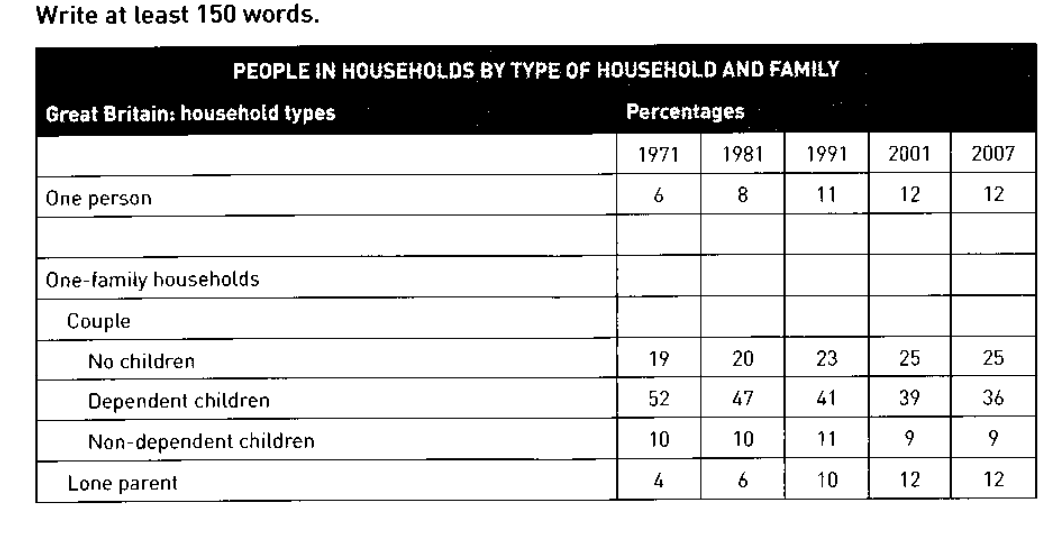
The table below shows the change in some household types in Great Britain from 1971 to 2007.
Summarise the information by selecting and reporting the main features, and make comparisons where relevant.
PEOPLE IN HOUSEHOLDS BY TYPE OF HOUSEHOLD AND FAMILY
Student answer (Band 6.5)
The table summarises the variation in some households types in Great Britain between 1971 and 2007.
Overall, despite a decline throughout the period, households with dependent children remained the largest category. Notably, there was a decline in proportion of households with non-dependent children and those with no childen. In contrast, households with one person and couples with no children have been increasing throughtout the period.
Regarding those that experienced a downward trajectory, families with dependent children accounted for just over half (52%) of the total in 1971, this figure however saw a moderate decline reaching its lowest in 2007 at 36%. Similarly, families with non-dependent children fluctuated slightly, hovering between 11% in 1991 and 9% in 2007, making it the lowest category.
Turning to those that saw an upward trend, families with one person accounted for only 6% in 1971, it then saw a marginall rise throughout the entire period, reaching a peak of 12% in 2001, before levelling off at this figure in 2007.
Conversely, families with no children was represented by 19% of the total in 1971, this figure went up sightly throughout the period reaching its highest in 2001 at a quarter before stabilising at this figure in 2007. Meanwhile, lone parent was only 4% in 1971 , it saw a surge in its figures, rising to 6% in 1981, then 10% in 1991 before stabilising at 12% after 2001.
AI examiner evaluation
| Criterion | Band |
|---|---|
| Task Achievement / Task Response | 6.5 |
| Coherence and Cohesion | 7.0 |
| Lexical Resource | 6.5 |
| Grammatical Range and Accuracy | 6.0 |
| Overall | 6.5 |
Task Achievement / Task Response: Band 6.5
The response identifies the main pattern accurately: households with dependent children were the largest category despite falling from 52% to 36%, while one-person households, childless couples and lone-parent households generally increased. It also includes relevant figures and notes that one-person households and childless couples levelled off by 2007. This gives the report a clear overview and covers the main categories. However, some details are less fully or precisely reported: the overview says non-dependent-child households declined, although they rose slightly to 11% in 1991 before falling to 9%; the description of this group does not clearly state its starting value of 10%. Also, “those with no children” in the overview could be confused with non-dependent children. A more exact overview and fuller treatment of the small fluctuations would strengthen the report.
Coherence and Cohesion: Band 7.0
The information is organised clearly, moving from an overview to groups that declined and then those that increased. Paragraphing supports this progression, and signposts such as “Regarding” and “Turning to” help the reader follow the comparisons. The response also uses time markers and figures to connect changes across the period. Some linking is slightly mechanical, however, particularly the repeated contrastive openings “In contrast,” “Conversely,” and “Meanwhile.” A few long sentences join separate observations with commas, which weakens the flow—for example, the sentence beginning “families with dependent children accounted for just over half” combines the starting figure and subsequent decline without a clear grammatical break. More varied transitions and cleaner sentence boundaries would make the progression smoother.
Lexical Resource: Band 6.5
There is an adequate range of vocabulary for describing trends, including “decline,” “fluctuated,” “hovering,” “surge,” and “stabilising.” These choices help distinguish gradual change from a sharper rise, and the meaning remains clear. Some less common expressions are not used precisely or naturally: “a marginall rise” is an awkward collocation, while “saw a surge in its figures” is less suitable for a percentage that rose steadily over several years. There are also spelling errors, including “households types,” “childen,” “throughtout,” “sightly,” and “marginall.” Greater accuracy in spelling and more precise trend language would improve control and flexibility.
Grammatical Range and Accuracy: Band 6.0
The response uses a mix of simple and complex forms, including subordinate clauses and time-based comparisons, and the intended meaning is generally easy to understand. However, some grammatical and punctuation errors remain. For example, “families with dependent children accounted for just over half (52%) of the total in 1971, this figure however saw…” joins two independent clauses with a comma; the same pattern occurs in “families with one person accounted for only 6% in 1971, it then saw…”. There are also agreement and article issues in “families with no children was represented” and “lone parent was only 4%.” Check singular and plural subjects, and use full stops or suitable conjunctions to separate complete clauses. These corrections would make the varied sentence structures more controlled.
See this exact question answered at other band scores. The same prompt compared across bands.
Browse more IELTS Writing model answers or get your own writing scored by the same AI examiner.