Band 5.5 IELTS Writing Task 1 Model Answer
Overall Band Score: 5.5 · IELTS Summit Mastery · 2026-11-11
IELTS Writing Task 1 question
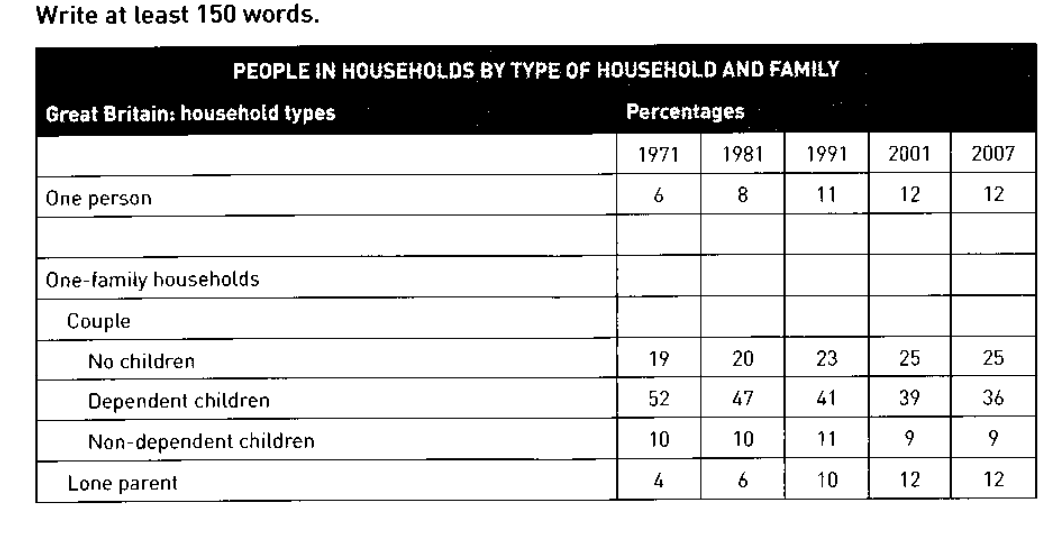
The table below shows the change in some household types in Great Britain from 1971 to 2007.
Summarise the information by selecting and reporting the main features, and make comparisons where relevant.
PEOPLE IN HOUSEHOLDS BY TYPE OF HOUSEHOLD AND FAMILY
Student answer (Band 5.5)
The table illustrates the modifications in some types of accommodation in England from from 1971 to 2007.
Overall, main feature of table was that one-family and couples has no seperate houses. Furthermore, the proportion of the dependent children homes significantly decreased over the years however, no youngster grew dramatically.
Firstly, we discuss decreasing trends such as the youngsters who depends upon parents their number decreased gradually from 52% to approximately its half 36% in 2007. On the other hand independent students accommadations were remains nearly constant which was 10% in 1971 and 9% in 2007.
Secondly, the increasing patterns. The concern was lone parent households their numbers was very few in 1971 however in 2007 it grew rapidly from 4% to 12%. The two developments was in the one person and childless homes, they also grow with time. Songle citizen households have 6% in 1971 and 12% in 2007 additionally, the proportion of no children residences commenced from 19% and finished at 25%.
AI examiner evaluation
| Criterion | Band |
|---|---|
| Task Achievement / Task Response | 5.0 |
| Coherence and Cohesion | 6.0 |
| Lexical Resource | 5.0 |
| Grammatical Range and Accuracy | 5.0 |
| Overall | 5.5 |
Task Achievement / Task Response: Band 5.0
You identify several important movements, including the fall in households with dependent children (52% to 36%) and the rise in lone-parent households (4% to 12%). You also report the increases for one-person and childless-couple households. However, the overview is unclear and includes an unsupported claim that “one-family and couples has no seperate houses”; the table gives percentages for household types, not whether they have separate homes. The statement that “no youngster grew dramatically” is also unclear and does not accurately summarise the overall pattern. Some categories are described imprecisely, and the response does not clearly establish the main contrast between the declining dependent-children share and the generally rising categories. Make the overview factual and compare the key trends directly.
Coherence and Cohesion: Band 6.0
The response has a recognisable structure: an introduction and overview are followed by paragraphs on decreasing and increasing trends. Sequencing phrases such as “Firstly” and “Secondly” help readers follow this plan, and the figures are generally grouped by direction of change. However, cohesion is sometimes mechanical, and some links between ideas are unclear. For example, “The two developments was in the one person and childless homes” does not clearly connect to the preceding point about lone-parent households. The overview also combines unrelated or confusing claims, which weakens the progression from the main picture to supporting details. Use clearer topic sentences and connect each comparison explicitly to the relevant household category.
Lexical Resource: Band 5.0
You use some task-relevant vocabulary, including “proportion,” “decreased,” “increasing patterns,” and “lone parent households,” so the reader can identify the broad subject. However, the range is limited and several word choices or collocations are inaccurate, sometimes making the meaning difficult to follow. “Types of accommodation” is not an accurate description of household types, while “independent students accommodations” and “no youngster grew dramatically” do not clearly name the categories in the table. There are also noticeable spelling errors, such as “seperate,” “accommadations,” and “Songle.” Use the table’s category labels consistently and choose precise terms such as “one-person households” and “couples without children.”
Grammatical Range and Accuracy: Band 5.0
You attempt both simple and more complex sentences, including a contrast with “On the other hand” and a clause beginning “however.” Nevertheless, errors in sentence structure, verb forms, and agreement are frequent enough to make some statements hard to interpret. Examples include “Overall, main feature of table was,” “one-family and couples has,” and “The two developments was.” The sentence “On the other hand independent students accommadations were remains nearly constant” also combines incompatible verb forms. Articles and punctuation are sometimes missing, and the opening repeats “from.” Practise building accurate subject–verb patterns and checking each sentence for a clear subject and one correctly formed main verb before adding complex clauses.
See this exact question answered at other band scores. The same prompt compared across bands.
Browse more IELTS Writing model answers or get your own writing scored by the same AI examiner.