Band 6.0 IELTS Writing Task 1 Model Answer
Overall Band Score: 6.0 · IELTS Summit Mastery · 2026-11-11
IELTS Writing Task 1 question
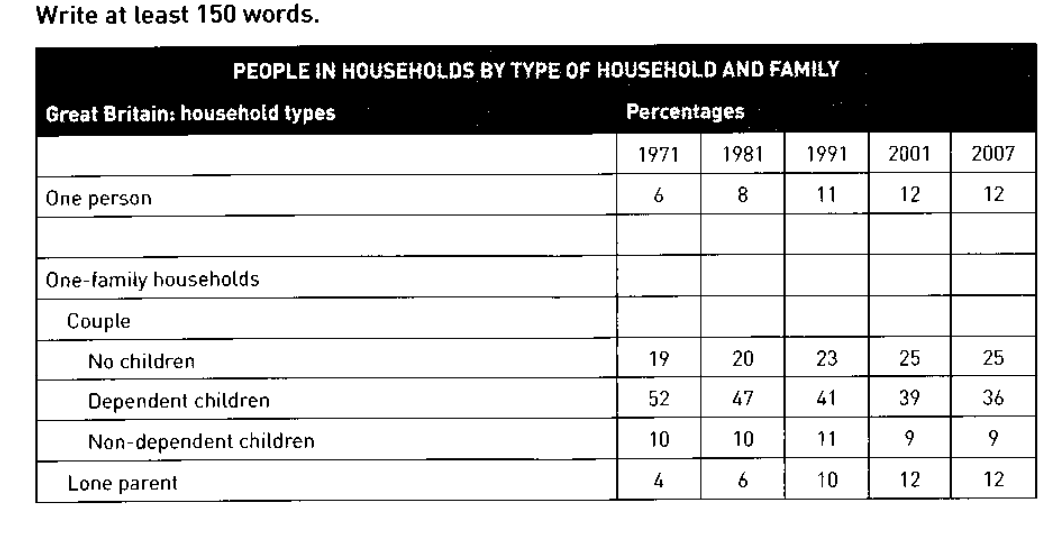
The table below shows the change in some household types in Great Britain from 1971 to 2007.
Summarise the information by selecting and reporting the main features, and make comparisons where relevant.
PEOPLE IN HOUSEHOLDS BY TYPE OF HOUSEHOLD AND FAMILY
Student answer (Band 6.0)
The table illustrates the change in some household types in Great Britain between 1971 and 2007.
Overall, it can be seen that one person, no children, and lone parent showed the increase percentage throughout the period, while dependent children and non-dependent children demonstrated the downward trend from 1971 to 2007.
Looking first at most popular categories, in 1971, the percentage of peole by no type of no children was 19%, then climbed to 23% in 1991. By 2001, it reached 25% and remained same in 2007. Similarly, the percentage of people of one person was 6% in 1971, before reaching 11% in 1991. In 2001, the percentage increased to 12% and remained stable by 2007, at 12%. Lone parent also showed the similar trend, as it began at 4% and ended with 12% in 2007.
Turning to the least common categories, dependent children, started at 52% in 1971, and dropped to 41% in 1991. By 2007, it reached only 36%. In addition, non-dependent children stood at 10 % in 1971 and rose to 11% in 1991. In 2001, it declined to 9 % and remained same in 2007.
AI examiner evaluation
| Criterion | Band |
|---|---|
| Task Achievement / Task Response | 6.0 |
| Coherence and Cohesion | 6.0 |
| Lexical Resource | 5.5 |
| Grammatical Range and Accuracy | 5.5 |
| Overall | 6.0 |
Task Achievement / Task Response: Band 6.0
You cover all five household categories and give a clear overview of the main contrast: one-person, childless-couple and lone-parent households generally rise, while households with dependent children fall. Several figures are reported accurately, including the dependent-children decline from 52% to 36% and the childless category reaching 25%. However, the overview overgeneralises by saying non-dependent children showed a downward trend throughout; this figure first rises from 10% to 11% before falling to 9%. The account also omits the 1981 values and gives limited comparison of the categories’ relative scale. Clarify that the table reports percentages of people in household types, and describe the non-dependent trend more precisely to make the key features more fully developed.
Coherence and Cohesion: Band 6.0
The response has a clear overall structure: an introduction, an overview, and two body paragraphs grouped by rising and falling categories. Sequencing is generally easy to follow, and phrases such as “Looking first” and “Turning to” help signal the shift between groups. Some linking is mechanical, however, with repeated use of “In 2001” and “Similarly,” and the grouping is not entirely consistent because non-dependent children briefly rise before declining. The phrase “least common categories” is also unclear when dependent children began as the largest category. Use more precise topic sentences and vary the links between comparisons; this would make the progression more natural and the relationships between figures clearer.
Lexical Resource: Band 5.5
You use a suitable range of trend vocabulary, including “climbed,” “dropped,” “declined,” and “remained stable,” and the meaning is generally clear. However, several word choices and collocations are awkward or inaccurate, such as “the percentage of peole by no type of no children,” “the percentage of people of one person,” and “showed the similar trend.” “Least common categories” is also unsuitable for dependent children, which had the highest percentage in 1971. There is a spelling error in “peole,” and spacing around the percent sign is inconsistent. Aim for precise labels such as “the proportion of people in one-person households” and “households with dependent children”; these will improve clarity and accuracy.
Grammatical Range and Accuracy: Band 5.5
You use both simple and more complex sentence forms, including clauses with “before” and “while,” and most sentences communicate the intended trend. Some grammatical errors remain. For example, “dependent children, started” incorrectly separates the subject from its verb with a comma, while “remained same” is missing an article in “remained the same.” In “it reached only 36%,” the pronoun’s reference is not fully clear, and “the percentage … was 6% … before reaching 11%” shifts awkwardly between a noun phrase and an implied subject. Check articles, punctuation around introductory phrases, and clear pronoun reference. More consistently controlled sentence patterns would make the comparisons easier to read.
See this exact question answered at other band scores. The same prompt compared across bands.
Browse more IELTS Writing model answers or get your own writing scored by the same AI examiner.