Band 6.0 IELTS Writing Task 1 Model Answer
Overall Band Score: 6.0 · IELTS Summit Mastery · 2026-11-11
IELTS Writing Task 1 question
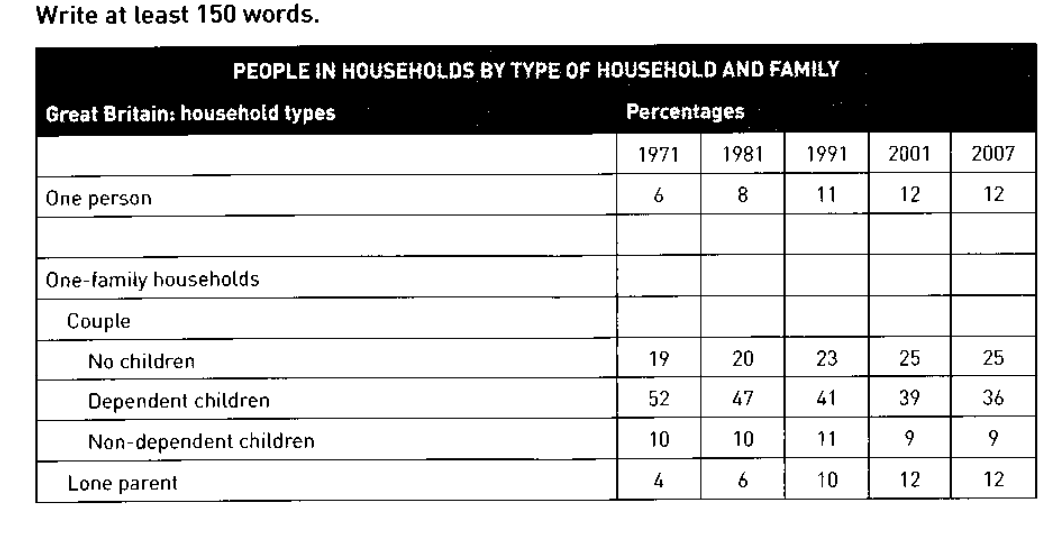
The table below shows the change in some household types in Great Britain from 1971 to 2007.
Summarise the information by selecting and reporting the main features, and make comparisons where relevant.
PEOPLE IN HOUSEHOLDS BY TYPE OF HOUSEHOLD AND FAMILY
Student answer (Band 6.0)
The table shows the percentage of individuals in households by the type of household and family.
Overall, there is a steady increase for one person household type. On the other hand Couple with no children have a rise and couple with dependent children have a decilne. Non-dependent children household type was consistent with minor fluctuation. Surpisingly Lone parent have a massive rise.
From 1971 to 1991 , One person household type showed a steady increase. It goes to 11 from 6. Similairly , Couple with No children follows the same trend and climb up form 19 to 23. Couple with dependent children represented a slight decline. Lone parents shows the great surge and it goes to 10 from 6.
In the 2000s , The One person household type remained consitent. Couple with No childer were levelled out and the percentage remains the same. Couple with dependent children followed a opposite trend , it percentage dropped from 39 to 36. Non- dependent children and Lone parent follows a similar trend and there percentage plateaued.
AI examiner evaluation
| Criterion | Band |
|---|---|
| Task Achievement / Task Response | 6.0 |
| Coherence and Cohesion | 6.0 |
| Lexical Resource | 6.0 |
| Grammatical Range and Accuracy | 5.5 |
| Overall | 6.0 |
Task Achievement / Task Response: Band 6.0
You identify several important patterns: the share of one-person households rises, couples with dependent children decline, and couples without children increase before levelling off. The overview also notes the rise in lone-parent households. However, some details are inaccurate or unclear. For example, lone parents rise from 4% to 10% between 1971 and 1991, not from 6% to 10%; the 6% figure is for 1981. The overview’s description of this as a “massive” rise is also imprecise. You could make the summary more complete by reporting the full period for the main changes, including the fall in dependent-child households from 52% to 36%, and by clearly stating the final figures for the categories discussed.
Coherence and Cohesion: Band 6.0
The response has a clear overall structure: an introduction, an overview, and two paragraphs describing changes over time. This makes the main direction of the data reasonably easy to follow. The time-based grouping is useful, and phrases such as “On the other hand” and “In the 2000s” help signal relationships and stages. However, some links are mechanical or unclear, and the final paragraph groups non-dependent children and lone parents as following a similar trend even though one remains broadly stable while the other rises before levelling off. Improve progression by grouping categories with genuinely similar patterns and using clearer references, such as naming the relevant percentage rather than repeatedly saying “the percentage.”
Lexical Resource: Band 6.0
You use an adequate range of trend vocabulary, including “steady increase,” “decline,” “surge,” “fluctuation,” and “levelled out.” These choices help communicate the broad patterns, and the meaning is generally clear despite some inaccurate or awkward phrasing. At times, however, word choice is imprecise: “massive rise” overstates the change, while “household type” is repeated and “follows a opposite trend” is not a natural collocation. There are also spelling errors, including “Surpisingly,” “Similairly,” and “consitent,” which reduce accuracy. Aim for precise, neutral reporting language and check spelling carefully; vary expressions such as “the proportion increased” and “the figure remained stable.”
Grammatical Range and Accuracy: Band 5.5
You attempt both simple and more complex sentence forms, and the overall meaning is usually understandable. For example, the opening overview contrasts increases and declines, while the later paragraphs compare changes across periods. Some grammatical errors remain, particularly with subject–verb agreement and sentence construction: “Lone parent have a massive rise” should use a singular or plural subject consistently, and “Non-dependent children and Lone parent follows” needs a plural verb and parallel wording. Articles and possessives are also sometimes missing, as in “it percentage dropped,” which should be “its percentage dropped” or, more naturally, “the figure fell.” Review punctuation around introductory time phrases and avoid unnecessary capitalisation within sentences. More consistently accurate clauses would strengthen the response.
See this exact question answered at other band scores. The same prompt compared across bands.
Browse more IELTS Writing model answers or get your own writing scored by the same AI examiner.