Band 5.5 IELTS Writing Task 1 Model Answer
Overall Band Score: 5.5 · IELTS Summit Mastery · 2026-11-11
IELTS Writing Task 1 question
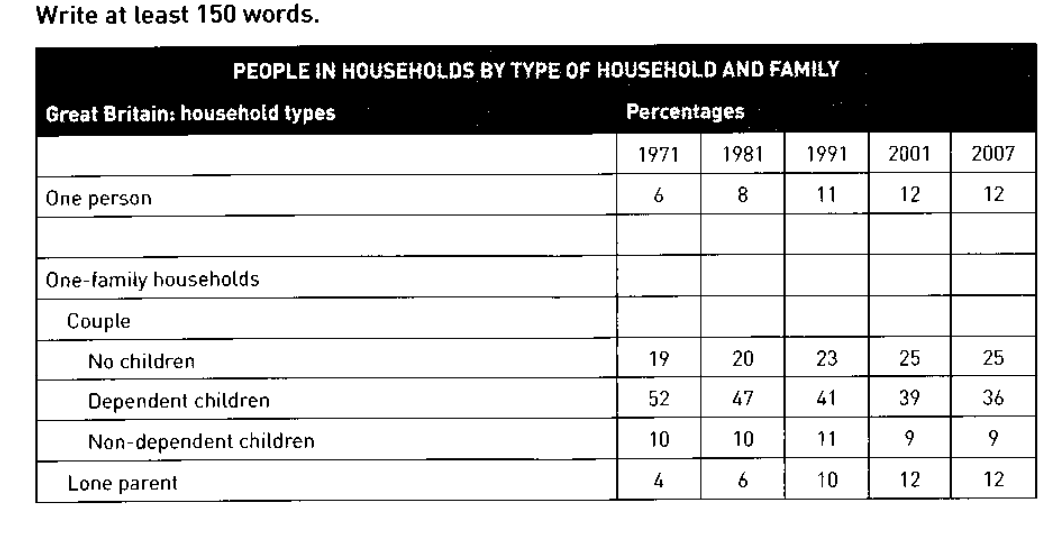
The table below shows the change in some household types in Great Britain from 1971 to 2007.
Summarise the information by selecting and reporting the main features, and make comparisons where relevant.
PEOPLE IN HOUSEHOLDS BY TYPE OF HOUSEHOLD AND FAMILY
Student answer (Band 5.5)
The table presents the data which shows the change in some household types in Great Britain from 1971 to 2007.
Overall, the household type dependent child showed the highest proportion in the given percentages. Conversely, one parent and lone parent showed the lowest rate in the percentages . No children and non dependent had not shown any major fluctuations.
By looking at the percentages, dependent children showed the highest share in the percentages. Although it was 52% in 1971 which decreased to 41% in 1991 and further fell to 36% in 2007 which was a dramatic change. On the other hand, no children was the second highest among percentages since it was 19% in 1971 which surged to 25% in 2007.
Furthermore, the lone person and one person household types were lowest among the others . Lone parent type was at 4% in 1971 which rose to 10% in 1991 and 12% in 2007. Non dependent children had not undergone major changes as it was 10% in 1971 and 1981 and then slightly dropped.
AI examiner evaluation
| Criterion | Band |
|---|---|
| Task Achievement / Task Response | 6.0 |
| Coherence and Cohesion | 5.5 |
| Lexical Resource | 5.5 |
| Grammatical Range and Accuracy | 5.5 |
| Overall | 5.5 |
Task Achievement / Task Response: Band 6.0
You identify the main pattern accurately: dependent-child households were the largest category and fell from 52% to 36%, while couples without children rose from 19% to 25%. You also report the increase in lone-parent households. This gives the response a relevant overview and supports it with key figures. However, some comparisons are unclear or inaccurate: one-person households were not among the lowest categories by 2007, reaching 12%, and the claim that “one parent and lone parent” were the lowest is confusing. The overview also misses the rise in one-person households and the fact that lone-parent and one-person figures both reached 12%. Develop these less fully covered trends and distinguish the categories precisely.
Coherence and Cohesion: Band 5.5
The response has a recognisable structure, with an introduction, an overview and two detail paragraphs. Sequencing from the largest category to other household types is generally understandable, and phrases such as “On the other hand” and “Furthermore” help signal movement between points. However, progression is weakened by repetition: dependent children are described as the highest category in both the overview and the first detail paragraph, and “percentages” is repeated several times. Some references are difficult to follow, particularly “one parent and lone parent” and “the lone person and one person household types.” Group related categories more clearly, use precise references, and make each paragraph add distinct information.
Lexical Resource: Band 5.5
You use a reasonable range of task-related terms, including “proportion,” “share,” “surged,” and “dramatic change,” so the main trends can be communicated. However, several choices are inaccurate or repetitive. “One parent” is not the table’s category name, and “lone person” appears to confuse one-person households with lone-parent households. “No children” and “non dependent” are also used without consistently identifying the full categories. Repeated use of “percentages” and broad phrases such as “major fluctuations” limit precision. Use the table’s labels consistently and choose trend language that matches the size and direction of each change.
Grammatical Range and Accuracy: Band 5.5
There is an attempt to use both simple statements and more complex clauses, for example, “Although it was 52% in 1971 which decreased to 41% in 1991…” and “Lone parent type was at 4%…which rose…”. Some sentence patterns are understandable, but clause construction is not always controlled: the “Although” clause is left without a clear main clause, and “which” is used awkwardly to connect changes. There are also errors in articles, number and agreement, as in “no children was” and “the lone person and one person household types were.” Improve sentence boundaries and make the subject of each verb explicit; this will make the comparisons easier to read while preserving your attempts at complex structures.
See this exact question answered at other band scores. The same prompt compared across bands.
Browse more IELTS Writing model answers or get your own writing scored by the same AI examiner.