Band 5.0 IELTS Writing Task 1 Model Answer
Overall Band Score: 5.0 · IELTS Summit Mastery · 2026-11-12
IELTS Writing Task 1 question
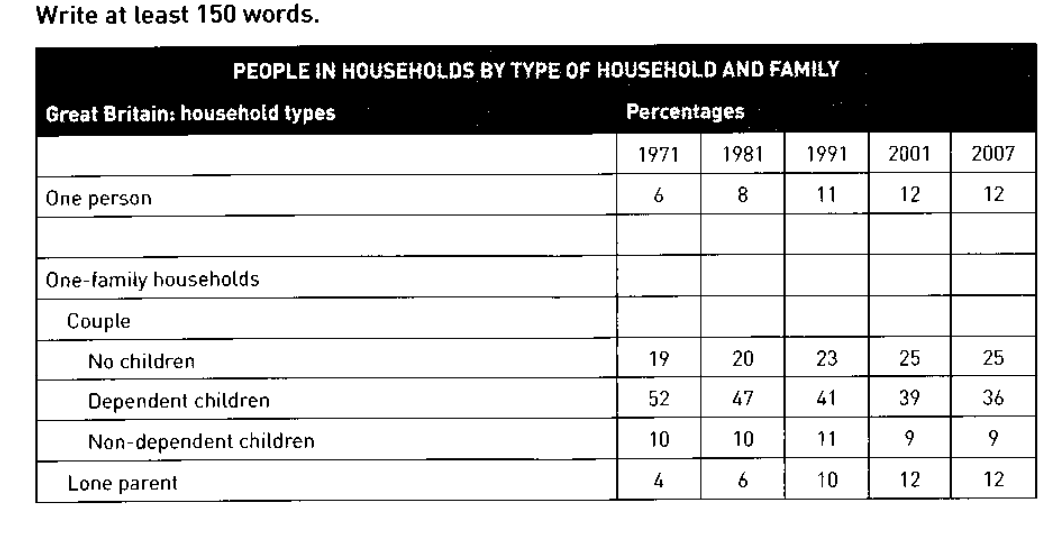
The table below shows the change in some household types in Great Britain from 1971 to 2007.
Summarise the information by selecting and reporting the main features, and make comparisons where relevant.
PEOPLE IN HOUSEHOLDS BY TYPE OF HOUSEHOLD AND FAMILY
Student answer (Band 5.0)
THE TABLE ILLUSTRATES THAT HOW MANY TYPES OF FAMILIES ARE LIVING IN THE GREAT BRITAIN OVER THE TIME PERIOD 1971 TO 2007.
OVERALL IT IS NOTICIABLE THAT THE FAMILY WHO HAS NO CHILDREN RISE SIGNIFICANTLY AS COMPARED TO OTHERS IN THE GIVEN TIME PERIOD AND THE FIGURE OF DEPENDENT CHILDREN DECLINED GRADUALLY.
IN THE YEAR 1971, IT IS SHOWN THAT THERE IS ONLY TWO TYPES OF HOUSEHOLD HO HAS CONATINS LESS PERCENTAGE IN THE GREAT BRITAIN. THE HIGHER NUMBER OF PERCENTAGE OF HOUSEHOLD IS DEPENDENT CHILDREN. AS WE CAN SEE THERE ARE TWO FIGURES NAMES ONE FAMILY AND COUPLE HOUSEHOLD HAVING NO PERCENTAGE OVER A PERIOD OF 36 YEARS. AND THE DEPENDENT CHILDREN FAMILY FALL STEADILY. THE FAMILY OF NON-DEPENDENT CHILDREN MOSTLY REMAINED CONSTANT FOR THE FIRST 10 YEARS AND LAST SIX YEARS PERIOD. FURTHERMORE ONE PERSON FAMILY AND LONE PARENT FAMILY ALSO REMAINED STABLE FOR LAST SIX YEAR PERIOD.
AI examiner evaluation
| Criterion | Band |
|---|---|
| Task Achievement / Task Response | 5.0 |
| Coherence and Cohesion | 5.0 |
| Lexical Resource | 5.0 |
| Grammatical Range and Accuracy | 5.0 |
| Overall | 5.0 |
Task Achievement / Task Response: Band 5.0
You identify two important broad trends: the share of households with dependent children fell, while the no-children couple category rose. However, the account only partially covers the table and some statements misread its categories. For example, “there are two figures names one family and couple household having no percentage” is inaccurate: the table gives percentages for each listed type, and “one-family households” is a heading rather than a separate data category. The overview also says the no-children group rose “significantly” without giving its change from 19% to 25%, and several other notable changes—such as one-person households rising from 6% to 12% and lone-parent households from 4% to 12%—are not clearly reported. Select and compare the main figures more precisely.
Coherence and Cohesion: Band 5.0
There is a basic structure: an opening statement, an overview beginning “OVERALL,” and a paragraph with further details. This gives the reader some sense of the response’s purpose. However, progression within the detail paragraph is difficult to follow because categories and comparisons are introduced without clear relationships. The sentence about “two figures names one family and couple household” is especially confusing, and the discussion moves from dependent children to non-dependent children and then to stability without a consistent comparison pattern. Linking expressions such as “Furthermore” are used, but they do not resolve these unclear connections. Organise the details into a clear sequence—for example, first the largest category and its decline, then the categories that increased—and use accurate references to each table row.
Lexical Resource: Band 5.0
The response uses some relevant vocabulary for describing data, including “declined gradually,” “fall steadily,” “remained constant,” and “period.” These choices show an attempt to describe trends rather than simply list categories. However, the range is limited and several word choices or collocations make the meaning unclear, as in “higher number of percentage,” “family who has no children,” and “two figures names.” Spelling errors such as “noticiable” and “conatins” are also noticeable. Use standard chart language and precise category labels: for example, “the proportion of couples with no children increased,” and “the percentage of households with dependent children fell.” Check spelling and avoid calling percentages “numbers” when describing proportions.
Grammatical Range and Accuracy: Band 5.0
You attempt more than isolated simple statements, using clauses such as “as compared to others” and “for the first 10 years,” but the range of sentence structures remains limited and errors are frequent enough to make some sentences difficult to interpret. The opening, “The table illustrates that how many types of families are living,” has an incorrect embedded-question structure and tense; a clearer form is “The table shows the percentages of people in different household types.” Agreement and verb forms are also inconsistent in “the family … rise” and “the dependent children family fall.” Articles and sentence construction cause further problems in “there is only two types.” Practise accurate subject–verb agreement, past-tense reporting, and complete comparisons, then proofread each sentence for a clear subject and verb.
See this exact question answered at other band scores. The same prompt compared across bands.
Browse more IELTS Writing model answers or get your own writing scored by the same AI examiner.