Band 5.5 IELTS Writing Task 1 Model Answer
Overall Band Score: 5.5 · IELTS Summit Mastery · 2026-11-12
IELTS Writing Task 1 question
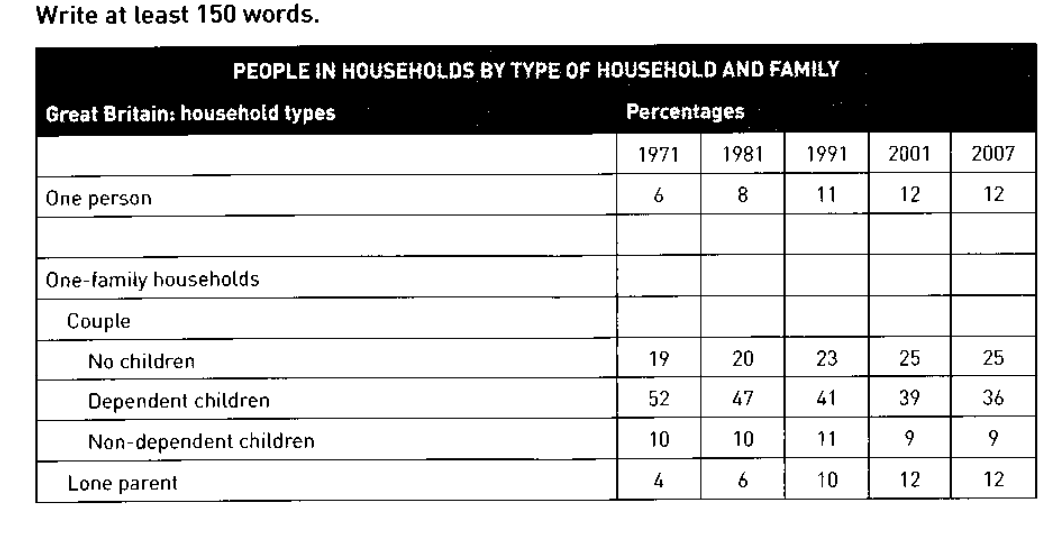
The table below shows the change in some household types in Great Britain from 1971 to 2007.
Summarise the information by selecting and reporting the main features, and make comparisons where relevant.
PEOPLE IN HOUSEHOLDS BY TYPE OF HOUSEHOLD AND FAMILY
Student answer (Band 5.5)
The table presents the information about the percentage of different family types in Great Britain from 1971 to 2007.
Overall, the most important point is that the percentage of a family having no children and alone parents, was increased continously across all the five years.Dependent children were deceasing into all 5 years which is a good progress.
A steadily growth in one person family from 6 percent in 1971 to 12 percent in 2007 .The percentage of a family which had no children was slowly increased between all five years.In 1971 the children were becoming independent as a reult the ratio of dependent children decreased from 52 percent in 1971 to 36 percent in 2007 ,respectively .
The percentage of alone parents was began to increase in 1971 from 4 percent to 10 percent in 1991.After that the percentage increased continously to 12 percent in 2007.
AI examiner evaluation
| Criterion | Band |
|---|---|
| Task Achievement / Task Response | 5.0 |
| Coherence and Cohesion | 5.5 |
| Lexical Resource | 5.5 |
| Grammatical Range and Accuracy | 5.0 |
| Overall | 5.5 |
Task Achievement / Task Response: Band 5.0
You identify several relevant trends, including the rise in one-person households and lone-parent families and the fall in households with dependent children. The figures you give for these changes are accurate, and the opening overview attempts to highlight the main pattern. However, the overview is unclear and partly inaccurate: the share of couples with no children did not rise continuously, as it remained at 25% in 2001 and 2007, and “alone parents” is not a clear description of the category. The response also omits the non-dependent-children figures and gives little comparison across categories. It is 138 words, below the required 150, so the task is only partially covered. Add a clearer overview and a few relevant comparisons to complete the summary.
Coherence and Cohesion: Band 5.5
The response has a basic structure, with an introduction, an overview and further details, and it generally moves from household trends to specific figures. This gives the reader some sense of organisation. However, progression is limited: the second paragraph repeats the overview’s claims rather than developing a clear comparison, and the final paragraph focuses only on lone-parent households. Linking is also sometimes awkward, as in “After that,” while the phrase “respectively” does not clearly connect the figures to a comparison. Improve the progression by grouping related increases together, then contrasting them with the decline in dependent-child households. Clearer sentence links and paragraph development would make the organisation more effective.
Lexical Resource: Band 5.5
You use some relevant vocabulary for describing data, including “percentage,” “increased,” “decreased,” and “from … to …,” so the main trends are usually understandable. However, the range is limited and several word choices or collocations are inaccurate, which makes parts of the report unclear. For example, “alone parents” does not name the table category naturally, and “a good progress” adds an unsupported judgement rather than describing the data objectively. There are also spelling errors such as “continously” and “reult.” Use precise category labels from the table and vary standard reporting language, such as “the proportion of lone-parent households rose” or “the share of households with dependent children fell.”
Grammatical Range and Accuracy: Band 5.0
You attempt both simple and more developed sentences, including a time clause in “After that the percentage increased…” and a sentence linking a proposed cause to a numerical change. However, grammatical errors are frequent and sometimes make relationships between ideas difficult to follow. Examples include “was increased,” “were deceasing,” and “was began to increase,” where verb forms are incorrect. The sentence “A steadily growth …” is also incomplete and has an incorrect article and word form. Punctuation and spacing are inconsistent, particularly around sentence boundaries and commas. Practise forming accurate past-tense trend sentences, for example, “The proportion rose from 6% in 1971 to 12% in 2007,” and check each sentence for a complete subject and verb.
See this exact question answered at other band scores. The same prompt compared across bands.
Browse more IELTS Writing model answers or get your own writing scored by the same AI examiner.