Band 6.5 IELTS Writing Task 1 Model Answer
Overall Band Score: 6.5 · IELTS Summit Mastery · 2026-11-12
IELTS Writing Task 1 question
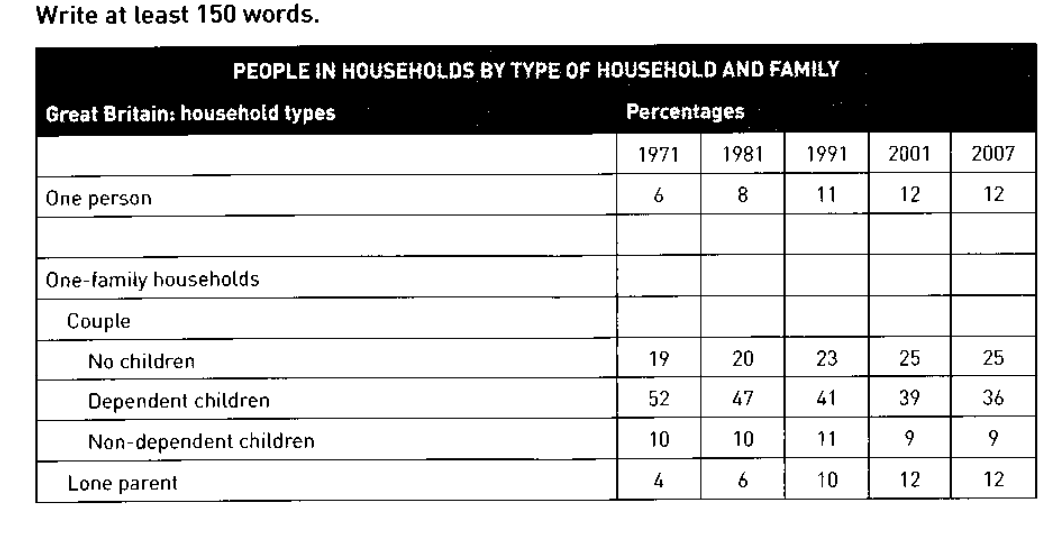
The table below shows the change in some household types in Great Britain from 1971 to 2007.
Summarise the information by selecting and reporting the main features, and make comparisons where relevant.
PEOPLE IN HOUSEHOLDS BY TYPE OF HOUSEHOLD AND FAMILY
Student answer (Band 6.5)
The table gives information about how some of the household types changed in Great Britain between 1971 and 2007.
Overall, among one household families, the percentage of household with no children increased while the proportion of families with dependent or non-dependent children decreased over the period. Meanwhile, family of one person, families including lone parent also rose during this period. However, households with dependent children were the highest in proportion in both the starting and ending of the period.
In 1971, only 6% families contained only one person whereas by 2007, the proportion reached to 12%. Among one family households, the percentage of couple without any kids was 19% which gradually rose to 25% at the end of the period.In the meantime, the proportion of lone parent was 4% in 1971 and ended the period with 12% in 2007.
The percentage of families containing children dropped throughought the period. Households with dependent children were dominant on 1971 with 52% percentage which declined to 36% in 2007. The families containing non-dependent children experienced a slight drop from 10% in 1971 to 9% in 2007.
AI examiner evaluation
| Criterion | Band |
|---|---|
| Task Achievement / Task Response | 7.0 |
| Coherence and Cohesion | 7.0 |
| Lexical Resource | 6.5 |
| Grammatical Range and Accuracy | 6.0 |
| Overall | 6.5 |
Task Achievement / Task Response: Band 7.0
You identify the main overall patterns: the share of households with dependent children fell, while one-person, childless-couple and lone-parent households rose. You also correctly note that dependent-child households remained the largest category at both endpoints, and your figures for 1971 and 2007 are accurate. This gives the response a clear overview and relevant supporting comparisons. To make the account more fully developed, include a few intermediate values or describe the timing of changes—for example, dependent-child households declined from 52% to 41% by 1991 and then to 36%, while lone-parent households rose to 10% in 1991 before reaching 12%. Also, the overview says non-dependent-child households decreased, although they briefly rose from 10% to 11% in 1991 before falling to 9%.
Coherence and Cohesion: Band 7.0
The response is organised in a clear sequence: an introduction, an overview, and two paragraphs comparing household categories. The overview helps the reader understand the main trends before the details, and phrases such as “Meanwhile” and “In the meantime” signal relationships between points. The final paragraph also groups the two categories involving children logically. To strengthen progression further, make the links between categories and time periods more precise, and avoid repeating “the period” without specifying the relevant change. For instance, the final paragraph could contrast the substantial fall in dependent-child households with the much smaller change in non-dependent-child households, while noting the latter’s temporary rise in 1991. This would make the comparisons more tightly connected.
Lexical Resource: Band 6.5
You use a suitable range of trend vocabulary, including “increased,” “declined,” “gradually rose,” “dominant,” and “proportion,” and the meaning is generally clear. There is also some flexibility in how you describe household groups. However, several word choices and collocations are imprecise, such as “family of one person,” “reached to 12%,” and “dominant on 1971 with 52% percentage.” “Kids” is also less appropriate in this formal report than “children.” Spelling errors such as “throughought” detract from accuracy. These issues do not prevent understanding, but more natural, precise phrasing would show stronger control: use “one-person households,” “rose to 12%,” and “accounted for 52% in 1971.”
Grammatical Range and Accuracy: Band 6.0
You use a mix of simple and more complex sentence forms, including a subordinate clause in “while the proportion of families with dependent or non-dependent children decreased.” Most relationships between ideas remain understandable. Some grammatical errors persist, however. In “the percentage of household with no children,” the plural noun should be “households”; “family of one person” also needs a plural form in this context. The construction “reached to 12%” uses an unnecessary preposition, and “the starting and ending of the period” is not a well-formed parallel phrase. There are also punctuation and spacing issues, including the missing space after the full stop before “In the meantime.” Review articles, plurals, and verb patterns, and proofread sentence boundaries to improve accuracy.
See this exact question answered at other band scores. The same prompt compared across bands.
Browse more IELTS Writing model answers or get your own writing scored by the same AI examiner.