Band 5.0 IELTS Writing Task 1 Model Answer
Overall Band Score: 5.0 · IELTS Summit Mastery · 2026-11-14
IELTS Writing Task 1 question
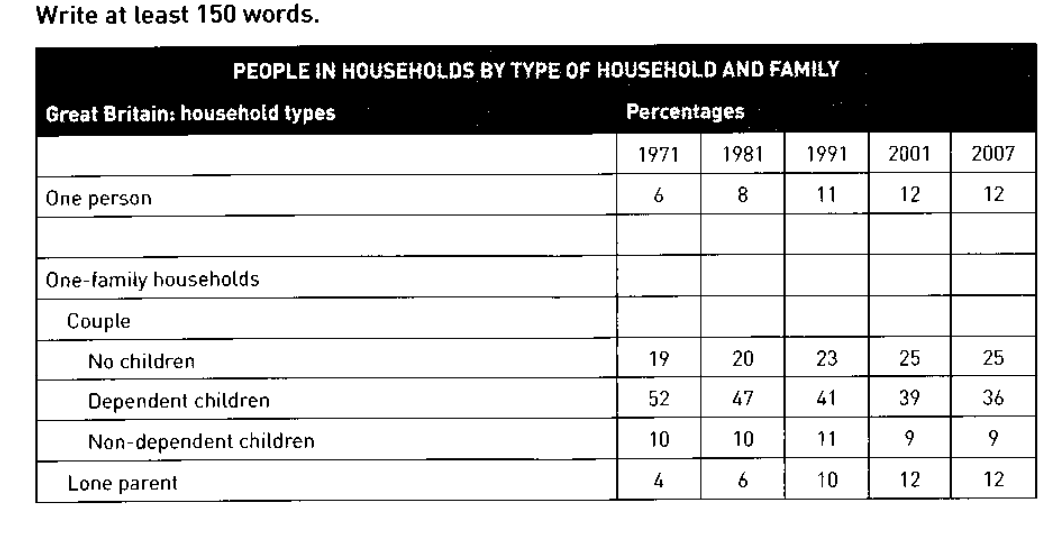
The table below shows the change in some household types in Great Britain from 1971 to 2007.
Summarise the information by selecting and reporting the main features, and make comparisons where relevant.
PEOPLE IN HOUSEHOLDS BY TYPE OF HOUSEHOLD AND FAMILY
Student answer (Band 5.0)
The table illustrates the variation in certain household categories in Great Britain from 1971 to 2007.
Overall, the chart shows the ratio of dependent children is high in the year of 1971 is 52 percent, while it steadily decrease to 36 through out the period, where as non-dependent children takes the lowest valua from 1971 to 2007.
The one person household just recevied 6 percent in the year 1971, and moving upward which is 12 percent in 2007. The one-family households and couple do not participate in the in this chart, as there boxes are empty.
The Great Britain household category of no children also raising from 19 to 25 percent, while lone parent take ten percent in the year 1991 and grow up only two percent till 2007, which is 12 percent. So the table explore the data of changes in some household types in Great Britain frome 1971 to 2007.
AI examiner evaluation
| Criterion | Band |
|---|---|
| Task Achievement / Task Response | 5.5 |
| Coherence and Cohesion | 5.0 |
| Lexical Resource | 5.0 |
| Grammatical Range and Accuracy | 5.0 |
| Overall | 5.0 |
Task Achievement / Task Response: Band 5.5
You identify the main overall decline in the dependent-children category, from 52% to 36%, and note increases in one-person households, couples without children, and lone-parent households. These are relevant features and the figures cited are accurate. However, the overview is unclear: describing non-dependent children as having the “lowest value” is inaccurate, since lone-parent households are lower in 1971 and non-dependent children are not the lowest in later years. The statement that one-family households and couples are absent because their boxes are empty also misreads the table; the couple subcategories are shown, including no children, dependent children, and non-dependent children. To strengthen the response, give a clear overview of the main contrasts and report the non-dependent-children trend accurately.
Coherence and Cohesion: Band 5.0
The response has a basic sequence: an introduction, an overview, and then details about several household types. This gives the reader some organisation, and linking expressions such as “while” and “also” help connect comparisons. However, progression is not consistently clear. The claim that couple households are absent interrupts the data description and conflicts with the figures that follow. The final sentence repeats the introduction rather than adding a useful comparison, while “So” makes the ending sound conversational. Organise the body into related groups—for example, declining categories and increasing categories—and use clear references to distinguish the overall household types from their subcategories.
Lexical Resource: Band 5.0
You use some task-relevant terms, including “dependent children,” “non-dependent children,” “lone parent,” and “household categories,” so the topic is generally identifiable. However, the range is limited and several word choices or collocations are inaccurate, which sometimes makes the meaning difficult to follow. For example, “the ratio … is high” is not a natural way to describe a percentage, and “the one person household just recevied 6 percent” uses an unsuitable verb. There are also noticeable spelling errors, including “valua,” “recevied,” and “frome.” Use precise reporting language such as “accounted for,” “stood at,” “rose,” and “fell,” and check spelling carefully.
Grammatical Range and Accuracy: Band 5.0
You attempt both simple and more extended sentences, including comparisons joined with “while” and “whereas.” However, control is inconsistent, and errors in verb forms, agreement, articles, and sentence construction recur. For instance, “the ratio … is high … is 52 percent” has an incomplete and awkward structure, while “it steadily decrease” needs a correctly formed verb. In “lone parent take ten percent … and grow up,” the subject–verb agreement and verb construction are faulty. The sentence about empty boxes also contains a confusing construction. Practise building accurate sentences around a clear subject and verb, and use past-tense forms consistently when describing changes over the period.
See this exact question answered at other band scores. The same prompt compared across bands.
Browse more IELTS Writing model answers or get your own writing scored by the same AI examiner.