Band 6.0 IELTS Writing Task 1 Model Answer
Overall Band Score: 6.0 · IELTS Summit Mastery · 2026-11-14
IELTS Writing Task 1 question
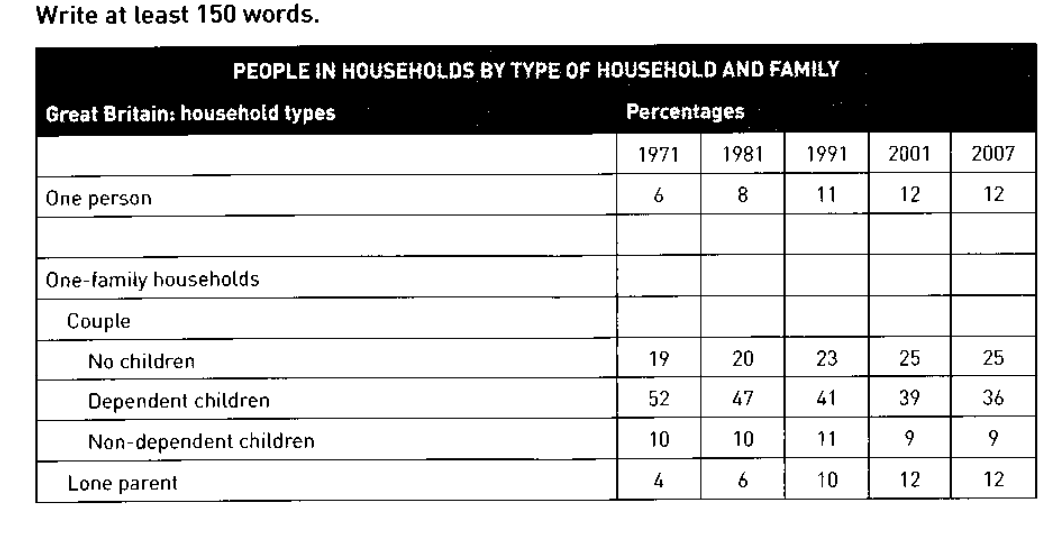
The table below shows the change in some household types in Great Britain from 1971 to 2007.
Summarise the information by selecting and reporting the main features, and make comparisons where relevant.
PEOPLE IN HOUSEHOLDS BY TYPE OF HOUSEHOLD AND FAMILY
Student answer (Band 6.0)
The table illustrates the propotion of different types of household in Great Britain between 1971 and 2007.
Overall, the percentage of dependent children is higher throughout the duration, while lone parent category is 4% in 1971, while it is increased upto 12% in 2007. We can see sn upward trend in all types of household except dependent children and non-dependent children.
The percentage of one person household type is 6 in 1971, which increased to 8% in 1981, then relatively stable in 1991, 2001 and 2007 with a value of about 12%. No children category also shows the same trend with a slight increase from 19% to 20% and then to 23% in 1991, while remains stable from 2001 to 2007 with a value of 25%.
The dependent children type shows a downward trend from 52% in 1971 to 36% in 2007. Similarly, non-dependent children followed a slight downward trend from 10% to 9%.
AI examiner evaluation
| Criterion | Band |
|---|---|
| Task Achievement / Task Response | 6.0 |
| Coherence and Cohesion | 6.0 |
| Lexical Resource | 6.0 |
| Grammatical Range and Accuracy | 5.5 |
| Overall | 6.0 |
Task Achievement / Task Response: Band 6.0
You identify several important patterns, especially the fall in households with dependent children from 52% to 36% and the rise in one-person households and couples without children. The overview also recognises that dependent-child households remain the largest category. However, some details are inaccurate or unclear: one-person households rose to 11% in 1991, rather than remaining stable from 1981, and non-dependent-child households rose slightly to 11% in 1991 before falling to 9%. The overview’s claim that all categories except the two child groups increased is broadly useful, but the discussion does not report the lone-parent figures beyond the overview. More precise coverage of these changes would make the summary more complete and better supported.
Coherence and Cohesion: Band 6.0
The response has a clear overall structure: an introduction, an overview, and two paragraphs describing the figures. The categories are grouped sensibly, and linking expressions such as “Overall,” “Similarly,” and “while” help show relationships between trends. However, some cohesion is mechanical or unclear. In the overview, “while” is repeated in a way that makes the comparison awkward, and “We can see” adds little. The reference to one-person households being “then relatively stable” is also confusing because the figures rise from 8% to 11% before levelling off. Organising the overview around the main rises and falls, then using accurate comparisons in the detail paragraphs, would improve progression.
Lexical Resource: Band 6.0
You use an adequate range of task-related vocabulary, including “percentage,” “downward trend,” “slight increase,” and “stable,” and the meaning is generally clear. There are some spelling and word-choice inaccuracies, such as “propotion” and “sn upward,” which reduce precision. Phrases such as “different types of household” and “one person household type” are understandable but repetitive and less natural than concise category labels. “Increased upto” is also an awkward collocation. Aim to use accurate, consistent terms for the table categories and vary trend language carefully; this would make the report more precise without requiring unnecessarily complex vocabulary.
Grammatical Range and Accuracy: Band 5.5
You use a mix of simple and complex sentences, including relative clauses (“which increased to 8%”) and contrast clauses (“while remains stable”). Most of the message is understandable, but some grammatical errors remain. For example, “while it is increased” uses an incorrect verb form, and “while remains stable” lacks a subject and needs a suitable verb form. The sentence beginning “Overall” also joins two contrasting points with repeated “while,” making its structure difficult to follow. There are occasional article and number-pattern issues in phrases such as “one person household type.” Practise forming accurate past-tense comparisons and ensure each clause has a clear subject and verb.
See this exact question answered at other band scores. The same prompt compared across bands.
Browse more IELTS Writing model answers or get your own writing scored by the same AI examiner.