Band 5.5 IELTS Writing Task 1 Model Answer
Overall Band Score: 5.5 · IELTS Summit Mastery · 2026-11-14
IELTS Writing Task 1 question
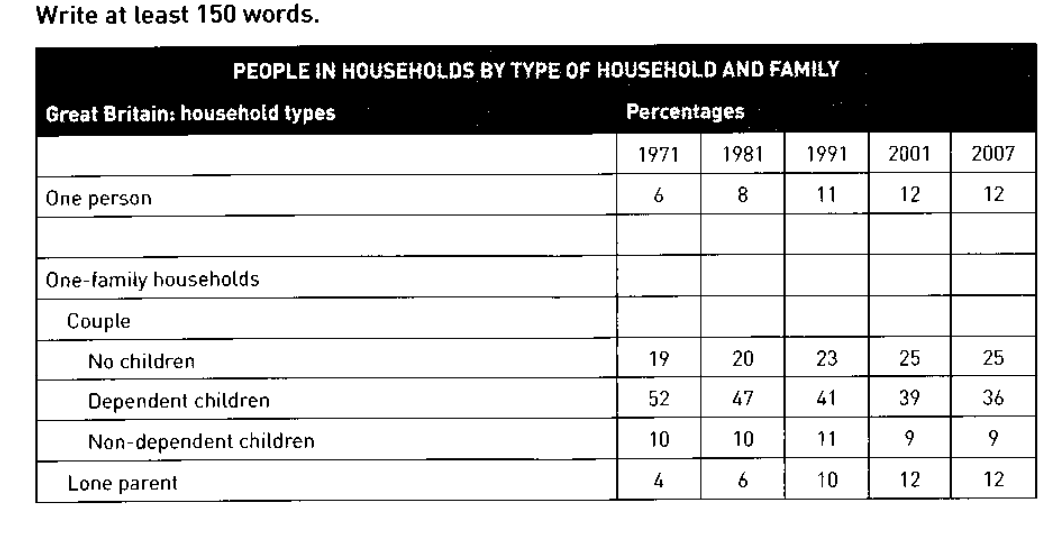
The table below shows the change in some household types in Great Britain from 1971 to 2007.
Summarise the information by selecting and reporting the main features, and make comparisons where relevant.
PEOPLE IN HOUSEHOLDS BY TYPE OF HOUSEHOLD AND FAMILY
Student answer (Band 5.5)
The table illustrate the information about changes happened in different household and families of great britain from 1971 to 2007.
Overall, there was seen increment in percentage of members in several household.Household with dependent children member were decreased in these years.Non-dependent children were stable in these years.
First of all, Household with one person was at 6 percent in 1971.One person household increased from 1971 till 2007 from 6 percent to 12 percent.Houses with dependent children were on highest percentage at 52 percent but there percentage drop in upcoming decade from 52 percentage to 36.
Families with no children at great britian were 19 percent in 1971 then in upcoming there seen a slight increase in these type of families taking them at 25 percentage in 2007.Non-dependent children families became almost stable in terms of percentage during these years from 10 percentage then slight one percent increase in 1991 and then 2 percent decrease till 2007 making at 9 percent.Lone parent group were at lowest percentage at 4 percent but then it inreased to 12 pwecwnt groups of lase parent.
AI examiner evaluation
| Criterion | Band |
|---|---|
| Task Achievement / Task Response | 6.0 |
| Coherence and Cohesion | 6.0 |
| Lexical Resource | 5.0 |
| Grammatical Range and Accuracy | 5.0 |
| Overall | 5.5 |
Task Achievement / Task Response: Band 6.0
You identify the main overall pattern: the share of households with dependent children fell, while one-person and lone-parent households increased. You also report several relevant figures accurately, including the rise in one-person households from 6% to 12% and the fall in dependent-child households from 52% to 36%. The overview is present, but it is somewhat unclear and does not fully compare the categories; for example, calling non-dependent-child households “stable” overlooks their small rise to 11% in 1991 before falling to 9%. Some details are also imprecise, such as describing lone-parent households as the lowest without clarifying that this applies only at the start. Make the overview more precise and select key comparisons more clearly.
Coherence and Cohesion: Band 6.0
The response has a recognisable structure, with an opening, an overview and a body paragraph, and it generally moves through the household categories in a sensible order. Time markers such as “in 1971” and “in 2007” help readers follow the data. However, the progression is sometimes mechanical, with repeated openings such as “Household with…” and “Families with…”. Some links and references are unclear: “there percentage drop” does not clearly identify the figure, and “then in upcoming” leaves the time relationship vague. Separate the comparisons into clearer groups and use precise references to categories and years. This would make the organisation more consistently easy to follow.
Lexical Resource: Band 5.0
You use enough topic vocabulary to communicate the main trends, including “percentage,” “increased,” “decreased,” and “stable.” However, the range is limited and several word choices or collocations are unnatural, such as “increment in percentage,” “percentage drop,” and “taking them at 25 percentage.” Repetition of “household,” “families,” and “percentage” also reduces flexibility. There are spelling errors, including “britian,” “inreased,” and “pwecwnt,” which make parts of the final sentence difficult to understand. Aim for accurate, conventional data-reporting language, such as “the proportion rose to” or “accounted for,” and check spelling carefully. These changes would improve precision and readability.
Grammatical Range and Accuracy: Band 5.0
You attempt both simple and more extended sentences, and the reader can usually understand the intended comparisons. However, some grammatical errors recur in sentence formation, agreement, articles and verb forms. For example, “The table illustrate” needs subject–verb agreement, while “there was seen increment” is an awkward passive construction. In “Household with dependent children member were decreased,” the singular/plural forms and verb pattern are not controlled. Several sentences also run together without clear punctuation, particularly the long sentence about non-dependent children. Use straightforward, accurate structures first, then add complex clauses where you can control them; check agreement and sentence boundaries during revision.
See this exact question answered at other band scores. The same prompt compared across bands.
Browse more IELTS Writing model answers or get your own writing scored by the same AI examiner.