Band 6.0 IELTS Writing Task 1 Model Answer
Overall Band Score: 6.0 · IELTS Summit Mastery · 2026-11-15
IELTS Writing Task 1 question
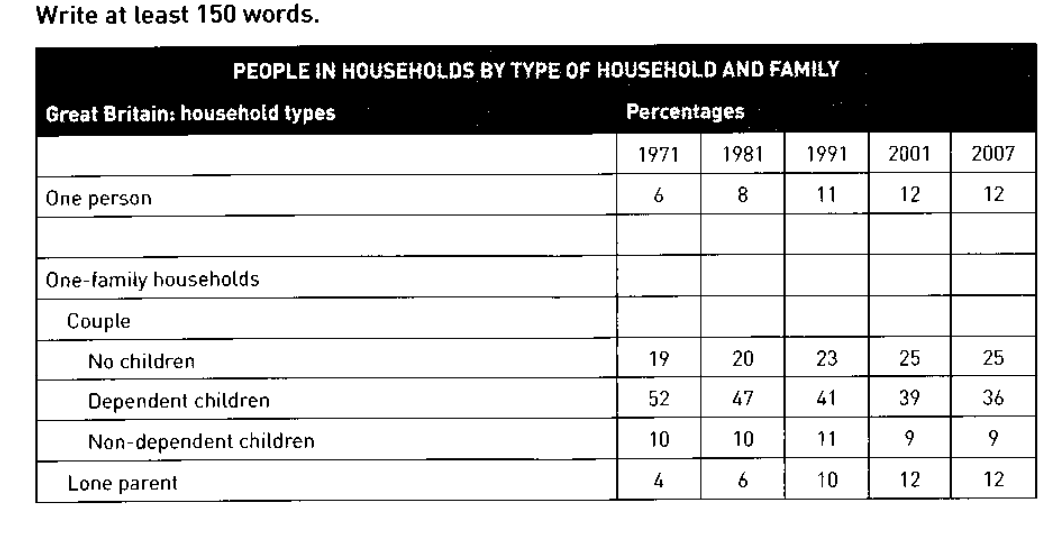
The table below shows the change in some household types in Great Britain from 1971 to 2007.
Summarise the information by selecting and reporting the main features, and make comparisons where relevant.
PEOPLE IN HOUSEHOLDS BY TYPE OF HOUSEHOLD AND FAMILY
Student answer (Band 6.0)
The table illustartes the number of families and households living in United Kindom between 1971 to 2007.
Overall, single individuals living in houses increase gradually 2% from 1971 to 2007. Whereas, the families having no children also rose 6%. Dependent children fall 16%, non-dependent pupils also decline by 1% and lone parent increase 8%.
In Great Britian, one person living in house increase 2% in 1981, 3% in 1991 but the number of single individuals remain same from 2001 to 2007 around 12%. One-family households with no children also saw a rise of 6% from 1971 till 2007. In contrast, the family households with dependent pupils decrease 16% and at the end of 2007 only 36% children are dependent.
Families with non-dependent children contribute 10% in 1971 and 1981 but, increase 1% in year 1991 and also deacrease 2% in 2001 and figure remain the same for year 2007. Number of lone parent also rose from 1971 till 2007 approximately 8%.
AI examiner evaluation
| Criterion | Band |
|---|---|
| Task Achievement / Task Response | 6.0 |
| Coherence and Cohesion | 6.0 |
| Lexical Resource | 5.5 |
| Grammatical Range and Accuracy | 5.5 |
| Overall | 6.0 |
Task Achievement / Task Response: Band 6.0
You identify the main overall movements: the shares for one-person and childless-couple households rise, while households with dependent children decline. You also include relevant figures, such as the fall from 52% to 36% for dependent children and the increase from 4% to 12% for lone-parent households. However, the overview is presented as a list of changes rather than a clear comparison of the most significant features, and some details are imprecise: one-person households rise by six percentage points overall, not two, and non-dependent children finish at 9%, after falling from 11% in 1991. The response covers the categories, but clearer, more accurate comparisons and a sharper overview would make the key trends more fully developed.
Coherence and Cohesion: Band 6.0
The response has a recognisable structure, with an opening, an overview and two paragraphs of details. The information is generally grouped by household type, and linking expressions such as “Whereas” and “In contrast” help signal comparisons. However, the overview repeats information that is then restated in the detail paragraphs, and the sequence of figures for non-dependent children is difficult to follow, particularly in “increase 1% in year 1991 and also decrease 2% in 2001.” Some transitions are also awkwardly attached to sentence fragments or clauses. Organise the overview around the largest contrasts, then report each trend once in a logical order, using clear references to the years and categories.
Lexical Resource: Band 5.5
You use relevant task vocabulary, including “households,” “dependent,” “non-dependent,” “rise,” and “decline,” so the reader can understand the categories and general trends. There is some repetition of basic verbs such as “increase,” “rise,” and “decrease,” and several choices are inaccurate or unnatural: “single individuals living in houses” is less precise than “one-person households,” while “dependent pupils” does not match the table’s category of dependent children. Spelling errors such as “illustartes,” “Britian,” and “deacrease” also reduce accuracy. Aim for precise labels from the table and vary trend language appropriately, for example “accounted for” or “fell to,” while checking spelling and collocations.
Grammatical Range and Accuracy: Band 5.5
You attempt both simple and more complex sentence forms, including contrast clauses such as “Whereas, the families having no children also rose 6%.” The main meaning is usually understandable, but some grammatical errors remain. Subject–verb agreement and verb forms are inconsistent: “one person living in house increase” and “the figure remain” should use past-tense forms such as “increased” and “remained.” Comparisons also need more accurate grammatical framing, as in “increase 2% in 1981,” where the intended change should be expressed as an increase of two percentage points. Articles and prepositions are sometimes missing or awkward. Use consistent past tense for the historical data and check agreement and sentence boundaries.
See this exact question answered at other band scores. The same prompt compared across bands.
Browse more IELTS Writing model answers or get your own writing scored by the same AI examiner.