Band 5.5 IELTS Writing Task 1 Model Answer
Overall Band Score: 5.5 · IELTS Summit Mastery · 2026-11-16
IELTS Writing Task 1 question
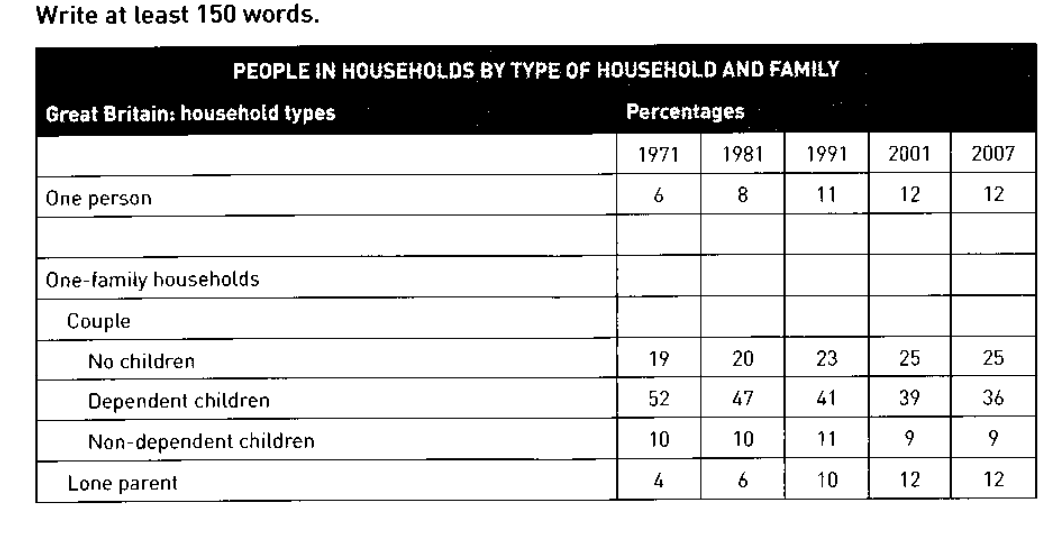
The table below shows the change in some household types in Great Britain from 1971 to 2007.
Summarise the information by selecting and reporting the main features, and make comparisons where relevant.
PEOPLE IN HOUSEHOLDS BY TYPE OF HOUSEHOLD AND FAMILY
Student answer (Band 5.5)
The table illustrates the variation of household and family in Great Britain from 1971 to 2007.
Overall, there are two main categories of household such as single person and one family households in which percentage of single person household number increased over the time period. On the other hand, one family household had many sub categories where there was a variation trend in that categories but most likely no children household's percentage increasedover the time frame.
By looking at the table, number of household of one person rose rapidly as it started at only 6% in 19671 and following decades it percenatage rose and ultimately it ended with 12% in 2007. From the One family household category there are no data for couple household, but similar trend was seen in no children category as it was initially 19% which rose to 25% after five decades. Lone parent household perenatge was very low as initially it was 4% after five decades it rose to 12%
On the other hand, dependent children and non dependent children showed a decline trend.
AI examiner evaluation
| Criterion | Band |
|---|---|
| Task Achievement / Task Response | 6.0 |
| Coherence and Cohesion | 6.0 |
| Lexical Resource | 5.5 |
| Grammatical Range and Accuracy | 5.0 |
| Overall | 5.5 |
Task Achievement / Task Response: Band 6.0
You identify the broad pattern that one-person and lone-parent households increased, while dependent-child households declined, and you include several accurate figures: one-person households rose from 6% to 12%, couples without children from 19% to 25%, and lone-parent households from 4% to 12%. The overview also recognises that the table contains different family types. However, the main features are not fully reported: the largest category, dependent children, is only mentioned as declining, without its substantial fall from 52% to 36%, and the non-dependent-child figures are not described. The claim that there are “no data for couple household” is misleading; the table gives figures for couples with no children. A clearer overview and fuller comparison of the major trends would strengthen the response.
Coherence and Cohesion: Band 6.0
The response has a recognisable structure: an introduction, an overview, a paragraph with selected figures, and a final contrast. This gives the reader a generally coherent route through the information. However, the final paragraph is very brief and does not develop the decline it introduces, while the main data paragraph combines several categories without a consistent comparison. Some linking is mechanical, particularly the repeated use of “On the other hand,” and the reference to “that categories” is unclear. Organise the details into clearer groups—for example, rising categories in one paragraph and falling categories in another—and use precise references to connect each figure to its household type.
Lexical Resource: Band 5.5
You use relevant task vocabulary such as “percentage,” “household,” “increased,” “decline,” and “dependent children,” so the topic is generally understandable. There are also attempts at more formal phrasing, including “illustrates the variation” and “over the time period.” However, several choices are inaccurate or awkward, such as “variation trend,” “rose rapidly” for a gradual change, and “number of household” when discussing percentages. Spelling errors, including “percenatage” and “perenatge,” also reduce precision. Aim for accurate collocations such as “the proportion of one-person households” and “showed a downward trend,” and check spelling carefully. This would make the vocabulary more precise and natural.
Grammatical Range and Accuracy: Band 5.0
You attempt both simple and more complex sentences, including a contrast introduced by “On the other hand” and a clause beginning “as it started at only 6%.” The main message is usually recoverable, but some grammatical errors recur. For example, “in which percentage of single person household number increased” has an unclear clause structure, and “it ended with 12%” uses an imprecise grammatical pattern for describing a figure. There are also problems with articles, plurals, and agreement in phrases such as “one family household had many sub categories” and “Lone parent household percentage was very low.” Use controlled sentence patterns such as “The proportion of one-person households rose from 6% to 12%,” and proofread sentence boundaries and punctuation.
See this exact question answered at other band scores. The same prompt compared across bands.
Browse more IELTS Writing model answers or get your own writing scored by the same AI examiner.