Band 5.5 IELTS Writing Task 1 Model Answer
Overall Band Score: 5.5 · IELTS Summit Mastery · 2026-11-16
IELTS Writing Task 1 question
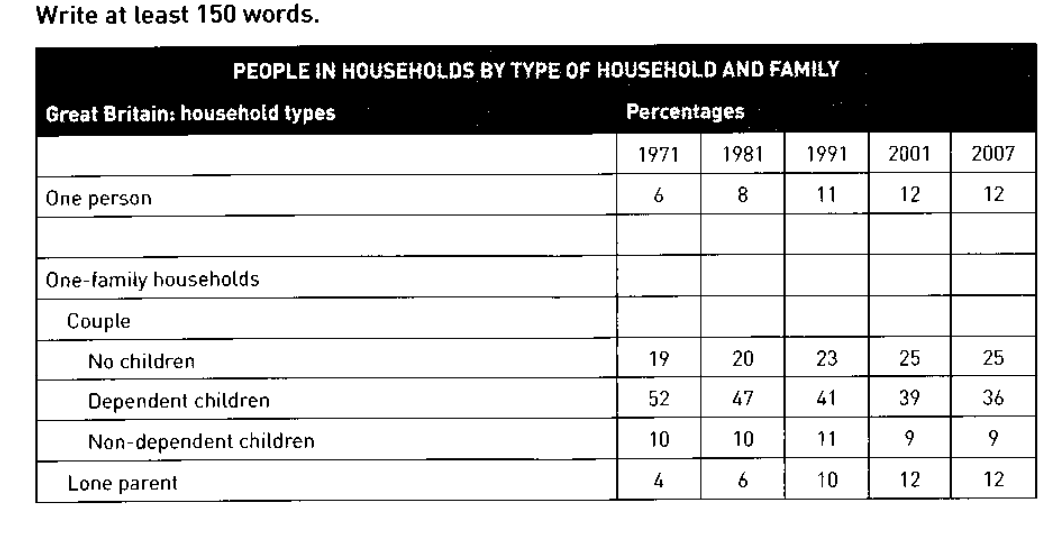
The table below shows the change in some household types in Great Britain from 1971 to 2007.
Summarise the information by selecting and reporting the main features, and make comparisons where relevant.
PEOPLE IN HOUSEHOLDS BY TYPE OF HOUSEHOLD AND FAMILY
Student answer (Band 5.5)
The table illustrates the changes in the number of people in household types in Great Britain over a period of 26 years starting from 1971.
Overall it can be see that,the number of family having no children increased over the years,Interesame can be said for one person family and also for the lone parent.Interestingly, the number of family with dependent children decreased dramatically over this period.The figure for couple having a non dependent children also decreased slightly.
According to the table,we can say that in 1971 the number One person family was 6 which doubled to 12 in 2007.The figure for couple having no children in 1971 was 19 which slightly increased to 25 in 2007.The same can not be said for the couple having dependent children.The number decreased drastically over the year starting from 52 at 1972 and resulting in 36 in 2007.The number of couple having non dependent children slightly decreased to 9 in 2007 which was at 10 in 1971.But the figure for lone parent experienced a drastic rise.The number was at 4 in 1971 and it peaked at 12 in 2007.
AI examiner evaluation
| Criterion | Band |
|---|---|
| Task Achievement / Task Response | 6.0 |
| Coherence and Cohesion | 5.5 |
| Lexical Resource | 5.5 |
| Grammatical Range and Accuracy | 5.5 |
| Overall | 5.5 |
Task Achievement / Task Response: Band 6.0
You identify the main overall patterns: the shares for one-person households, couples without children and lone-parent households rose, while the dependent-children category fell. You also support these points with several accurate start-and-end figures, such as 6% to 12% for one-person households and 52% to 36% for dependent children. However, the response is not fully precise: the table gives percentages, not numbers of people, and the dependent-children figure starts at 52% in 1971, not 1972. The overview also says non-dependent households decreased, although their share first rose to 11% before falling to 9%. More precise reporting of the units and intermediate movement would make the key features clearer and more fully developed.
Coherence and Cohesion: Band 5.5
The response has a recognisable structure, moving from an introduction to an overview and then to supporting details. This helps the reader follow the main comparisons, and linking expressions such as “Overall,” “According to the table,” and “But” show an attempt to connect ideas. However, progression is sometimes mechanical, with repeated sentence openings such as “The number” and “The figure,” and the overview and detail paragraph repeat several points rather than developing them in a clear sequence. Punctuation spacing and inconsistent capitalisation also interrupt the flow. Grouping the rising categories together and then contrasting them with the declining category would create a more coherent progression, while clearer references would reduce repetition.
Lexical Resource: Band 5.5
You use a relevant range of vocabulary for describing trends, including “increased,” “decreased,” “doubled,” “dramatically,” and “slightly.” These choices generally communicate the direction and scale of change. However, some wording is imprecise or unnatural: “number of people in household types” does not accurately describe percentages, and “family having no children” and “couple having a non dependent children” are awkward formulations. “Interesame” appears to be a spelling or typing error, and “peaked” is not the best choice for a value that simply reached 12% at the end. Use standard category labels and precise terms such as “proportion” or “share” to make comparisons more natural and accurate.
Grammatical Range and Accuracy: Band 5.5
You attempt both simple and more complex sentence forms, including contrast with “The same can not be said…” and a relative clause in “which was at 10 in 1971.” The main meaning is usually understandable, but some grammatical errors remain. For example, “it can be see” needs a past participle, and “the number of family” has a number-agreement problem. The sentence beginning “Overall” also contains unclear clause boundaries, while “starting from 52 at 1972” has an incorrect preposition and tense pattern. Commas are frequently attached to the following word or used inconsistently. Check verb forms, singular/plural agreement, and sentence punctuation, then proofread each sentence for a complete and clearly structured clause.
See this exact question answered at other band scores. The same prompt compared across bands.
Browse more IELTS Writing model answers or get your own writing scored by the same AI examiner.