Band 5.5 IELTS Writing Task 1 Model Answer
Overall Band Score: 5.5 · IELTS Summit Mastery · 2026-11-16
IELTS Writing Task 1 question
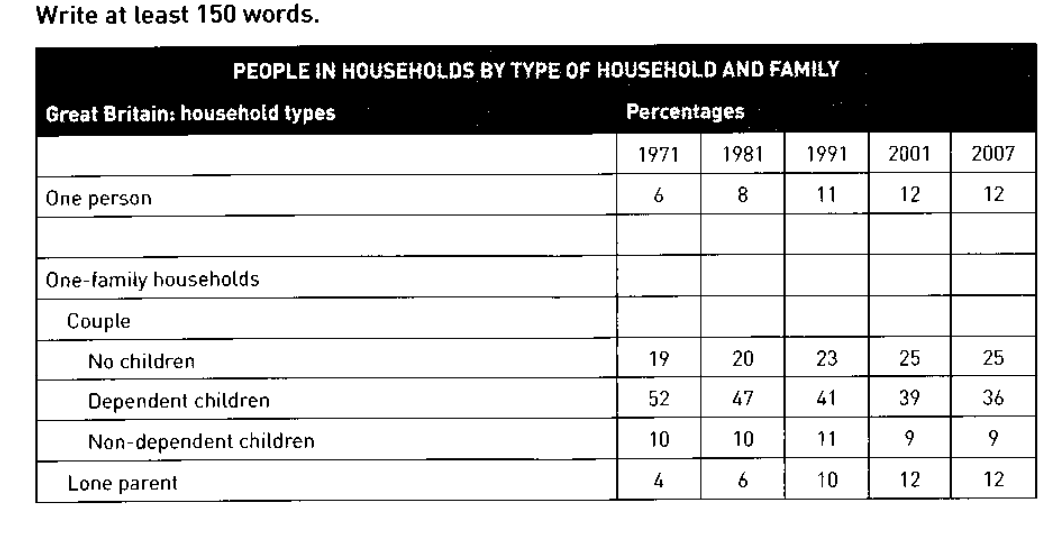
The table below shows the change in some household types in Great Britain from 1971 to 2007.
Summarise the information by selecting and reporting the main features, and make comparisons where relevant.
PEOPLE IN HOUSEHOLDS BY TYPE OF HOUSEHOLD AND FAMILY
Student answer (Band 5.5)
The table illustrates the prportion of people in households by type of household and family in Great Britain from 1971 to 2007.
Overall, the proportion of one person is increased over the period. In one-family households, the couple with no children and lone parents are highly rise, while dependent and non-dependent are decreased.
In 1971, looking first at the one person type that was change through out the time and surge from 6% to 12% in 2007. While in one-family households types, the couple who have no child are increase in quantity throughout the period of 1971 to 2007 from 19% to 25%.
Following this the dependent and non-dependent childrens are rapidly decrease in numbers. Finally the lone parent are wentup from 4% to 12% in 2007.The significant transformation occured by rapidly increasing proportion of one person and couple who have no child, in contrast the dependent and non-dependent proprotion marginally wentdown through out the time.
AI examiner evaluation
| Criterion | Band |
|---|---|
| Task Achievement / Task Response | 5.5 |
| Coherence and Cohesion | 5.5 |
| Lexical Resource | 5.5 |
| Grammatical Range and Accuracy | 5.0 |
| Overall | 5.5 |
Task Achievement / Task Response: Band 5.5
You identify the overall rise in the one-person, childless-couple and lone-parent categories, and the fall in households with dependent children. The figures you give for the first three categories are accurate: one-person households rise from 6% to 12%, childless couples from 19% to 25%, and lone parents from 4% to 12%. However, the overview says non-dependent households decreased, although they rise slightly from 10% to 11% before falling to 9%; describing this as a marginal decline misses that fluctuation. The dependent-children category is the clearest major change, falling from 52% to 36%, but you do not report its figures. The response is also 3 words below the required minimum. Include the key figures and distinguish the two child categories more precisely.
Coherence and Cohesion: Band 5.5
The response has a recognisable structure: an introduction, an overview and a body that moves through several household types. Sequencing phrases such as “Overall,” “In 1971” and “Finally” help signal the stages of your account. However, the progression is not consistently clear because the body repeats points from the overview and groups the dependent and non-dependent categories together without explaining their different trends. The sentence beginning “While in one-family households types” is an incomplete contrast, and the final sentence repeats the main changes rather than adding a clear comparison. Use separate, logically ordered sentences for the categories, and connect comparisons directly—for example, contrast the sharp fall in dependent-child households with the slight net fall in non-dependent-child households.
Lexical Resource: Band 5.5
You use relevant vocabulary for describing data, including “proportion,” “surge,” “in contrast” and “transformation,” and the reader can generally identify the household categories being discussed. However, the range is limited and several choices or forms are inaccurate or unnatural, such as “highly rise,” “increase in quantity,” “rapidly decrease in numbers” and “wentdown.” There are also spelling errors, including “prportion,” “childrens” and “proprotion,” which reduce precision. Some terms are repeated rather than varied, and “surge” overstates the steady rise from 6% to 12%. Aim for accurate, conventional chart language and check spelling and word forms before submitting.
Grammatical Range and Accuracy: Band 5.0
You attempt both simple and more complex sentence forms, including a contrast introduced by “While” and a concluding sentence beginning “in contrast.” However, complex structures are often faulty, and errors occur frequently enough to make parts of the response awkward to follow. Examples include “the proportion of one person is increased,” where the verb form is incorrect, and “the lone parent are wentup,” which has problems with agreement and verb construction. “While in one-family households types” is also an incomplete clause, while “the dependent and non-dependent childrens are rapidly decrease” combines incorrect agreement with an unsuitable verb form. Practise forming complete sentences with a clear subject and a correctly conjugated verb, then check singular and plural agreement.
See this exact question answered at other band scores. The same prompt compared across bands.
Browse more IELTS Writing model answers or get your own writing scored by the same AI examiner.