Band 5.5 IELTS Writing Task 1 Model Answer
Overall Band Score: 5.5 · IELTS Summit Mastery · 2026-11-16
IELTS Writing Task 1 question
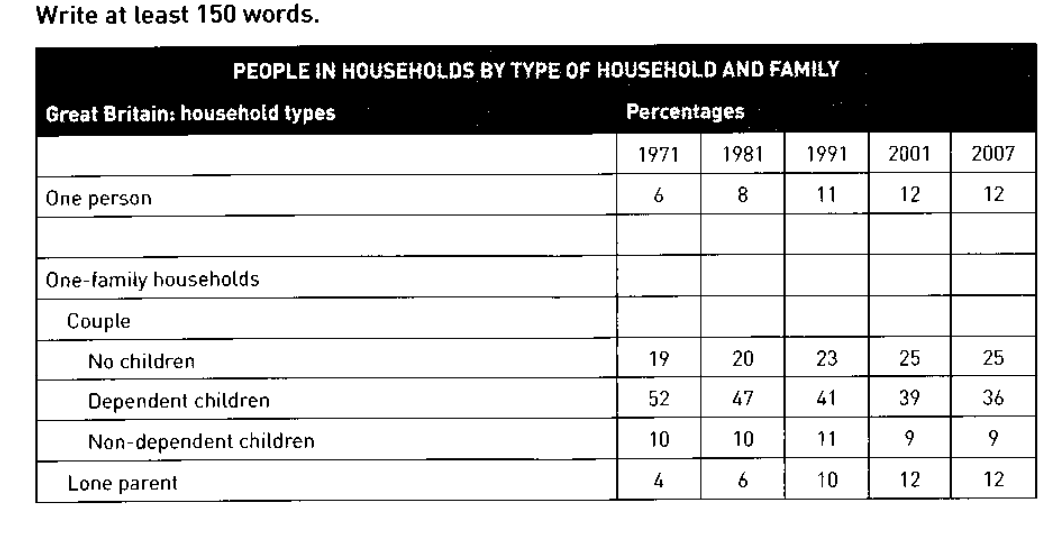
The table below shows the change in some household types in Great Britain from 1971 to 2007.
Summarise the information by selecting and reporting the main features, and make comparisons where relevant.
PEOPLE IN HOUSEHOLDS BY TYPE OF HOUSEHOLD AND FAMILY
Student answer (Band 5.5)
The table presents the variation in the UK households between 1971 and 2007.
Overall, the proportion of households with only one member, families with childless couples and sigle parent had been increased significantly. Households with dependent children were on top of the list but fell significantly in 2007.
One person households accounted for 6% of the total which grew steadily and peaked at 12% in 2007. With regards to the family structure: there was an significant rise in families with no children which rose from 19% in 1971 to 25% in 2007. Similarly, lone parent showed an increasing trend rising from only 4% to 12% in 2007.
The most striking shift was shown by families having dependent children. In 1971, majority of households had children but over the years this trend declined till it fell to only 36% in 2007. Families with no dependent children had so such clear trend it stood at 10% in 1971, then rose to
AI examiner evaluation
| Criterion | Band |
|---|---|
| Task Achievement / Task Response | 5.5 |
| Coherence and Cohesion | 5.5 |
| Lexical Resource | 6.0 |
| Grammatical Range and Accuracy | 5.5 |
| Overall | 5.5 |
Task Achievement / Task Response: Band 5.5
You identify several important patterns: one-person households, childless couples and lone-parent households all increased, while households with dependent children declined from 52% to 36%. These figures support a relevant overview and show awareness of the main contrast. However, the overview is not fully precise: “increased significantly” overstates some changes, and the claim that dependent-child households “fell significantly in 2007” suggests a single-year fall rather than a decline across the period. The final discussion of non-dependent children is unfinished, so this category’s trend is not reported. To strengthen the response, complete that comparison and describe the overall changes accurately, including that this category rose slightly before falling.
Coherence and Cohesion: Band 5.5
The response has a recognisable structure, with an introduction, an overview and paragraphs describing the figures. The progression from general trends to specific household types is mostly understandable, and phrases such as “Similarly” and “The most striking shift” help signal relationships. However, the final sentence stops after “then rose to”, leaving an idea incomplete and disrupting the ending. Some links are also imprecise: “With regards to the family structure” does not clearly introduce the two categories that follow, while “but” in the overview joins ideas whose relationship could be expressed more clearly. Finish each comparison and organise the categories consistently—for example, group the rising types together, then contrast them with the declining types.
Lexical Resource: Band 6.0
You use an adequate range of task-related vocabulary, including “proportion”, “accounted for”, “declined”, “trend” and “striking shift”. These choices make the main comparisons clear, and there is some variety in how changes are described. However, several word choices or collocations are inaccurate or awkward, such as “the variation in the UK households”, “had been increased”, and “families having dependent children”. “Sigle” is also misspelled, and “so such clear trend” appears to be an unsuccessful phrase. Use standard chart language and check spelling and collocation; for example, refer to “household types in Great Britain” and “families with dependent children”. This would make the vocabulary more precise without requiring more elaborate wording.
Grammatical Range and Accuracy: Band 5.5
You attempt both simple and complex sentences, including clauses with “which” and “but”, and most of the intended comparisons remain understandable. However, errors in tense, articles and sentence construction recur. For example, “had been increased” is not the appropriate form for a trend over the period; “there was an significant rise” has an article error; and “In 1971, majority of households” needs an article. The final sentence is also grammatically incomplete, ending with “then rose to”. Use the past simple consistently for the historical data, check singular/plural agreement and articles, and ensure every sentence has a complete ending. These revisions would improve accuracy while preserving your attempts at varied sentence forms.
See this exact question answered at other band scores. The same prompt compared across bands.
Browse more IELTS Writing model answers or get your own writing scored by the same AI examiner.