Band 5.0 IELTS Writing Task 1 Model Answer
Overall Band Score: 5.0 · IELTS Summit Mastery · 2026-11-16
IELTS Writing Task 1 question
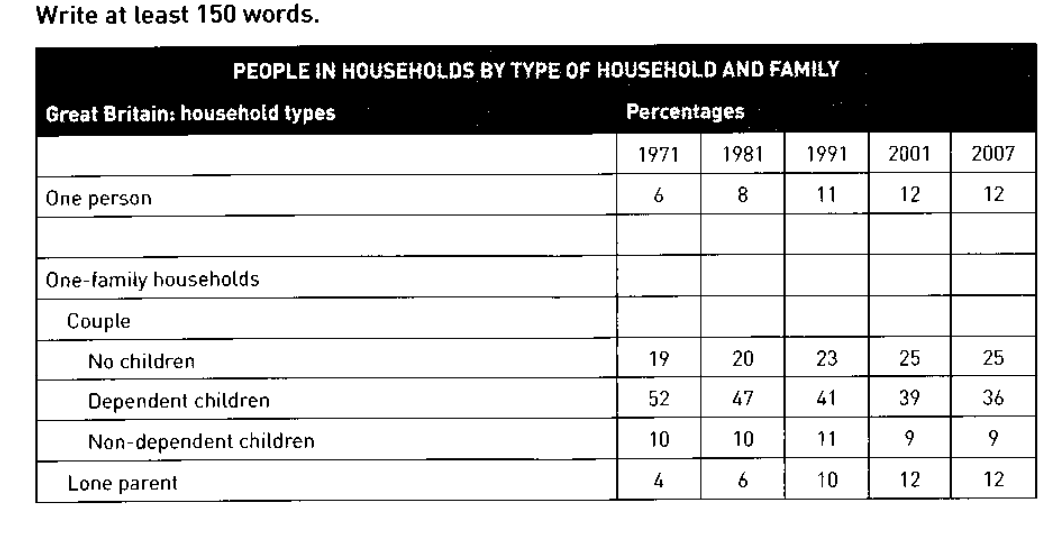
The table below shows the change in some household types in Great Britain from 1971 to 2007.
Summarise the information by selecting and reporting the main features, and make comparisons where relevant.
PEOPLE IN HOUSEHOLDS BY TYPE OF HOUSEHOLD AND FAMILY
Student answer (Band 5.0)
The table given below illustrates the type of household in Great Britain from year 1971 to 2007.
To begin with, one person data in year 1971 is lower and gradually rise from year 1971 to 2007 and the figure is 12. There were no couples shown in the data. Family's with no children were 19 in year 1971, 20 in 1981 and numbers increased to 25 in year 2007. In addition, dependent pupils data was 52 in 1971 and led to a fall in numbers in year 2007 to 36.
Moreover, Non-dependant pupils same number of data can be seen in year 1971 and 1981 that is 10 and led to decrease to data 9 in year 2007. Lone parent data was so small in number about 4 in year 1971 and gradually inclined in year 2001 to 2007 about 12. In comparison, one individual and lone parent, the data depicts almost same number from year 1971 to 2007.
In conclusion, dependant children number was so much at rise year 1971 and decreased to 36 in year 2007. It is crucial for pupils to become independent and meet populance from different walks of life.
AI examiner evaluation
| Criterion | Band |
|---|---|
| Task Achievement / Task Response | 4.5 |
| Coherence and Cohesion | 5.5 |
| Lexical Resource | 5.0 |
| Grammatical Range and Accuracy | 5.0 |
| Overall | 5.0 |
Task Achievement / Task Response: Band 4.5
You identify several relevant changes, including the rise in one-person households, the increase in couples without children, and the decline in households with dependent children. However, the response only partially summarises the table: it gives no clear overview of the main patterns, and some statements are inaccurate or unclear. For example, “There were no couples shown” conflicts with the figures for couples with and without children; the table shows no separate total for couples, not an absence of couples. The comparison claiming that one-person and lone-parent figures were “almost same” across the period is also misleading, as their starting values differ. Focus on the largest overall trends and report the categories precisely, without adding advice about pupils or independence.
Coherence and Cohesion: Band 5.5
The response has a basic paragraph structure, moving from an introduction to two groups of details and a concluding paragraph. Sequencing words such as “To begin with,” “Moreover,” and “In comparison” help signal movement between points. However, progression is weakened by grouping figures without a clear organising principle, and some links do not express a meaningful comparison. The conclusion repeats the decline in dependent-child households rather than summarising the table’s overall picture, then shifts to an unrelated comment about pupils. Use a concise overview after the introduction, organise the details into clear trend groups, and ensure each linking phrase accurately describes the relationship between the figures.
Lexical Resource: Band 5.0
You use some relevant vocabulary for describing data, including “increased,” “fall,” “decrease,” and “in comparison,” so the reader can identify several intended trends. However, the range is limited and some word choices are inaccurate or unnatural for this table. “Dependent pupils” and “Non-dependant pupils” mislabel household categories, while “data” is repeatedly used where “figure” or “percentage” is needed. Phrases such as “gradually inclined” and “so small in number” are also imprecise. Use standard terms such as “households,” “share,” “rose,” and “declined,” and check spelling and word forms, including “dependent.” This would make the description more precise and easier to follow.
Grammatical Range and Accuracy: Band 5.0
The response uses mostly simple sentence patterns, with a few attempts to combine ideas using “and,” “while,” and introductory phrases. Meaning is generally recoverable, but errors occur frequently in verb forms, agreement, articles, and sentence construction. For example, “one person data … gradually rise” needs a past-tense verb and a clearer subject, while “Family's with no children were 19” has an incorrect plural form and an awkward structure. The sentence beginning “Moreover, Non-dependant pupils same number…” is incomplete, and “the data depicts almost same number” lacks an article and has unclear agreement. Practise accurate past-tense reporting and build complete sentences around the category and its percentage before attempting longer structures.
See this exact question answered at other band scores. The same prompt compared across bands.
Browse more IELTS Writing model answers or get your own writing scored by the same AI examiner.