Band 5.0 IELTS Writing Task 1 Model Answer
Overall Band Score: 5.0 · IELTS Summit Mastery · 2026-11-17
IELTS Writing Task 1 question
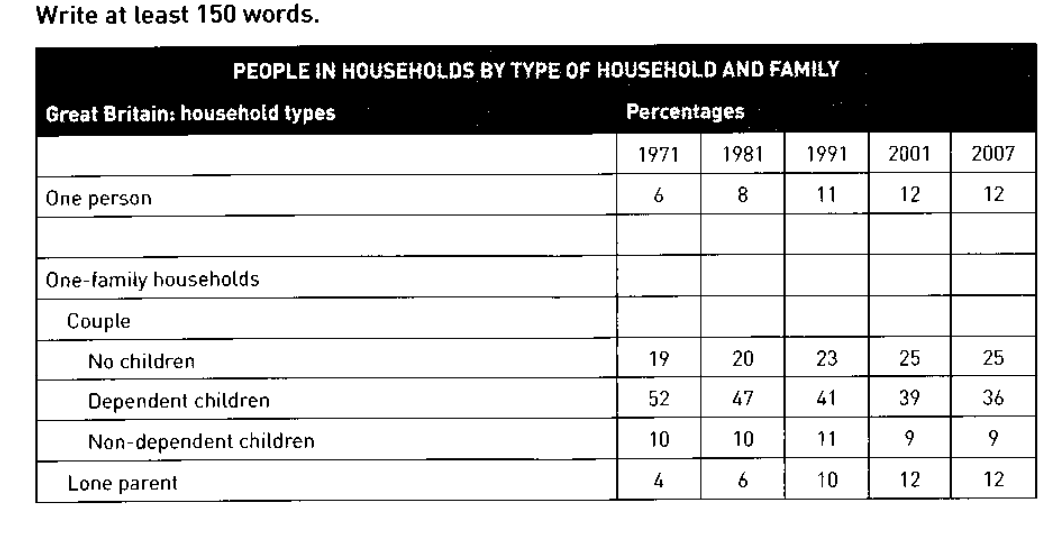
The table below shows the change in some household types in Great Britain from 1971 to 2007.
Summarise the information by selecting and reporting the main features, and make comparisons where relevant.
PEOPLE IN HOUSEHOLDS BY TYPE OF HOUSEHOLD AND FAMILY
Student answer (Band 5.0)
The table illustrates the amount of household types is changed in Great Britain from 1971 to 2007.
To commence, one person changed 6% type of household in 1971. Whereas, it was incresed by 2% in 1981. Moreover, in 1991 it stood at 11% change in household type, while it rose similar persentage in 2001 and 2207, at 12% each. While, lone parent were changed 4% household in 1971, which rose in 1981 and 1991, at 6% and 10% respectively. Moreover, the similar numbers were looked in 2001 and 2007, at 12% each.
On the other hand, one family households, the couple were change nothing in all given years. While, no childen were changed 19% household in 1971, which climed up in 1981,1991,2001, and 2007 at 20%, 23%, 25%, and 25% respectively. However, the proportion of change in household were declined in dependent children in 1971, 1981,1991,2002, and 2007, at 52%, 47%, 41%, 39%, and 36% respectively. The alomost smiliar persent seen for non- dependent children. In addition, in 1971 and 1981, there were no change in household, at 10% each, and in 2002 and 2007, the proportion was again similar, at 9% each, but, in 1991, the the percentage went up by 11% .
Overall, the marjority of household were changed by dependent children and couple were changed nothing in household.
AI examiner evaluation
| Criterion | Band |
|---|---|
| Task Achievement / Task Response | 5.0 |
| Coherence and Cohesion | 5.5 |
| Lexical Resource | 5.0 |
| Grammatical Range and Accuracy | 5.0 |
| Overall | 5.0 |
Task Achievement / Task Response: Band 5.0
You report several relevant figures accurately, including the rise in one-person households from 6% to 12% and the fall in households with dependent children from 52% to 36%. However, the response only partly fulfils the task because it gives a sequence of figures rather than a clear overview of the main changes. The final statement that dependent children made up the majority is relevant, but saying couples “were changed nothing” is inaccurate: the table gives no separate percentage for couples, only for the listed household categories. The opening also describes the “amount” of household types changing, which does not clearly explain that the figures are percentages of people in household types. Identify the main upward and downward trends directly, and avoid claims unsupported by the table.
Coherence and Cohesion: Band 5.5
The response has a basic structure, with an opening, two body paragraphs and a concluding statement. It also groups one-person and lone-parent households separately from the other categories, which gives the reader some organisation. However, progression within the paragraphs is often mechanical: repeated “Moreover,” “While,” and “However” do not always show the relationship between the figures, and some sentence fragments interrupt the flow, such as “Whereas, it was incresed by 2% in 1981.” The final overview repeats information without clearly synthesising the trends. Use a more purposeful sequence—first summarise the overall pattern, then compare rising categories with declining ones—and connect sentences with accurate, varied linking phrases.
Lexical Resource: Band 5.0
You use some relevant terms for describing data, including “stood at,” “rose,” “declined,” “proportion,” and “respectively.” This gives you a basic vocabulary for reporting figures. However, the range is limited and several repeated or inaccurate expressions make the meaning less clear, especially “changed household,” “similar numbers were looked,” and “the proportion of change in household.” There are also noticeable spelling errors, such as “incresed,” “persentage,” “childen,” and “alomost.” Choose precise terms for shares and trends, and check spelling carefully. For example, describe a figure as a “percentage” or “proportion,” and say that it “increased” or “remained stable,” rather than saying a household type “changed.”
Grammatical Range and Accuracy: Band 5.0
You attempt some longer sentences using clauses such as “which rose in 1981 and 1991” and “while it rose similar persentage in 2001 and 2207,” but these structures are often faulty. Errors in verb forms and agreement occur throughout: “one person changed,” “lone parent were changed,” and “the couple were change.” Several sentences begin with dependent conjunctions, including “Whereas” and “While,” without a complete main clause. Articles and sentence boundaries are also inconsistent, as in “the the percentage went up.” These frequent problems sometimes make the intended comparison difficult to follow. Practise accurate simple sentences first, then combine them with correctly formed clauses, for example: “The figure rose from 6% in 1971 to 8% in 1981.”
See this exact question answered at other band scores. The same prompt compared across bands.
Browse more IELTS Writing model answers or get your own writing scored by the same AI examiner.