Band 5.0 IELTS Writing Task 1 Model Answer
Overall Band Score: 5.0 · IELTS Summit Mastery · 2026-11-17
IELTS Writing Task 1 question
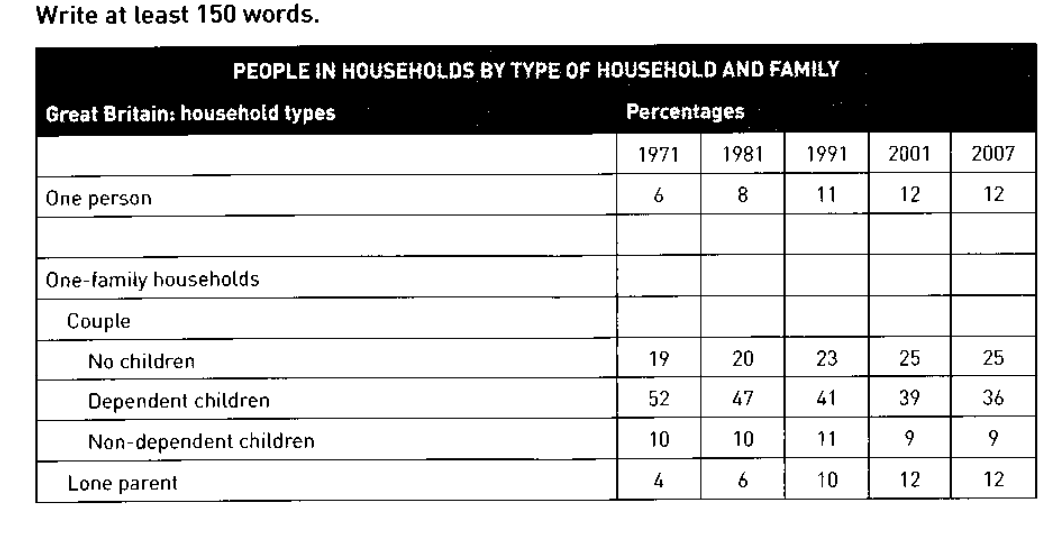
The table below shows the change in some household types in Great Britain from 1971 to 2007.
Summarise the information by selecting and reporting the main features, and make comparisons where relevant.
PEOPLE IN HOUSEHOLDS BY TYPE OF HOUSEHOLD AND FAMILY
Student answer (Band 5.0)
The table compares the changes in Peopls houseolds types of households and family in britain during1971 to 2007. The Individuals data given here is in persentages.
Overall, the table illustrate that households types of Dependent Children wah the greater in numbers throughout the given period. menwhile, lone parent was contribute their lowest in the earliest. However, it can increase in number in 1981 to 2007.
To commence with, in 1971 Dependent children proportion 52%.. However, it can decrese in number and it remain only 36 percent in 2007. while one person in households was 6 percent in 1971, after that it was increase to 12 percent in 2007.Wherease, no childrn in households were same beetween 2002 to 2007 which 25%. Non dependent children also same as no children in households it also similar in numbers during 2001 to 2007 which 9%.
Furthermore, the lone pearent in household start with small proprtion with 4%, it grows in numbers throughout the given period and in 2007 this data was 12%. During 1971 to 2007 only Dependent children and Non-dependent children persentage was decrse throught the period it stars with highest with it and it towards 2007 the number was fall.
AI examiner evaluation
| Criterion | Band |
|---|---|
| Task Achievement / Task Response | 5.5 |
| Coherence and Cohesion | 5.0 |
| Lexical Resource | 5.0 |
| Grammatical Range and Accuracy | 5.0 |
| Overall | 5.0 |
Task Achievement / Task Response: Band 5.5
You identify the dominant category, dependent-child households, and report its decline from 52% to 36%; you also note the rise in one-person and lone-parent households. These are relevant main features. However, the overview is unclear and does not summarise the full pattern accurately: dependent-child households were the largest category throughout, but lone-parent households were not the lowest by 2007, when they reached 12%. Some details are imprecise or incorrect, such as saying no-children households were unchanged “between 2002 to 2007” rather than 2001–2007, and describing non-dependent children as similar to no-children households. The response covers several categories but leaves the overall comparisons underdeveloped. State the key trends clearly and check dates and category values.
Coherence and Cohesion: Band 5.0
The response has an introduction, an overview, and two detail paragraphs, so there is some organisation. It also attempts to guide the reader with phrases such as “Overall,” “To commence with,” and “Furthermore.” However, progression within paragraphs is difficult to follow because several categories and comparisons are joined in long sequences, and the final paragraph repeats the decline in dependent-child households without adding a clear comparison. Linking words are sometimes inaccurate or mechanical, including “However” where the next point is not a contrast and “Wherease” before a comparison that is not clearly expressed. Group the rising categories together and the declining or stable categories together, then use precise links and references to make each comparison easy to follow.
Lexical Resource: Band 5.0
You use some task-relevant vocabulary, including “proportion,” “percentage,” “throughout,” and “decreased,” and you attempt to describe trends rather than simply list figures. However, the range is limited and several word choices or forms make the meaning unclear, such as “was contribute their lowest,” “it can increase in number,” and “the number was fall.” Spelling errors are frequent, including “Peopls,” “houseolds,” “persentages,” and “pearent.” Some expressions are also imprecise: percentages describe shares, so “rose to 12%” is clearer than “grows in numbers.” Build a reliable set of trend verbs and collocations, and proofread spelling and word forms carefully.
Grammatical Range and Accuracy: Band 5.0
You attempt both simple and more complex sentences, including contrasts introduced by “while” and “however,” but control is inconsistent. Errors in verb forms and agreement occur repeatedly: “the table illustrate,” “it can decrese,” “it was increase,” and “the number was fall.” Articles and sentence construction are also problematic, as in “Dependent children proportion 52%” and “lone parent was contribute their lowest.” Punctuation sometimes obscures the structure, for example the double full stop after “52%..” and the lower-case “while” beginning a new sentence. These errors can make relationships between figures difficult to understand. Practise complete subject–verb sentences, using past-tense forms such as “stood at,” “fell,” and “rose,” and check each sentence for a clear grammatical structure.
See this exact question answered at other band scores. The same prompt compared across bands.
Browse more IELTS Writing model answers or get your own writing scored by the same AI examiner.