Band 5.0 IELTS Writing Task 1 Model Answer
Overall Band Score: 5.0 · IELTS Summit Mastery · 2026-11-18
IELTS Writing Task 1 question
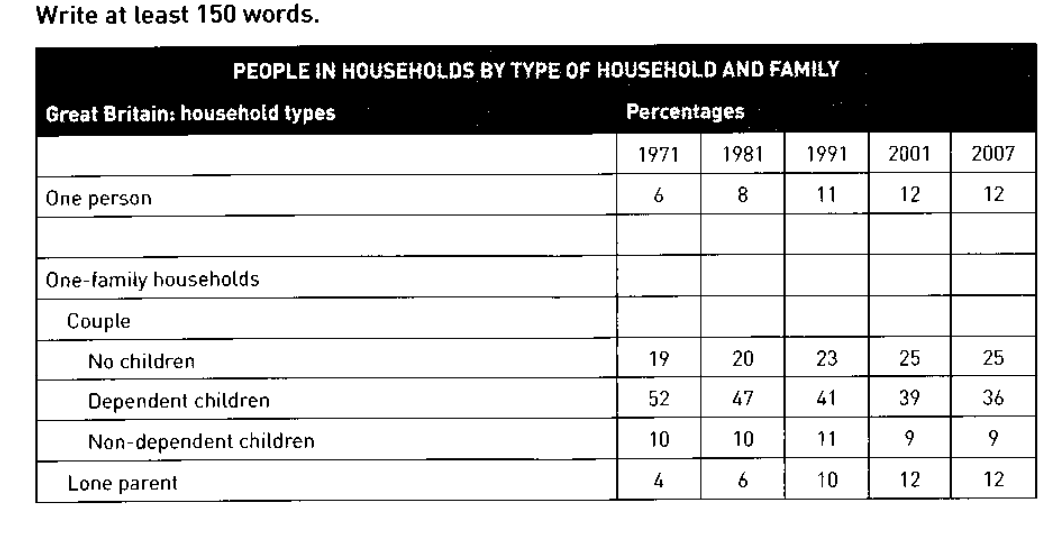
The table below shows the change in some household types in Great Britain from 1971 to 2007.
Summarise the information by selecting and reporting the main features, and make comparisons where relevant.
PEOPLE IN HOUSEHOLDS BY TYPE OF HOUSEHOLD AND FAMILY
Student answer (Band 5.0)
In this table, The great Britain people change type of household and family since 1971 to 2007. For instance, The table illustrates the percentage change in some household types.
Overall, it is clear that the dependent childern in 1971, 52% was the highest; while In 2007 the 36% of dependent childern was the lowest. In addition, dependent childern decreased the percentage after decade.
For example, In great britain, government announced for upto 15 years young childern to find and doing work then most of the dependent childern grow and doing jobs.
In terms of one person, they increase change in some household from 1971 to 2007 alomost 6 percent increase last 26 years. In another two categories one-family households and couple not given th percentage of change in some household types. Furthermore, No childern increase 19 to 25% from 1971 to 2007 almost 6 percent increment. Non-dependent childern minor change in household types. Lone-parent 4 to 12% increase from 1971 to 2007.
Regarding this table, Dependent childern was decreased after decades, which was significantly higher decreasement percentage to others. Meanwhile Non-dependent childern remainded stable at 9,10%.
AI examiner evaluation
| Criterion | Band |
|---|---|
| Task Achievement / Task Response | 5.5 |
| Coherence and Cohesion | 4.5 |
| Lexical Resource | 5.0 |
| Grammatical Range and Accuracy | 5.0 |
| Overall | 5.0 |
Task Achievement / Task Response: Band 5.5
You identify several relevant trends, including the rise in one-person households from 6% to 12%, the increase in couples without children from 19% to 25%, and the fall in dependent-child households from 52% to 36%. However, the overview misstates the final comparison: 36% was still the largest category in 2007, not the lowest. The explanation about government policy and children finding work is unsupported by the table and should be omitted. Some categories are only vaguely described, and the sentence saying figures for “one-family households and couple” are not given is inaccurate: the table provides figures for the listed family types. A clearer overview and more accurate selection of key comparisons would make the response more complete.
Coherence and Cohesion: Band 4.5
The response has some paragraphing and uses signposts such as “Overall,” “For example,” and “In terms of,” so the reader can recognise an attempt to organise the report. However, the progression is not consistently logical: the unsupported explanation about government policy interrupts the description of the data, and the final paragraph repeats the decline in dependent-child households without adding a clear comparison. Linking phrases are sometimes used mechanically or inaccurately, while references such as “they” and “this table” do not always make the subject clear. Group the overview separately, then describe the main increases and decreases in a logical order, using comparisons to connect the figures rather than repeating points.
Lexical Resource: Band 5.0
You use some task-relevant terms, including “percentage,” “dependent children,” “increase,” and “decreased,” which help communicate the general subject. However, the range is limited and several word choices or collocations are unnatural, such as “increase change,” “6 percent increment,” and “higher decreasement percentage.” Spelling errors, including “childern,” “alomost,” and “remainded,” also reduce accuracy. Some phrases are imprecise, for example “minor change” does not clearly describe the small fluctuations in the non-dependent-child figures. Build a more precise set of trend expressions and check spelling and word forms; this will make the comparisons easier to understand.
Grammatical Range and Accuracy: Band 5.0
You attempt both simple statements and longer sentences, including a contrast introduced by “while” and a sentence beginning “In terms of one person.” However, the longer structures are often faulty, and frequent errors in articles, word order, agreement, and verb forms make some sentences difficult to follow. For example, “The great Britain people change type of household” lacks a clear grammatical structure, while “dependent childern decreased the percentage” uses an incorrect subject–verb relationship. Capitalisation is also inconsistent, as in “The” and “In” after commas. Practise accurate basic sentence patterns first, then add subordinate clauses; check that each sentence has a clear subject and correctly formed verb.
See this exact question answered at other band scores. The same prompt compared across bands.
Browse more IELTS Writing model answers or get your own writing scored by the same AI examiner.