Band 5.0 IELTS Writing Task 1 Model Answer
Overall Band Score: 5.0 · IELTS Summit Mastery · 2026-11-18
IELTS Writing Task 1 question
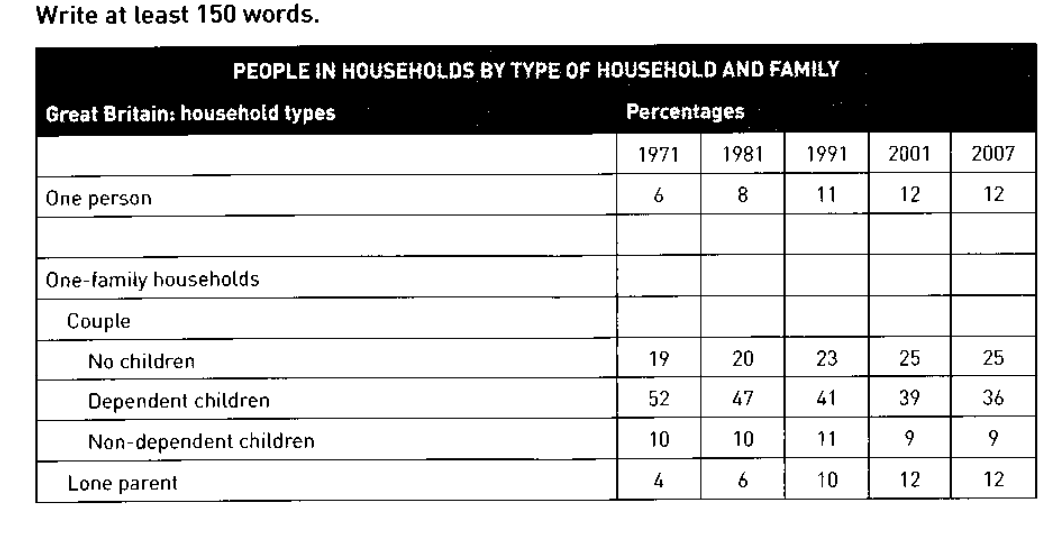
The table below shows the change in some household types in Great Britain from 1971 to 2007.
Summarise the information by selecting and reporting the main features, and make comparisons where relevant.
PEOPLE IN HOUSEHOLDS BY TYPE OF HOUSEHOLD AND FAMILY
Student answer (Band 5.0)
This table shows that change in some household types in Great Britain from 1971 to 2007.
The table compare the percentages of household in different categories specially during years
Overall, it is evident that one person was low in the 1971 but is rise up in 2007.
Specifically, the dependent children in 1971 was 52 but it was reduced in 2007 and went to 36. However, one person household doubled in 2007.
On the other hand, lone parent household in 1971 was 4 but increased by 12 in 2007.Similarly, no children was 19 in 1971 but it rise up in 2007.
AI examiner evaluation
| Criterion | Band |
|---|---|
| Task Achievement / Task Response | 4.0 |
| Coherence and Cohesion | 5.0 |
| Lexical Resource | 5.0 |
| Grammatical Range and Accuracy | 5.0 |
| Overall | 5.0 |
Task Achievement / Task Response: Band 4.0
You identify several relevant changes, including the fall in households with dependent children from 52% to 36%, and rises in one-person and lone-parent households. However, the response is very brief and reports only a small selection of the table, with no meaningful comparison across the intervening years. The overview is also unclear: saying one-person households “was low” does not clearly summarise the main pattern, and “doubled” is inaccurate because the figure rose from 6% to 12%—it doubled, but the year and comparison are not stated precisely. The no-children figure is described as rising, but its final value is omitted. The response contains 89 words, below the required 150; 12 words copied from the prompt were not counted. Include a fuller overview and more accurate, supported comparisons.
Coherence and Cohesion: Band 5.0
The response has a basic structure: an introduction, an overview, and a paragraph with selected details. Linking expressions such as “Overall,” “Specifically,” and “On the other hand” show an attempt to guide the reader. However, the progression is limited because the details are presented as separate statements rather than organised into clear comparisons between rising and falling categories. “On the other hand” does not establish a clear contrast with the preceding point, and the final sentence adds another trend without completing the comparison. Develop a logical sequence—for example, group the declining dependent-children figure against the increases in one-person and lone-parent households—and use linking phrases only where the relationship between ideas is clear.
Lexical Resource: Band 5.0
You use relevant basic terms from the table, including “percentages,” “dependent children,” “lone parent,” and “increased.” This makes the topic generally recognisable. However, the vocabulary range is limited and some phrases are imprecise or unnatural, such as “one person was low,” “is rise up,” and “increased by 12.” The last phrase can suggest an increase of 12 percentage points, rather than a rise to 12%. Repetition of “in 1971” and “in 2007” also limits variety. Use accurate reporting language and distinguish a final value from the size of a change, such as “rose to 12%” or “increased by 8 percentage points.”
Grammatical Range and Accuracy: Band 5.0
You produce several simple sentences and attempt a contrast with “However,” so the basic message can usually be followed. However, grammatical errors occur frequently, particularly in subject–verb agreement and verb forms: “The table compare” should be “The table compares,” while “one person was low … but is rise up” needs a consistent, accurate structure. In “the dependent children … was 52,” the plural subject does not agree with “was”; a clearer construction is “the figure for dependent children was 52%.” The sentence “no children was 19 … but it rise up” also has agreement and tense errors. Practise accurate past-tense reporting and use a wider range of correctly formed sentence patterns.
See this exact question answered at other band scores. The same prompt compared across bands.
Browse more IELTS Writing model answers or get your own writing scored by the same AI examiner.